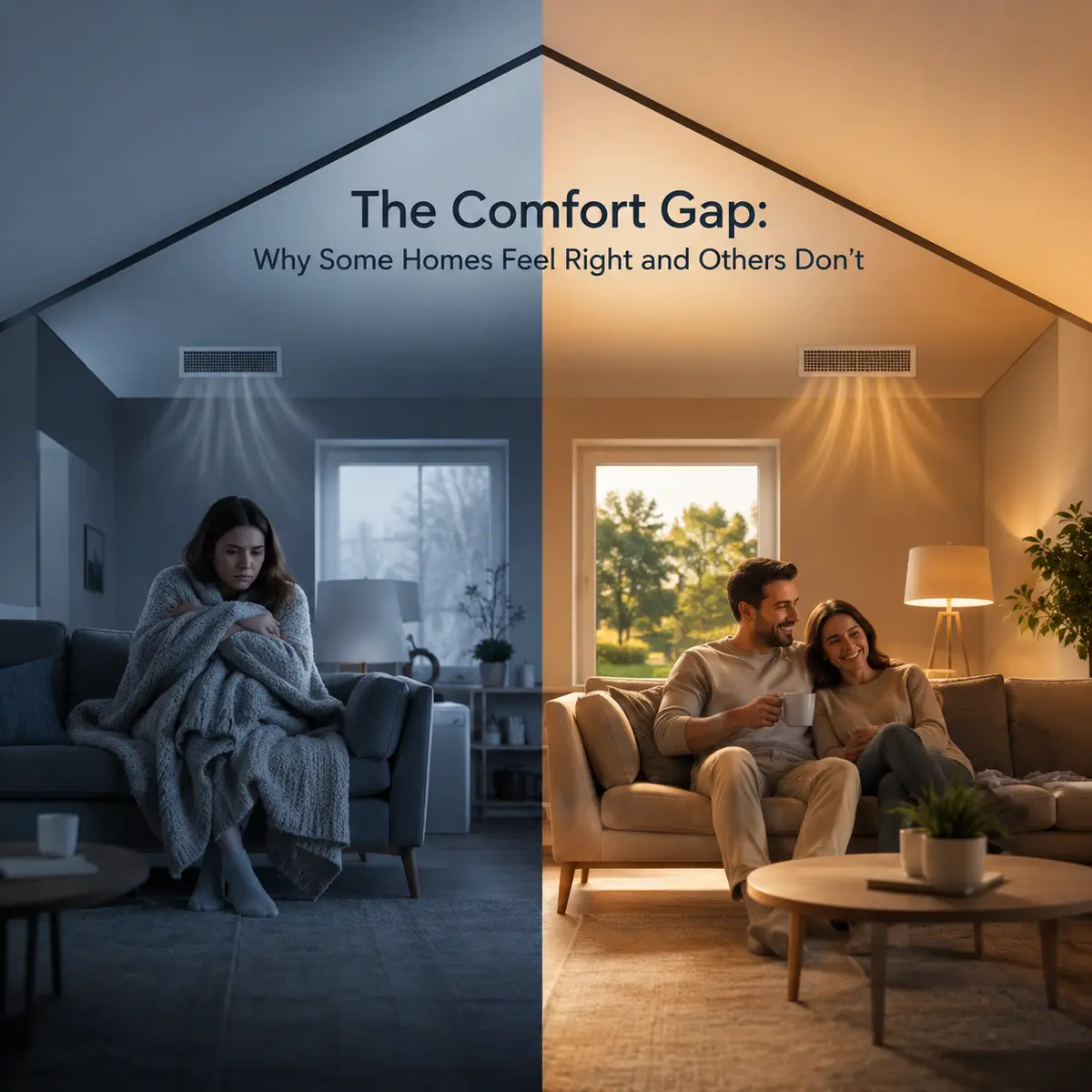
Have you ever walked into a home and
instantly felt at ease?
The temperature feels balanced. The
air feels fresh. Every room seems to welcome you. Nothing feels forced.
Then there are other homes.
One room feels like summer. Another
feels like winter. The air feels heavy. Certain spaces never seem comfortable
no matter how much the thermostat gets adjusted.
That difference has a name: The
Comfort Gap.
And surprisingly, it’s rarely about
just the thermostat.
Comfort Is More Than Temperature
Most homeowners think comfort means
one simple thing: temperature.
If the thermostat says 72°F, the
home should feel comfortable… right?
Not exactly.
True comfort is a combination of
multiple invisible factors working together:
Humidity control
Indoor air quality
Insulation performance
Duct system efficiency
Window heat transfer
Equipment sizing
Air pressure balance
When one of these systems is off,
your body notices—even if you can’t explain why.
That’s why two homes set to the
exact same temperature can feel completely different.
The Hidden Science Behind “Feels Right”
Your body is incredibly intelligent.
It constantly reads subtle
environmental signals:
Is there stagnant airflow?
Are surfaces radiating heat?
Is humidity making the air feel sticky?
Is cold air pooling near floors?
This creates what experts often call perceived comfort.
For example:
A house at 74°F with balanced
humidity and proper airflow can feel significantly more comfortable than a
poorly ventilated home at 70°F.
Comfort is about experience—not just
numbers.
The
Biggest Reasons Homes Feel Uncomfortable
1.
Poor Airflow Distribution
This is one of the most common
comfort killers.
If your HVAC system pushes too much
air to one area and too little to another, temperature imbalances happen
instantly.
Signs include:
Cold basements
Weak airflow from vents
Rooms that never match thermostat settings
Your HVAC system may be working
hard—but not working smart.
2.
Incorrect HVAC Sizing
Bigger isn’t always better.
An oversized HVAC system cools or
heats too quickly, shutting off before properly managing humidity.
An undersized system runs endlessly
without reaching ideal comfort.
Either way, your comfort suffers.
Proper load calculations matter far
more than equipment size alone.
3.
Humidity Problems
Humidity changes everything.
Too much humidity makes the air feel
heavy, sticky, and warmer than it actually is.
Too little humidity can create:
Static electricity
Irritated sinuses
Uncomfortable breathing
Ideal comfort lives in balance.
4.
Leaky Ductwork
Your duct system is your home's
comfort highway.
Leaks mean conditioned air escapes
before reaching intended rooms.
That creates:
- Uneven temperatures
- Higher energy bills
- Longer system runtime
- Reduced comfort consistency
A strong HVAC unit cannot overcome
weak duct design forever.
5.
Poor Insulation & Air Leaks
Even perfect HVAC equipment
struggles if your home constantly loses conditioned air.
Common problem zones:
Crawlspaces
Windows
Exterior wall penetrations
Door seals
Comfort leaks are often
invisible—but expensive.
Why
Newer Homes Can Still Feel Wrong
This surprises many homeowners.
A newer home doesn’t automatically
mean a comfortable home.
Construction shortcuts, poor duct
design, rushed installations, and improper balancing can create discomfort from
day one.
Age isn’t always the issue.
Execution is.
The
Emotional Side of Comfort
Home is where your nervous system
resets.
When your environment feels wrong,
you notice it mentally:
Irritation
Fatigue
Restlessness
Constant thermostat battles
Comfort isn’t luxury.
It directly impacts quality of life.
A properly balanced home feels
peaceful because your body stops fighting the environment.
How
to Close the Comfort Gap
Real solutions start with
diagnosis—not guesswork.
Look for:
✓ Airflow testing
✓ Duct inspection
✓ Static pressure evaluation
✓ Humidity assessment
✓ Insulation review
✓ Equipment sizing verification
✓ Indoor air quality analysis
The goal isn’t simply heating or
cooling.
The goal is creating a home that
feels consistently right.
Final
Thought
If your home never feels quite
comfortable, there’s usually a measurable reason.
Comfort is engineering, airflow,
design, and environmental balance working together.
Because when your home feels right…
You feel right too.
Your Thermostat Only Knows One Spot
A thermostat reads the air around itself and nothing else. If it hangs in a hallway on the first floor, it can be satisfied while the bedrooms upstairs are still warm, or while a room with big west-facing windows heats up every afternoon. The system shuts off because the hallway is comfortable, not because the house is.
Placement makes it worse when the thermostat sits:
- In direct sun or near a lamp, TV or kitchen appliance
- Next to a supply register blowing straight at it
- On an exterior wall or near a drafty door
Moving the thermostat, adding remote room sensors that average several rooms, or splitting the house into zones with separate controls can bring the reading much closer to how the house actually feels. In a two-story Long Island colonial or a split-level, zoning is often the most direct fix for the floor that never matches the rest.
Simple Checks Before You Call
Some comfort problems have plain causes you can rule out in a few minutes before booking an evaluation:
- Filter. A clogged filter starves the whole house of airflow. Replace it and see whether the far rooms improve.
- Registers and returns. Make sure supply vents are open and that rugs, beds and couches are not covering them or the return grilles. A blocked return can be as harmful as a blocked supply.
- Closed-off rooms. Shutting vents in unused rooms does not save much and can upset the balance of the rest of the system.
- Doors. If a bedroom only feels stuffy with the door closed, it may lack a path for air to return.
If the problem is still there after these checks, the cause is usually in the ducts, the equipment sizing or the building itself, which is where a proper evaluation comes in.