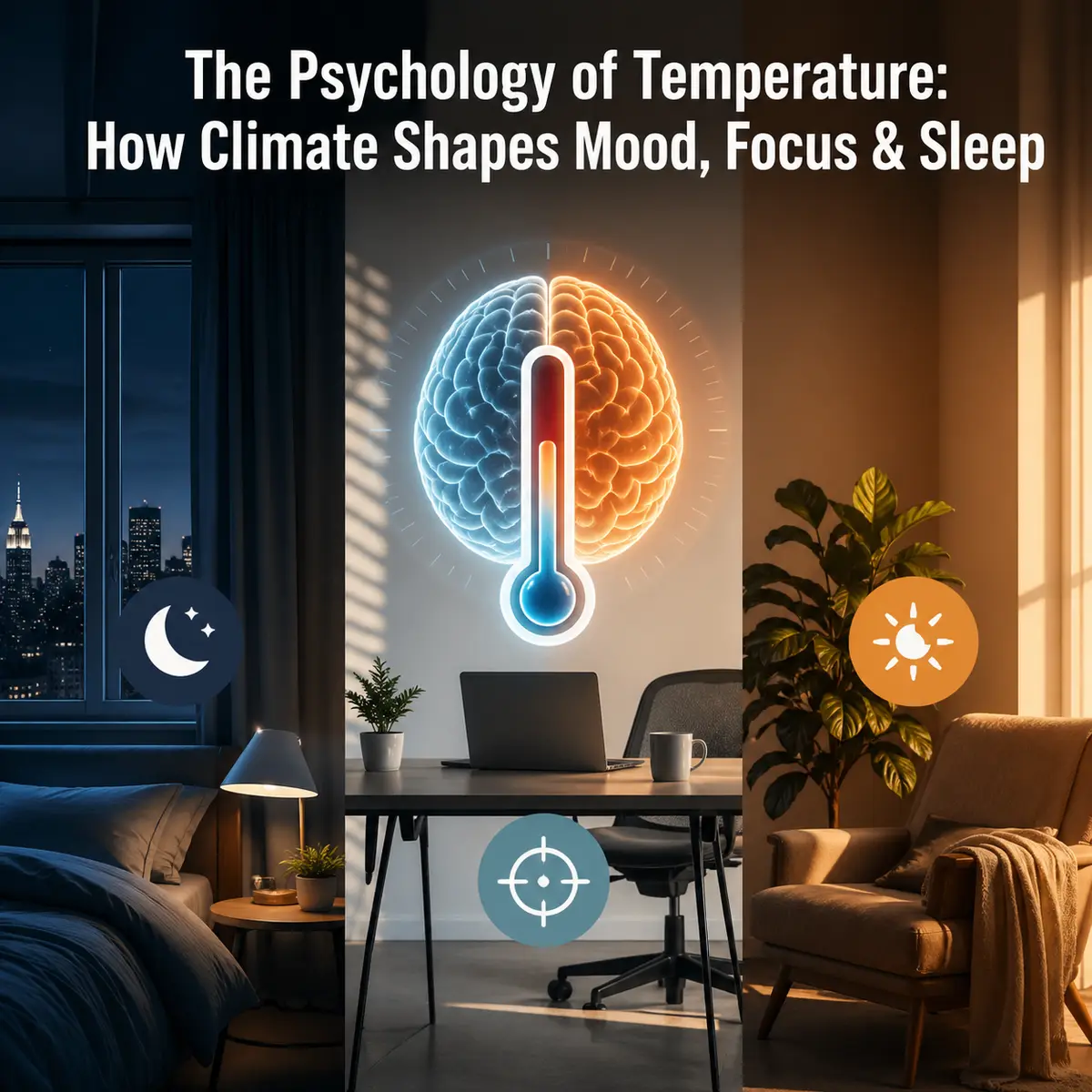
Most people think of temperature as
a comfort setting—something you adjust and forget.
But your environment is doing far
more than keeping you warm or cool.
It’s quietly shaping your MOOD,
your FOCUS, and even your SLEEP QUALITY—every single day.
And if you’re a professional
navigating long work hours, high pressure, and constant mental demand, this
isn’t a small detail.
It’s a hidden performance factor.
Temperature & Mood: The Emotional Climate You Live In
Your brain is deeply connected to
your physical environment.
Patience drops
Stress levels climb
When it’s too cold:
Energy shifts toward survival, not creativity
You may feel withdrawn or sluggish
This isn’t just perception—it’s
biology.
Studies show that thermal
discomfort directly impacts emotional regulation. That’s why a poorly
controlled indoor climate can quietly turn a normal day into a frustrating one.
Insight:
A stable, balanced indoor temperature creates a calm emotional baseline,
allowing you to respond—not react—to your day.
Temperature
& Focus: The Invisible Productivity Lever
There’s a good chance your
environment played a role.
Research suggests that:
Ideal cognitive performance occurs around 68–72°F (20–22°C)
Warmer environments increase mental fatigue
Cooler environments can reduce dexterity and concentration
In a city like New York—where
professionals already operate at high intensity—this matters even more.
A few degrees off can mean:
Reduced accuracy
Lower overall output
Insight:
Productivity isn’t just about discipline. It’s about conditions.
Temperature
& Sleep: Where Recovery Begins
Sleep is where your mind resets and
your body repairs.
And temperature is one of the most
critical factors influencing it.
Your body naturally cools down to
initiate sleep.
If your environment fights that process, you struggle.
Cooler rooms promote deeper, uninterrupted sleep
Overheating leads to frequent waking and lighter sleep cycles
For professionals, poor sleep isn’t
just tiring—it compounds:
Increased stress
Lower resilience
Control your night environment, and you upgrade your entire next day.
New York professionals face unique
challenges:
Long indoor hours (offices, apartments, commutes)
- Older buildings with inconsistent HVAC systems
This creates a constant battle
between:
Internal comfort
From
Comfort to Control: A Smarter Approach
Most people treat temperature as
reactive:
“Adjust it when it feels wrong.”
But high performers think
differently:
“Design it so it supports me all the
time.”
- Maintaining consistent indoor temperatures
- Upgrading inefficient HVAC systems
- Using smart thermostats for precision control
- Scheduling regular system maintenance
Because when your environment is
optimized, you remove friction from your life.
Final Thought: Your Environment Is Shaping You
You don’t notice it.
You don’t think about it.
But every day, your surroundings are
influencing:
How you think
How well you recover
Temperature isn’t just a setting.
It’s a silent force behind
your performance, your clarity, and your well-being.
Master your environment…
and you quietly upgrade everything else.