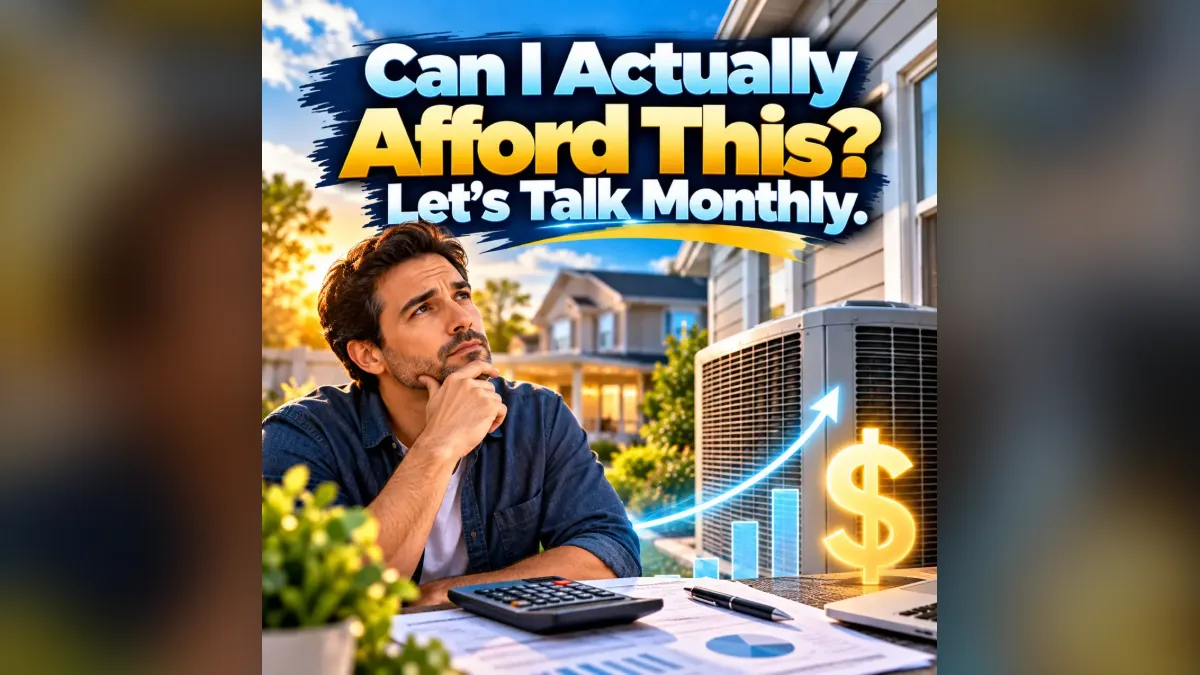
Can I Actually Afford This? Let's Talk Monthly.
This article is
general information about how HVAC financing works, not financial advice.
Terms, rates, and approval depend on the lender and on your individual
circumstances. Read any agreement in full before signing.
Someone quotes you a number for a new system and your stomach drops. That reaction is normal and it is also slightly the wrong question.
Almost
nobody pays for a heating or cooling system out of pocket in one go. The
practical question is not "do I have this money today." It is what
does this cost per month, and how does that compare to what I'm already
spending.
This article explains how HVAC financing actually works, what determines your monthly payment, and the one promotional structure that catches people out. We are going to be specific about that last one, because it is common and it is genuinely expensive when it goes wrong.
The Number You're Comparing Against Isn't Zero
Here
is the comparison most people skip. Keeping an old system is not free, it just
costs you in ways that do not arrive as a single bill.
Before
you decide anything, add up what the current system actually costs you per year:
•
Repairs. What did you spend last year and the
year before? Two service calls a season adds up fast.
•
Excess energy. An aging or underperforming
system runs longer for the same result. Compare your kilowatt-hours year over
year, as our guide on high electric bills
explains.
•
Refrigerant. If you are topping up every summer,
that cost is rising every year as R-410A supply tightens.
•
The failure that's coming. Not a monthly cost,
but a real one, and it tends to arrive at the worst moment.
Divide
that annual total by twelve. That is the number your monthly payment is
actually competing with, not zero.
For some homeowners the gap closes almost entirely. For others it does not, and knowing that honestly is better than guessing. Our guide on how to repair or replace your AC walks through the decision on its merits.
What Actually Determines Your Monthly Payment
Four
variables, and you have influence over three of them.
|
Variable |
What it does |
Can you change it? |
|
Amount financed |
The single biggest lever |
Yes, rebates, a deposit, and right-sizing all
reduce it |
|
Term length |
Longer term, lower monthly, more total interest |
Yes, and the trade-off is real |
|
Interest rate |
Depends on credit, lender, and promotion |
Partly, shop it |
|
Credit profile |
Determines rate and approval |
Over time |
The
term trade-off deserves a moment. Stretching a loan from five years to ten
roughly halves the monthly payment and substantially increases what you pay
overall. Neither choice is wrong. A lower monthly that fits your budget
comfortably has real value, and paying less in total has real value. Just make
the trade knowingly rather than by default.
One
guideline worth applying: do not finance longer than the equipment will
last. A fifteen-year loan on a system with a fifteen-year life means your
final payments land right as you start thinking about replacement.
The Four Ways People Pay for This
Contractor-arranged financing
Most
HVAC companies, including us, work with a lender who specialises in home
improvement financing. You apply at the kitchen table, usually get a decision
quickly, and the work proceeds.
The
advantages: fast, convenient, often promotional rates, and no collateral
against your home.
What
to understand: the contractor pays a fee to the lender to offer promotional
rates, and that cost exists somewhere. It is entirely reasonable to ask whether
there is a difference between the cash price and the financed price. A straight
answer to that question tells you a lot about who you are dealing with.
Home equity loan or HELOC
Borrowing
against your home typically carries the lowest interest rate of these options,
and interest may be tax-deductible in some circumstances, a question for your
accountant, not your HVAC contractor.
The
trade-off is serious and worth stating plainly: your home is the collateral.
That is a meaningfully different risk from an unsecured loan. It also takes
longer to arrange, which rules it out in an emergency.
Personal loan or credit union
Often
overlooked, and frequently competitive, particularly through a local credit union.
Unsecured, fixed term, no promotional structures to decode.
Worth
getting a quote from your own bank or credit union before you sign anything at
the kitchen table, purely as a comparison. It takes an afternoon.
Credit card
Generally
the most expensive option unless you have a genuine interest-free promotional card and
a concrete plan to clear the balance within the promotional window.
If
it is the only route available in an emergency, it beats going without heat in
January. Just treat it as a bridge and refinance it onto something cheaper.
The 0% Offer: Read This Part Twice
This
is the most important section in the article, and the one a lot of homeowners
wish they had read first.
Promotional
financing comes in two forms that sound identical and are not.
Waived interest (truly interest-free). No interest accrues during the promotional period.
If a balance remains at the end, interest starts from that point forward on the
remaining balance. Straightforward.
Deferred
interest. Interest accrues from day one behind the scenes. If you pay the
balance in full by the end of the promotional period, it is waived entirely. If
you do not, even by a small amount, the entire accrued interest is added to
your balance, calculated from the original purchase date.
That
second structure is common in home improvement financing, and the difference is
not small. A balance you were $200 short of clearing can trigger a retroactive
interest charge on the full original amount, at a rate that is often well into
double digits.
How
to protect yourself:
1.
Ask directly: "Is this deferred interest or
waived interest?" Those exact words. A good lender rep answers
immediately.
2.
Find the phrase in the agreement, usually near
language like "if the balance is not paid in full by the promotional end
date."
3.
Note the promotional end date the day you sign,
and set a reminder two months before it.
4.
Calculate your own payment, not the minimum.
Minimum payments are frequently set too low to clear the balance within the
promotional window, which is how people end up short.
5.
Know the post-promotional APR before you sign,
not after.
Deferred
interest is not a scam and it is not hidden, it is disclosed. But it is
disclosed in a document nobody reads at the end of a long day, and the
consequence of missing it is severe. Anyone selling you financing should
explain this unprompted.
Want the
actual monthly figure for your house before you decide anything? We will give
you the number, the term, and the APR in writing, with no obligation. Book a free estimate or call (631) 414-7141.
Questions to Ask Before You Sign Anything
Print
this list. Ask every one of them, of any contractor.
1.
What is the APR after any promotional period ends?
2.
Is the promotional interest deferred or waived?
3.
What is the total cost of creditthe full amount
I will have paid at the end?
4.
Is there a prepayment penalty if I pay it off
early?
5.
Who is the actual lender? The contractor is not
the lender.
6.
Is the cash price different from the financed price?
7.
What is the minimum monthly payment, and will it
clear the balance before the promotion ends?
8.
What happens if I miss a payment?
9.
Does the rate depend on which equipment tier I
choose?
10.
Can I see the agreement before I sign it, rather
than on a tablet at the kitchen table?
That last one matters more than people realise. Nobody should be signing a multi-year credit agreement on a screen while a crew waits outside. If a contractor resists you taking it away to read, that is your answer.
Rebates Come Off the Top
Every
dollar of incentive is a dollar you do not finance, so sequence matters.
New
York State and utility programs continue to offer incentives on qualifying
efficient equipment, with heat pumps generally attracting the most support.
Terms change annually, so confirm what is live at the time you buy rather than
relying on an older article, including this one.
One
correction worth knowing: the federal §25C tax credit that offered up to
$2,000 on qualifying heat pumps expired for equipment placed in service after
December 31, 2025. If a contractor is still quoting that federal credit to you,
they are working from outdated information.
Two
practical points. First, some incentives arrive as an upfront discount and
some as a rebate afterward, which changes what you need to finance today. Ask
which applies. Second, incentive paperwork takes time, which is one more reason
a planned replacement beats an emergency one.
How Applying Works
Applying for contractor-arranged financing is usually quick, but it goes better with a little preparation:
- Get the scope and price first. Know what equipment and work you are financing, so you apply for the right amount.
- Have the basics ready. Lenders typically ask for identification, income and housing details.
- Expect a credit check. The result sets the approval, the rate and the credit limit.
- Read the agreement before you sign. Check the APR, the promotional terms, the end date and the minimum payment against the questions above.
At K2, financing is offered through Rheem KwikComfort, with credit provided by Synchrony Bank and subject to credit approval. Synchrony sets the approval, rates and terms. See our residential financing page for how it works.
What If My Credit Isn't Great?
Worth
addressing directly, because people avoid asking.
Home
improvement lenders work across a range of credit profiles, and approval with
less-than-perfect credit is common. What changes is the rate and sometimes the
term, which changes the monthly.
Things
that genuinely help:
•
A deposit. Reducing the financed amount improves
both approval odds and the monthly.
•
A co-applicant, if that fits your situation.
•
Checking with your own credit union first.
Existing relationships sometimes produce better terms than a general lender.
•
Choosing a shorter term if you can carry the
payment, since shorter terms sometimes price better.
•
Applying in a planned window rather than an
emergency, so you have time to compare rather than taking the first
approval.
And if the answer is that financing a full replacement is not workable right now, say so. There are usually intermediate options, a repair that buys a season, prioritising the most impactful work, or a smaller scope, and a decent contractor will help you find them rather than pushing the full job.
When Financing Is the Wrong Move
Four
situations where we would tell you to stop.
When
it pushes you into equipment you don't need. A lower monthly on a premium
system can make an upgrade feel free. It is not free, it is the same money
spread thinner. Decide what the house needs first, on the merits, then work out
how to pay for it. Our guides on variable-speed
systems and the biggest cooling
upgrade cover that decision.
When
the term outlives the equipment. Still paying for a system after it has
been replaced is a bad place to be.
When
you're financing a repair on a system that needs replacing. Borrowing for a
major repair on a fifteen-year-old system usually means borrowing twice.
When
the payment doesn't actually fit. A monthly that only works if nothing else
goes wrong this year is not affordable. A contractor who encourages you past
that point is not looking after you.
Planned Beats Emergency, Financially
The
single biggest factor in what you pay is not the interest rate. It is whether
you had time.
In
a planned replacement you can compare financing offers, apply for incentives,
choose correctly sized equipment, and install in a shoulder season when
schedules are open. In an August emergency you take the first approval,
whatever equipment is in stock, and none of the paperwork.
That
is the same argument as our guide on why "eventually"
is the most expensive word in HVACand on the financing side the
difference is measured in real money.
If your system is over twelve years old and starting to need attention, having the financing conversation now, while nothing is broken, costs you nothing and puts you in a completely different position later.
Get the Real Numbers Before You Decide
The
honest summary: a new system is a large number, and the monthly payment is a
much smaller one. Both of those are true, and neither on its own tells you
whether it is affordable.
What
tells you is the comparison, the monthly payment set against what you are
already spending on repairs, refrigerant, and excess energy on a system that is
declining. Sometimes that comparison is close. Sometimes it is not, and the
right answer is to keep the old system running another season.
K2 Cooling & Heating has served Long Island since 2002. We will
give you the monthly payment, the term, the APR, and the total cost of credit
in writing, and we will tell you plainly if financing a replacement is not the
right move for you right now.
Call
(631) 414-7141 or contact our team
for an estimate with no obligation. You can also see our financing options before you talk to anyone.
We serve Deer Park, Babylon, West Babylon, North Babylon, Dix Hills,
Huntington, Farmingdale, Massapequa, and the surrounding Suffolk and Nassau
communities.
Need a technician rather than a guide? See our AC installation service, or read about HVAC repair in Deer Park, NY. K2 answers 24/7 at (631) 414-7141.