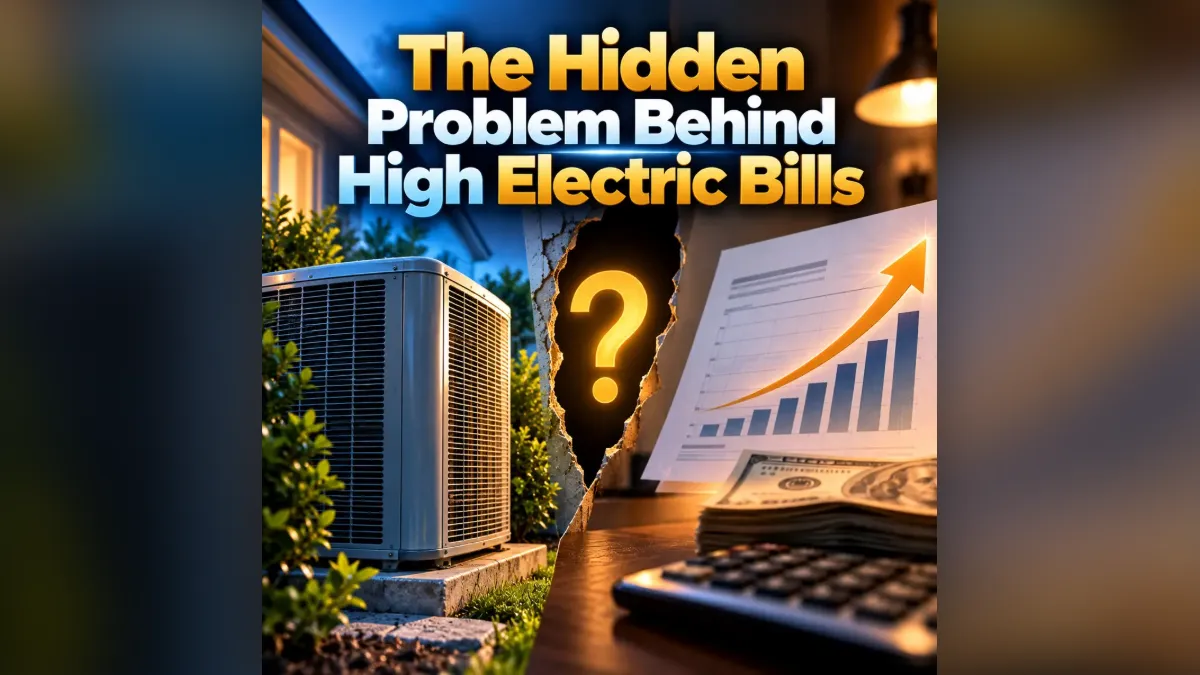
The Hidden Problem Behind High Electric Bills
The
bill arrives, it is significantly higher than you expected, and you do what
everyone does. You blame the rates, complain about it, and pay it.
Sometimes
that is the right answer. Rates on Long Island are among the highest in the
country and they do move.
But
there is a second possibility that almost nobody checks, and it is the reason
this article exists. Your air conditioner may be running far more hours than it
needs to, and your bill has no way of telling you that.
This guide explains why the bill hides the problem, the seven things that quietly extend run time, and how to find out which one is yours before you spend money on any of it.
Your Bill Measures Hours, Not Comfort
Here
is the framing that makes everything else make sense.
Your
utility bill measures energy consumed. For a home with central air, cooling is
typically the largest single electrical load in summer, and consumption depends
almost entirely on how many hours the compressor ran.
Nothing
on your bill reports run time. You see kilowatt-hours and a dollar amount. You
do not see that your system ran 2,100 hours this summer instead of 1,400.
And
importantly, you cannot feel the difference either. A house held at 74 degrees
feels the same whether the system worked efficiently to get there or struggled
for twice as long. The comfort is identical. Only the bill changes.
That
is the hidden problem. Not a dramatic failure, a system quietly working harder
than it should, producing the same result at a higher cost, with no symptom you
would ever call about.
Before Anything Else: Read the kWh, Not the Dollars
This
is the single most useful thing in this article and it takes five minutes.
Dollars
conflate two variables: how much energy you used and what you paid per unit.
Rates change, delivery charges change, and taxes change. Comparing dollar
amounts across years tells you almost nothing.
Kilowatt-hours
are the honest number. Pull up this July's bill and last July's, and compare
kWh only.
•
kWh roughly flat, dollars up, this is a rate problem,
not an equipment problem. Frustrating, but nothing to fix in your basement.
•
kWh up 10–20% with no change in the household, something is drawing more than it used to. Keep reading.
•
kWh up sharply, something specific changed. Either
equipment degraded, a component failed, or a new load appeared.
One
adjustment: account for the weather. A brutally hot July genuinely uses more energy
than a mild one, and that is not a fault. Compare like with like where you can,
and give yourself some tolerance for a hotter or colder season.
Most
utilities show a usage history chart in the online account. That graph is more
informative than any single bill.
Seven Things That Make Your System Run Longer
1. Duct leakage: the biggest hidden one
If
your ducts run through an unconditioned attic, extremely common in Long Island
ranches, Capes, and split-levels, this is the first thing to suspect and the
largest single waste in most homes.
Every
gap, disconnected joint, and torn flex duct in that attic is dumping air you
paid to cool into a 130-degree space. The system then runs longer to make up
for what never arrived.
Return-side
leaks are worse still. A gap in return ductwork actively pulls superheated
attic air into your system, so you are cooling your attic on purpose, and
importing a fresh load of humidity every cycle.
The reason this stays hidden is that nothing feels wrong. The vents still blow cold. The house still gets cool. It just takes twice as long, and the attic is where the difference goes.
2. Dirty coils
Both
coils cost you run time, in different ways.
A
fouled outdoor condenser coil cannot reject heat properly, so head pressure
rises and the compressor draws more current for the same output. A fouled
indoor evaporator coil absorbs less heat and removes less moisture, so cycles
run longer to achieve the same result.
This one compounds invisibly across years, which is exactly why it goes unnoticed. Our guide on dirty coils covers the mechanism and which one you can clean yourself.
3. Low refrigerant
An
undercharged system produces less cooling per hour of operation. It runs and
runs without satisfying the thermostat, and on a hot day it may never reach
setpoint at all.
Important:
refrigerant is not consumed. A sealed system does not use it up. If you are
low, you have a leak, and topping it off without finding the leak means paying
again next summer, at a higher price, since R-410A supply keeps tightening
under the federal phasedown.
Signs
include ice on the refrigerant lines, longer run times with weak cooling, and
an oily residue at connections. This one needs an AC repair visit, since
refrigerant work requires certification.
4. Humidity you are fighting with temperature
This
one is subtle and it is very common on Long Island.
If
your indoor humidity is high, 74 degrees feels like 78. So you drop the
thermostat to 70 chasing comfort you are not going to get, because the problem
was never temperature.
Now
you are running the system substantially longer to hold a setpoint you do not
actually need. And because lower setpoints produce shorter, more frequent
cycles, dehumidification often gets worse, which makes you drop it again.
Fixing
the humidity usually lets you sit comfortably at 74 or 75 instead of 69, and
across a Long Island summer that is a real reduction. Our guide on why a house
feels sticky covers the causes.
5. The fan set to ON
Check
your thermostat right now. If the fan setting says ON rather than AUTO, the
blower is running twenty-four hours a day.
That
is a motor running continuously, which is a direct energy cost. It also
re-evaporates moisture off the wet evaporator coil back into your house between
cycles, which feeds the humidity problem in the previous section.
Four
seconds to fix, no cost, and it is worth checking before you read any further.
6. A weak capacitor
A
run capacitor degrades gradually rather than failing outright. As it weakens,
the compressor and fan motor draw more current to do the same work.
Your
system keeps working. Nothing seems wrong. It is simply consuming more
electricity every hour it runs, and running hotter while it does it, which is
also how a weak capacitor eventually becomes a dead compressor.
A
technician measures capacitance under load in about ninety seconds. You cannot
detect it any other way.
7. An oversized system
Counterintuitive but real: a system too large for the house costs more to run, not less.
Oversized
equipment short cycles, blasting the house to setpoint in eight minutes,
shutting off, and repeating. Motors draw their heaviest current at startup, so
frequent starts consume more than fewer, longer cycles.
Short
cycles also remove very little humidity, which pushes you into the problem in
section four. The two compound.
It Might Not Be Your HVAC At All
We
are an HVAC company, so treat this section as the one where we tell you the
answer might not be us.
Before
you spend money on your system, rule these out. Any of them can account for a
meaningful jump in usage.
•
A pool pump. Common on Long Island and often one of the
largest loads in the house. An older single-speed pump running long hours is a
serious consumer.
•
A second refrigerator or freezer in the garage. Old
ones are inefficient, and a garage in August makes them run constantly.
•
A dehumidifier running around the clock in a basement,
which is a compressor doing exactly the work your AC does.
•
An electric water heater, particularly with a new
household member or a teenager taking long showers.
•
A failing appliance. A refrigerator with a bad door
seal or failing compressor runs continuously.
•
An electric vehicle. Obvious once stated, easy to
forget when comparing to last year.
•
Someone new working from home, which changes occupancy
patterns and thermostat behavior all day.
If
your usage jumped in a single month with no weather change, look for a new load
before you look at your air conditioner.
Want the
answer instead of a theory? An efficiency check measures airflow, refrigerant
charge, amp draw, and duct performance, and tells you where the run time is
going. Book an efficiency check or call (631) 414-7141.
How to Actually Diagnose It Yourself
Three
tests, no tools beyond a phone and a timer.
The year-over-year comparison
Pull
twelve to twenty-four months of usage history from your utility account and
look at the kWh graph, not the dollars.
A
gradual upward creep across several years points to equipment degradation, coils, refrigerant, capacitor. A sudden step change in one month points to a
specific event or a new load.
The run-time test
On
a hot afternoon, time your cooling cycles with a phone timer. Record how long
the system runs before shutting off, and how long it stays off.
•
15–20 minutes or longer per cycle on a design-day
afternoon is healthy
•
7–10 minutes, repeatedly, points to an oversized system
or a control problem
•
Running continuously without reaching setpoint points
to low refrigerant, dirty coils, or duct losses
This
single measurement narrows the field more than anything else you can do without
instruments.
The attic duct test
On
a hot day with the system running, go into the attic, carefully, and not in
the middle of the afternoon when it is dangerously hot up there.
Look
for disconnected sections, crushed flex duct, insulation that has fallen away,
and visible gaps at joints. Put a hand near connections and feel for air
escaping. If any duct feels warm on the outside while the system is running,
its insulation is failing.
You are not fixing anything on this trip. You are finding out whether duct sealing belongs on your list, and it very often does.
What Fixes It, Ranked by Value
Free
•
Set the fan to AUTO
•
Change the air filter, and keep doing it monthly during
heavy use
•
Clear two feet around the outdoor unit and rinse the
condenser coil with a garden hose, power off at the disconnect first
•
Unblock supply and return vents
•
Raise the setpoint one or two degrees, longer,
steadier cycles cost less than short frequent ones and dehumidify better
•
Close blinds on sun-facing windows during the day
Service
•
Duct sealing, especially return-side leaks in the
attic. Usually the highest-value item on this entire page.
•
Coil cleaning, both sides
•
Leak detection and correct refrigerant charge if the
system is undercharged
•
Capacitor replacement if it tests below spec
•
Blower speed adjustment, which often improves
dehumidification and lets you run a higher setpoint
•
A full inspection measuring static pressure,
temperature split, and amp draw, this is what actually locates the waste
A
maintenance plan bundles most of this into scheduled visits, which is the
practical way to stop the gradual creep before it becomes a bill you notice.
Equipment
•
Attic insulation and air sealing. Not HVAC work, but
frequently a bigger win than anything on the HVAC side.
•
A whole-house dehumidifier, which lets you hold a
higher setpoint comfortably
•
A smart thermostat, mainly for scheduling and for the
run-time data it gives you
• Right-sized, variable-speed replacement when the system is due anyway
When the Equipment Itself Is the Problem
Sometimes
nothing is broken and nothing is dirty. The system is simply old.
A unit installed in 2008 at 13 SEER was never as efficient as current equipment, and after fifteen years of wear it is performing below even that. No amount of cleaning recovers efficiency the equipment never had.
If
your system is past twelve years and your usage has been creeping for several
summers, the honest answer may be that maintenance is managing a decline rather
than reversing it. Our guide on how to repair or replace your AC walks through that
decision, and financing exists so a replacement can be planned rather than
forced.
Two
cautions on replacement. Insist on a proper load calculation rather than
matching the old unit's tonnage, oversizing is the single most common
installation error and it costs you money forever. And do the duct sealing and
insulation first if they are needed, because a high-efficiency system
delivering through leaky ducts wastes most of what you paid for.
Why This Costs More on Long Island
The
same inefficiency costs more here than almost anywhere.
Electric
rates. Long Island rates run well above the national average, so every wasted
kilowatt-hour is worth more. A percentage of waste that would be tolerable
elsewhere is expensive here.
Attic
ductwork. Our housing stock puts a lot of ductwork in unconditioned attics that
reach 130 degrees. That is the worst possible place for a leak.
Humidity.
Our dew points push people toward lower setpoints than the temperature alone
would justify, extending run time across the whole season.
Older
housing. A lot of 1950s and 60s construction with original ductwork, marginal
insulation, and equipment that has been replaced by tonnage-matching rather
than load calculation.
Salt air. Along the South Shore, corrosion degrades condenser performance faster than fouling alone would, which shows up as run time long before it shows up as a failure.
Find Out Rather Than Guess
Start
with the free steps. Pull your kilowatt-hour history and compare it to last
year. Check whether the fan is on AUTO. Time a cooling cycle on the next hot afternoon.
Those three cost nothing and will tell you whether you have an equipment
problem or a rate problem.
If
the numbers point at the system, the next step is measurement rather than
guesswork. Static pressure, temperature split, amp draw, refrigerant charge,
and duct performance are the readings that locate where the run time is going,
and they need instruments.
K2
Cooling and Heating has served Long Island since 2002. Our efficiency check
measures the system rather than estimating it, and produces a written finding, including when the honest answer is that your equipment is fine and the problem
is somewhere else.
Call
(631) 414-7141 or contact our team. We serve Deer Park, Babylon, West Babylon,
North Babylon, Dix Hills, Huntington, Farmingdale, Massapequa, and the
surrounding Suffolk and Nassau communities.
Already
know your coils have not been touched in years? Start there, our guide on
dirty coils explains why that alone can account for a great deal of it, and a
maintenance plan keeps it from creeping back.
Need a technician rather than a guide? See our HVAC tune-up service, or read about HVAC repair in Deer Park, NY. K2 answers 24/7 at (631) 414-7141.