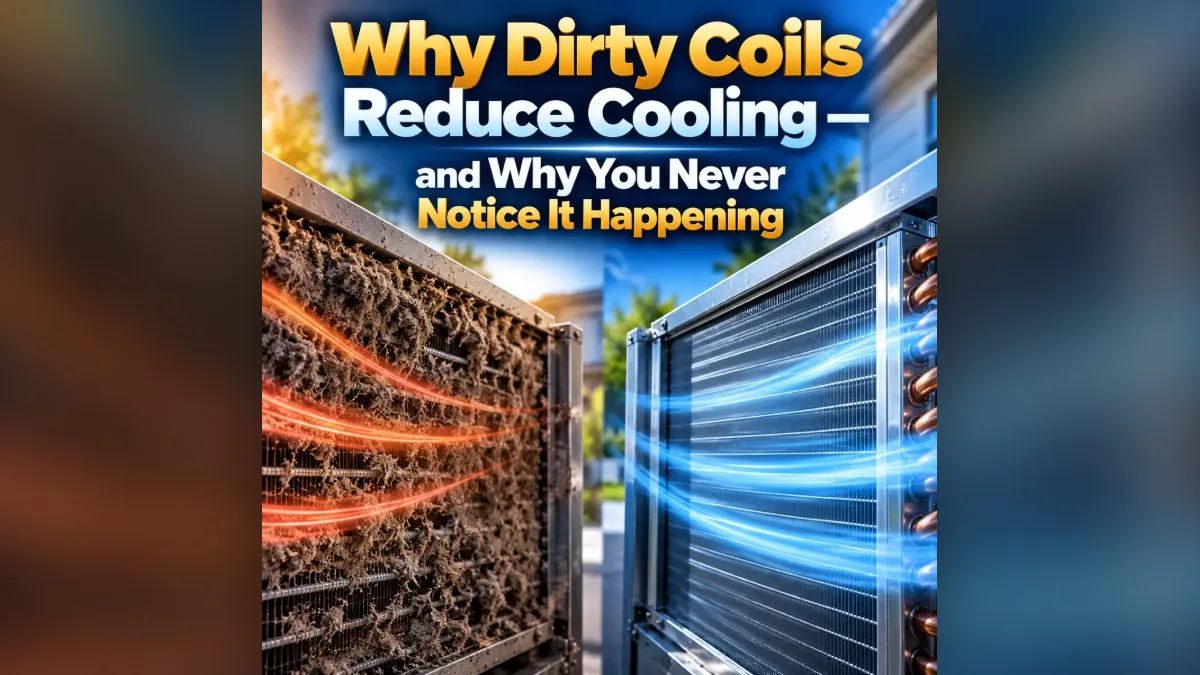
Why Dirty Coils Reduce Cooling: and Why You Never Notice It Happening
Here
is the thing about dirty coils: almost nobody calls us about them.
People
call because the house is not getting cool enough, or the electric bill jumped,
or the air feels damp, or there is ice on a pipe, or something smells like a
gym bag. Those are all the same problem wearing different clothes, and a large
share of the time the answer is a coil that has not been cleaned in years.
The
reason it goes unnoticed is that it happens slowly. A system does not lose its
cooling capacity overnight. It gives up a little each season, and you adjust
the thermostat a degree at a time without ever registering that you are
compensating.
This article covers what each coil does, what specifically goes wrong when it fouls, how to tell which one is your problem, and which of the two you can safely clean yourself.
Your System Has Two Coils and They Fail Differently
Almost
every article on this topic treats "the coil" as one thing. It is
two, they live in different places, they get dirty from different sources, and
they produce completely different symptoms.
The
condenser coil is outside, wrapped around the perimeter of the outdoor unit.
Its job is to release heat from your house into the outdoor air. It gets dirty
from the outside in, grass clippings, cottonwood, pollen, dryer lint, leaves,
and on Long Island's South Shore, airborne salt.
The
evaporator coil is inside, sitting above your furnace or inside your air
handler. Its job is to absorb heat from the air moving through your ducts. It
gets dirty from the inside, household dust that slipped past the filter,
bonded to a surface that is wet with condensation for four months a year.
Knowing which one is fouled tells you what to do. The symptom table below sorts it out.
The Physics, in One Paragraph
An
air conditioner is a heat-moving machine, and it moves heat by putting air in
direct contact with cold or hot metal. Everything depends on that contact.
A
layer of dust on a coil is an insulator. It sits between the air and the metal
and interferes with the exchange. It also physically blocks the gaps between
the fins, so less air gets through in the first place. You lose surface contact
and airflow at the same time, and both of those are the only things making the
system work.
That is the whole mechanism. Everything below is a consequence of it.
What a Dirty Condenser Coil Does
Head pressure rises
The
outdoor coil has to dump your house's heat into the outside air. When it is
coated in dirt, it cannot dump heat fast enough, so the refrigerant leaving it
stays hotter and at higher pressure than it should.
That
pressure is called head pressure, and the compressor is the thing that has to
work against it. Higher head pressure means the compressor is pushing against
more resistance on every single cycle, drawing more current and running hotter
to do the same job.
Your electric bill goes up before your comfort goes down
This
is the sequence that hides the problem. A dirty condenser coil does not
immediately stop your house from cooling. The system compensates by running
longer.
So
the first thing you notice is not discomfort, it is a summer electric bill
that climbed without an obvious reason. Most people attribute that to rates, or
a hot July, and move on.
Only
later, when the coil is bad enough that longer run times cannot compensate,
does the house actually stop reaching setpoint. By then the compressor has
spent seasons working against raised pressure.
Eventually the system protects itself
Most
systems have a high-pressure safety switch. When head pressure exceeds a limit,
it shuts the compressor down to protect it.
From inside the house that looks like an air conditioner that runs for a while, quits, sits for a bit, and starts again, usually on the hottest afternoon of the year, because that is when the pressure is highest. People assume the system is failing. Often the coil is just filthy.
What a Dirty Evaporator Coil Does
The freezing cascade
The
indoor coil produces the more dramatic failure, and it is counterintuitive: a
dirty coil makes the system freeze.
Here
is the chain. Dust on the evaporator restricts airflow and insulates the
surface. Less warm air passes over the coil, so less heat reaches the
refrigerant inside it. The refrigerant stays colder than designed. Coil surface
temperature drops below freezing. Condensation on the fins turns to ice.
Now
it accelerates, because ice blocks airflow even more thoroughly than dust does.
Within a couple of hours you can have a solid block of ice where a coil used to
be, and zero cooling.
There
is a worse consequence downstream. Refrigerant that should have boiled off into
vapor in the coil does not, because the iced coil is not absorbing heat. Liquid
refrigerant then reaches the compressor, which is built to compress vapor.
Liquid does not compress. That is called slugging, and it damages compressors.
If
you find a frozen evaporator coil, turn the system off at the thermostat and
leave the fan running to thaw it. Do not chip at the ice. Then find out why it
froze, a frozen coil is a symptom, and running the system again without fixing
the cause just repeats it. That is an AC repair visit.
Your house gets sticky before it gets warm
A
partially fouled evaporator coil hurts dehumidification before it hurts
cooling, and dehumidification is most of what makes a Long Island summer
bearable.
Moisture
removal depends on humid air making contact with a cold surface long enough to
condense. Insulate that surface with dust and you get less condensation, which
means more water left in your air.
The
result is a house that reads 72 on the thermostat and feels like 78. If that
sounds like your situation, our guide on why a house feels sticky covers the
full list of causes, but a dirty evaporator is one of the most common.
The smell nobody can place
The
evaporator coil is wet all summer. Wet, dark, dusty, and at room temperature is
an ideal environment for biological growth.
What
grows there produces the musty odor people describe as "dirty sock,"
which appears when the system starts and fades once it has been running. If the
condensate pan below the coil is also dirty or draining slowly, standing water
makes it considerably worse.
This is not just unpleasant. Every cubic foot of air in your house passes over that coil, and anyone in the home with asthma or allergies is breathing whatever is on it.
Which Coil Is Your Problem? A Symptom Guide
|
What you are experiencing |
Likely coil |
Why |
|
Electric bill up, cooling still adequate |
Condenser (outdoor) |
System compensating with longer run times |
|
House will not reach setpoint on hot days |
Condenser (outdoor) |
Cannot reject heat fast enough at peak load |
|
Runs, shuts off, restarts on hot afternoons |
Condenser (outdoor) |
High-pressure switch tripping |
|
Outdoor unit hotter and louder than it used to
be |
Condenser (outdoor) |
Compressor working against raised head
pressure |
|
Ice on the refrigerant line or indoor coil |
Evaporator (indoor) |
Restricted airflow dropping coil below freezing |
|
No cooling at all, but the fan is running |
Evaporator (indoor) |
Coil fully iced over |
|
House feels damp at a normal temperature |
Evaporator (indoor) |
Reduced condensation, poor moisture removal |
|
Musty smell when the system starts |
Evaporator (indoor) |
Biological growth on a wet, dusty coil |
|
Weak airflow from vents |
Evaporator, check filter first |
Restricted airflow through fouled fins |
|
Water around the indoor unit |
Evaporator (indoor) |
Thawing ice overwhelming the drain pan |
One caution on the last two:
always rule out the air filter first. A clogged filter produces several of the
same symptoms and costs fifteen dollars to eliminate as a variable.
Why You Never Notice It Happening
This
is the part worth dwelling on, because it explains why coil cleaning gets
skipped for a decade.
Coils
foul gradually. A season adds a layer. Capacity drops slightly. You compensate
without deciding to, the thermostat goes from 74 to 73, then to 72, then you
start running it earlier in the day.
Nothing
ever breaks. There is no moment that prompts a call. You simply arrive, several
summers later, at a house that needs the system set to 69 to feel the way it
used to feel at 74, with an electric bill to match.
The
homeowners most surprised by a coil cleaning are always the ones who told us
the system was working fine. It was working. It was just doing three times the
work to deliver less than it used to.
Not sure
whether your coils have ever been cleaned? If you do not know, they probably
have not. Book a coil cleaning or call (631) 414-7141.
What You Can Clean Yourself, and What You Cannot
The condenser: yes, carefully
Rinsing
the outdoor coil is a legitimate homeowner job and one of the highest-value
fifteen minutes you can spend on your system.
1.
Cut power at the outdoor disconnect, the grey box on
the wall beside the unit. Not just the thermostat.
2.
Clear a two-foot perimeter of leaves, clippings, weeds,
and anything stacked against the cabinet.
3.
Remove the top grille if accessible to clear debris
that collected inside. The fan motor wires are attached, lift straight up, do
not yank.
4.
Rinse with a garden hose, spraying from the inside
outward if you have access, or straight down through the top. This pushes
debris out the way it came in.
5.
Brush stubborn areas gently, working in the same
direction the fins run, up and down, never side to side.
6.
Let it dry, restore power, and run the system.
The evaporator: no
The
indoor coil is a different situation entirely, and this is not us protecting a
service call.
It
sits inside a sealed cabinet, often in an A-frame configuration where the dirty
side faces away from any access panel. Reaching it usually means removing
panels, and on many installations means partially disconnecting ductwork. Its
fins are thinner and more fragile than the condenser's.
It
also needs the right chemistry. Evaporator cleaners are formulated for the
specific soil on a wet indoor coil, and whatever you use has to drain into a
condensate pan that then has to handle it. Household cleaners can damage the
aluminum, and an aggressive acid cleaner used wrong will corrode the coil you
were trying to save.
Some
coils are genuinely inaccessible without pulling the coil, which is a
refrigerant-circuit job requiring EPA certification.
Three things that destroy coils
Every
one of these turns a cleaning into a repair. We see all three.
•
A pressure washer. It will flatten the fins in seconds,
and flattened fins restrict airflow permanently. Garden hose pressure only,
always.
•
Brushing side to side. Fins bend easily and do not
straighten well. Always work in the direction the fins run.
• Bleach or household cleaners. They corrode aluminum. Coil cleaners exist for a reason.
How Often Coils Actually Need Cleaning on Long Island
General
guidance underrates this for our area.
Condenser
coil: annually at minimum. Inland, once a season is fine. On the South Shore, Massapequa, Amityville, Babylon, and anywhere near open water, a freshwater
rinse twice a season is better, because airborne salt is corroding the aluminum
continuously, not just fouling it. That rinse is also part of the AC
winterizing checklist, because salt left on a coil through the winter keeps
working on it.
Evaporator
coil: inspected annually, cleaned every one to three years. How often depends
on filter quality and discipline, pets, carpet, whether anyone smokes, and how
much construction dust the house has seen. A home with two dogs and a cheap
fiberglass filter needs it more often than a home with a good filter changed
monthly.
Local
factors that shorten these intervals: cottonwood in June, which mats a
condenser coil faster than anything else; heavy pollen; a dryer vent
discharging near the outdoor unit; and lawn crews blowing clippings into it
every week.
A
maintenance plan generally includes coil cleaning in the seasonal visits, which
is the simplest way to stop tracking it yourself.
When a Coil Is Past Cleaning
Occasionally
the honest answer is that cleaning will not help.
Corroded
through. Long Island coils, particularly on the South Shore, develop corrosion
that eventually perforates the tubing. A cleaning cannot fix a coil that leaks
refrigerant.
Formicary
corrosion. Microscopic tunneling through copper tubing, caused by certain
airborne chemicals from household products. It produces pinhole leaks that are
extremely hard to locate and usually means coil replacement.
Fins
crushed beyond repair. Usually from a pressure washer or a weed whacker. Fin
combs restore some of it, but not all.
Age
plus condition. Replacing an evaporator coil on a fifteen-year-old system that
also uses phased-down R-410A refrigerant is often money badly spent. That is a
repair or replace conversation, not a coil conversation.
Get an Honest Look at Your System
If
you have never had your coils cleaned and your system is more than a few years
old, you are almost certainly running at reduced capacity and have adjusted to
it without noticing.
The
outdoor coil you can rinse yourself this weekend. Power off at the disconnect,
garden hose, gentle. That alone is worth doing.
The
indoor coil needs someone with access, the right cleaner, and a way to handle
the drainage. That is what a seasonal visit covers, along with measuring
whether the system is actually performing to spec rather than guessing at it.
K2
Cooling and Heating has served Long Island since 2002. Our cooling inspection
includes coil cleaning, condensate drain clearing, refrigerant charge
verification, and airflow measurement.
Call
(631) 414-7141 or contact our team. We serve Deer Park, Babylon, West Babylon,
North Babylon, Dix Hills, Huntington, Farmingdale, Massapequa, and the
surrounding Suffolk and Nassau communities.
On
the South Shore and dealing with salt corrosion? Our storm prep guide covers
the related coastal issues, and a maintenance plan puts the seasonal rinse on a
schedule so it does not depend on remembering.
Need a technician rather than a guide? See our AC repair service, or read about HVAC repair in Deer Park, NY. K2 answers 24/7 at (631) 414-7141.