Written by the service team at K2 Cooling & Heating in Deer Park, NY: licensed and insured HVAC contractors serving Suffolk and Nassau County, rated 4.8 across 352+ Google reviews.
"Tune-up" is one of the least standardized words in this industry. It can mean ninety minutes of measurement and cleaning, or it can mean eighteen minutes, a filter, and a quote for a new system.
Both get called the same thing and sometimes cost about the same. From the outside they look identical — a van, a technician, a clipboard.
So here is ours, item by item, with what each step is actually for. Print it, watch us work through it, and hold us to it.
Why We're Publishing Our Checklist
Two reasons, and the second one is the honest one.
First, you cannot judge what you cannot see. Most homeowners have no way to tell a thorough visit from a quick one, because the work happens inside a cabinet while they are in another room.
Second, we would rather compete on this than on price. If you know what a real tune-up involves, a cheaper visit that skips two-thirds of it stops looking like a bargain. That is better for us and better for you — and it only works if we actually do everything below, every time.
The Three Instruments
Before the checklist, the simplest test there is.
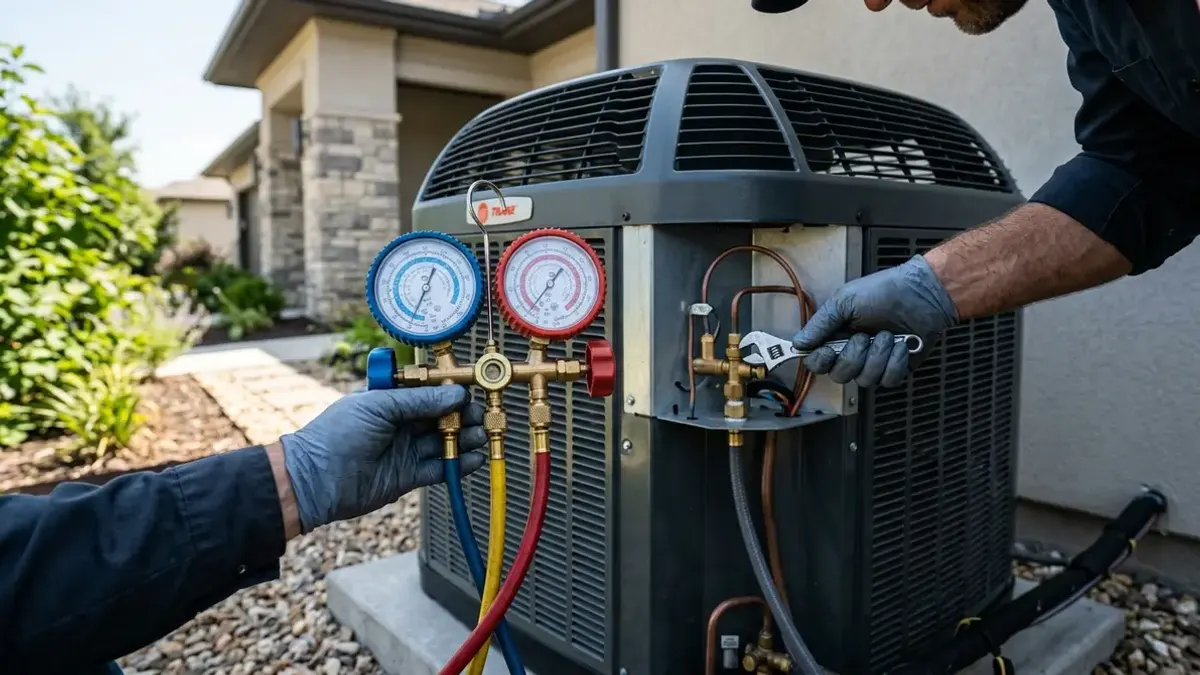
A genuine cooling tune-up requires three things that cannot be faked:
- Refrigerant gauges and temperature probes — to verify charge properly
- A manometer — to measure static pressure across the system
- A multimeter — to test capacitors under load and check amp draws
If a technician arrives with a screwdriver and a filter, no charge verification happened, no static pressure was measured, and no electrical testing was done. Whatever else took place, those three were not part of it.
That is the single fastest way to judge any company, including us.
Inside: The Indoor Unit
Air filter. Checked, and replaced if it does not pass light. Size and type noted — the wrong filter restricts airflow as badly as a dirty one.
Evaporator coil inspection. Visual check for dust loading, biological growth, and corrosion. A fouled indoor coil insulates the metal from the air and quietly removes cooling capacity. Our guide on dirty coils explains why this one costs you more than people expect. Cleaning is scheduled where needed rather than done reflexively — see the honest note near the end.
Blower wheel and motor. Wheel checked for dust build-up, which reduces airflow across the whole system. Motor amp draw measured against the nameplate rating, which is how a failing motor announces itself before it stops.
Condensate drain cleared and flushed. The single most common cause of water around an indoor unit is a drain line blocked with algae. Clearing it annually is the cheapest insurance against ceiling and floor damage there is.
Drain pan inspected. Checked for standing water, rust, and cracks. A pan that holds water is both a damage risk and a source of the musty smell people describe as dirty sock.
Float safety switch tested. Not just confirmed present — actually tested, by raising the float to verify it cuts the system off. An untested float switch is the same as no float switch on the day it matters.
Line set insulation checked. The foam sleeve on the large copper line degrades in UV and gets chewed by pests. Where it has failed, the pipe sweats and drips, and people reasonably mistake it for a leak.
Thermostat checked. Calibration verified against actual room temperature, operation confirmed, settings reviewed, and the fan setting checked. If it is on ON rather than AUTO, we will tell you why that is costing you money and making the house feel damp.
Outside: The Condenser
Power cut at the disconnect first. Nothing on this list happens with the unit energised.
Debris cleared. Leaves, grass clippings, cottonwood, and anything stacked against the cabinet. Two feet of clearance restored on all sides.
Condenser coil cleaned. Rinsed with appropriate pressure and technique — never a pressure washer, which flattens fins permanently. On the South Shore we pay particular attention here, because coastal air corrodes aluminum fins continuously rather than just fouling them.
Fins inspected and combed where they have been crushed by a weed whacker or a shovel. Bent fins restrict airflow permanently if left.
Fan motor and blade. Blade checked for cracks and balance, motor bearings checked by hand for roughness, amp draw measured. A motor that spins roughly in spring is a motor that seizes in August.
Electrical compartment opened. Contactor inspected for pitting and burning. Wiring checked for loose, corroded, or overheated connections — one of the most common causes of intermittent faults, and genuinely a fire risk when left.
Capacitor tested under load, not just visually. Readings compared to the rated value. A capacitor reading below spec is replaced, because a weak one makes the compressor hard-start on every cycle and that is how compressors die.
Pad and clearance checked. The unit should sit level on a solid base. A pad that has settled stresses the line set. In flood-prone areas we will raise the subject of elevating it.
Refrigerant lines inspected for oil residue, which is where refrigerant escapes.
The Measurements That Make It a Tune-Up
Everything above is inspection and cleaning, and it matters. But measurement is what separates a tune-up from a tidy-up.
Refrigerant charge by superheat and subcooling
Charge is verified using gauges and temperature probes, calculating superheat and subcooling and comparing them to the manufacturer's specification for your equipment.
What this is not: feeling the line to see if it is cold, or adding refrigerant because the system seems weak. Refrigerant is not consumed — a sealed system does not use it up. If charge is low, there is a leak, and the right response is to find it rather than top it up annually at rising prices.
Incorrect charge in either direction reduces capacity and shortens compressor life, so this reading matters even when nothing seems wrong.
Static pressure
Measured across the system with a manometer. This is the reading almost nobody takes, and it tells you whether your ductwork can actually carry the airflow your equipment needs.
High static pressure explains a surprising number of complaints: weak airflow, rooms that never cool, frozen coils, high bills, and premature blower failure. It also tells you which air filters your system can safely take, which is genuinely useful information to own.
Temperature split
Supply and return air temperatures measured and the difference compared to the expected range for current conditions.
A split outside the expected range points to a real problem — airflow, charge, or coil condition — and it is a quick cross-check on everything else measured.
Electrical readings
Compressor and fan motor amp draws measured against nameplate ratings. Capacitance measured under load. Voltage checked at the unit.
These readings are how components announce they are failing before they fail. A motor drawing above its rated amps is telling you something, months in advance.
What You Should Receive at the End
A walkthrough of what was found, and the readings in writing. That last part is the tell.
Your report should include:
| Reading | Why it matters |
|---|---|
| Superheat and subcooling | Confirms the charge is correct for your equipment |
| Static pressure | Shows whether ductwork can carry the required airflow |
| Temperature split | Cross-checks overall system performance |
| Capacitor value vs rated | Predicts the most common summer failure |
| Compressor and fan amp draws | Flags components degrading before they fail |
| Condensate drain status | Confirms the most common water-damage path is clear |
Keep these year to year. A capacitor drifting downward across three visits, or static pressure climbing as ductwork degrades, is a trend you can see — and trends are far more useful than any single reading.
A crew that writes its numbers down is a crew that took them. If you receive a checklist with ticks and no values, ask for the values.
How Long It Actually Takes
A proper cooling tune-up on a typical residential system runs roughly 60 to 90 minutes. Longer if the coil needs cleaning, if the condensate drain is badly blocked, or if something found needs investigating.
Twenty minutes is not a tune-up. It is a filter change and a look. That can be a perfectly honest service if that is what was sold — but it should not be priced or described as maintenance.
Six Signs You Got the Eighteen-Minute Version
- No gauges came off the truck. Charge was not verified.
- No manometer. Static pressure was not measured, so nobody knows what your ductwork is doing.
- The outdoor electrical compartment was never opened. The capacitor was not tested, and that is the most common summer failure.
- Nothing was written down. No readings means no measurements.
- The condensate drain was not touched. The cheapest and highest-value item on the list, skipped.
- It took twenty minutes and ended with a quote for a new system. Sometimes replacement genuinely is the answer, but it should arrive with readings behind it.
None of these prove bad intent. A company selling a cheap seasonal check may be doing exactly what it advertised. The problem is when that is priced and described as the same thing.
What a Tune-Up Can't Do
Worth being straight about the limits.
- It will not fix undersized or leaky ductwork. It will measure the problem and tell you it is there.
- It will not make an oversized system behave. Short cycling is a sizing issue, not a maintenance one.
- It will not restore a twenty-year-old system. Maintenance manages decline; it does not reverse it.
- It is not a repair visit. If we find a failing part, we will tell you what it is, what it costs, and whether it can wait. Repairs are quoted separately rather than absorbed quietly.
- It cannot find every future failure. Some components fail without warning. Measurement catches the ones that degrade first, which is most of them.
If a system is beyond the point where maintenance helps, we would rather say so than sell you an annual visit on equipment that will not see another summer.
What Doesn't Need Doing Every Year
An honest note, because some companies bill annually for work that does not need annual doing.
Evaporator coil cleaning. Inspected every year, cleaned every one to three years depending on filter quality, pets, and household dust. A clean coil does not need cleaning.
Duct cleaning. Not routine maintenance. It makes sense after construction dust, visible contamination, or a rodent or water problem — not on a schedule.
Refrigerant. Never a routine top-up. If it is low, you have a leak.
Condenser coil deep cleaning. The seasonal rinse is routine. A full chemical cleaning is not, unless the coil is genuinely fouled — though near the water, we check more carefully.
If something is on your invoice every single year that is not on this list of routine items, it is reasonable to ask why.
Watch If You Want To
Most homeowners never see what happens during a maintenance visit, which is exactly why the word means so little.
Now you have the list. Use it on us, and use it on anyone else quoting you a tune-up. The three instruments, the readings in writing, and the condensate drain are the three things to check — they sort the field faster than price does.
K2 Cooling & Heating serves homes within about 15 miles of Deer Park. Every item on this page is standard on our cooling visits, and you get the readings in writing.
Call or text (631) 414-7141, or toll-free (800) 531-2160. You can also book online. We serve Deer Park, Babylon, West Babylon, North Babylon, Dix Hills, Huntington, Farmingdale, Massapequa, and the surrounding Suffolk and Nassau communities.
Booking both seasons at once usually works out better — our maintenance plan covers the cooling and heating visits, and our AC repair page explains what happens if we find something that needs attention.