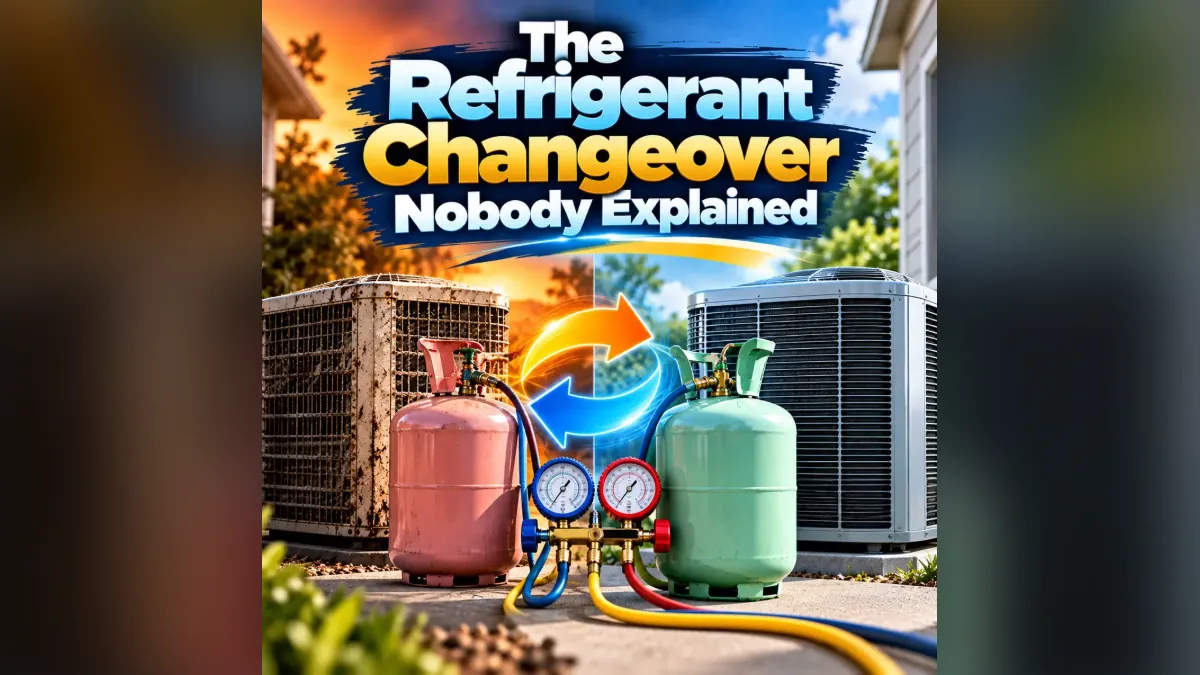
The Refrigerant Changeover Nobody Explained
Current as of [PUBLISH DATE]. Refrigerant regulations have changed several times in the last eighteen months, including a federal rule that took effect in July 2026. If you are reading this much later, confirm the current position before acting on it.
Somewhere in the last two years, a homeowner on Long Island was told their air conditioner runs on a banned refrigerant and needs replacing. It happens constantly, and it is not true.
The
R-410A phase-out is real. It is also almost universally misexplained,
partly because three separate rules get collapsed into one phrase, and partly
because the rules themselves changed again in 2026, in a way that does not
apply to New York.
Here
is the version that is actually accurate for a home in Deer Park, Babylon, or
Huntington.
Start Here: Your Air Conditioner Is Not Illegal
If
you have an R-410A system, three things are true:
•
You do not have to replace it. No rule requires
it, at any date.
•
It can be serviced. R-410A remains legal to buy
and charge into existing equipment, indefinitely.
•
It will get more expensive to service over time,
because production of the refrigerant is being reduced in steps.
That
last point is the only one that should influence any decision, and it matters
far more if your system leaks than if it does not.
Three Different Rules, Constantly Confused
The
confusion is structural. The phase-out regulated three things separately, and
people quote one while meaning another.
Manufacturing
Under
the AIM Act, the EPA set a global warming potential limit of 700 for new
residential air conditioning and heat pump equipment. R-410A has a GWP of
roughly 2,088, well above the line.
As
of January 1, 2025, manufacturers stopped producing and importing new R-410A
residential systems for the US market. That part is settled and applies
everywhere.
Installation
This
is where it gets messy, and where most articles online are now wrong for our
state.
The
original federal rule also banned installing leftover R-410A inventory
after January 1, 2026. In May 2026 the EPA reversed that, and effective July
27, 2026, pre-2025 R-410A equipment can be installed federally until supplies
run out.
That
federal reversal does not apply in New York. More on this below, because it
is the part that affects you.
Service
Servicing
was never restricted. There is no end date for charging R-410A into an existing
system. Reclaimed refrigerant is also permitted and will supply a growing share
of the market as virgin production tapers.
So:
manufacturing stopped, installation depends on your state, and service
continues. Three rules, three answers.
The New York Difference
This
is the section worth reading twice, because national content will tell you the
opposite.
New
York has its own refrigerant regulation, Part 494, administered by the
Department of Environmental Conservation. It was written to align with the original
federal rule, and it is an independent state requirement rather than a copy of
it.
When
the EPA removed the federal installation deadline in 2026, Part 494 kept New
York's January 1, 2026 installation prohibition in place. From 2026 onward,
newly installed residential and light commercial air conditioners and heat
pumps in New York must use a refrigerant at or below 700 GWP.
What
that means practically:
•
A contractor in Pennsylvania or Connecticut may be able
to install leftover R-410A equipment. In New York, that option is closed.
•
If a supplier or contractor tells you the federal
change means you can still get an R-410A system installed here, check it. The
federal relief does not reach this state.
•
Your existing system is unaffected. Part 494 does not
require replacing equipment before the end of its useful life, and reclaimed
refrigerant can be used to service it.
There
are also narrower rules for self-contained products like window units and
packaged equipment, which follow different dates than field-assembled split
systems.
If you want to verify any of this yourself, the DEC publishes a Part 494 fact sheet and FAQ. We would rather you check than take our word for it.
Is A2L Refrigerant Safe?
This
is the question that worries people once they hear the words "mildly
flammable," so let's be precise.
A2L
is a safety classification under ASHRAE Standard 34. The "2L"
specifically means lower flammability with a low burning velocitya
category distinct from genuinely flammable refrigerants like propane (which is
A3). A2L refrigerants require specific conditions to ignite and do not
propagate flame readily.
The
equipment is engineered around this. A2L systems include:
•
Refrigerant leak detection sensors built into
the indoor unit
•
Sealed or spark-resistant electrical components
•
Automatic responses to a detected leak,
typically running the blower to disperse refrigerant and locking out the system
•
Certification to updated safety standards for
this refrigerant class
These
refrigerants have been used in residential air conditioning in Europe, Japan,
and much of Asia for years. The change here is newer, not the technology.
What
it means for you as a homeowner: nothing you need to do differently day to
day. What it does mean is that whoever services your system needs A2L training
and the right recovery and leak detection equipment. That is a fair question to
ask any contractor before they work on a new system.
If You Own an R-410A System
The
practical guidance comes down to one question: does your system leak?
If
it holds charge and runs well: do nothing. Keep maintaining it. Replace it
when it reaches the end of its life on its own terms, not because of a
regulation. Our guide on repair or replace
covers that decision on the merits.
If
it needs refrigerant added: this is where the changeover actually bites.
Refrigerant is not consumed, a sealed system does not use it up. If you are
low, you have a leak, and every top-off is money spent on refrigerant that will
escape again.
R-410A
prices have risen substantially since 2022 and will keep climbing as production
allowances step down further. The recurring top-off that was mildly annoying
five years ago is becoming genuinely expensive, and that changes the math on
finding the leak versus living with it. Our guide on why "eventually" is the most expensive word in HVAC
applies directly here.
If
it is over twelve years old and leaking: that is the clearest case where
the changeover should influence your decision, not because your system is
illegal, but because you are about to spend rising money on a system near the
end of its life anyway.
On Long Island there is a local wrinkle. Salt air along the South Shore corrodes coils and connections, and coil leaks are more common here than inland. If you are near the water and your system has needed refrigerant more than once, that pattern is worth taking seriously. Keeping the coil rinsed and the system inspected under a maintenance plan is the cheapest defense.
Been told your
refrigerant is "banned" and you need a new system? Get a second
opinion before you spend anything. Book a free
estimate or call (631) 414-7141.
The Condenser-Only Trap
This
is the practical consequence almost nobody explains, and it catches people at
the worst moment.
When
an outdoor unit fails, the traditional cheap fix was to replace just the
condenser and keep the existing indoor coil. That option is largely gone.
You
cannot put A2L refrigerant into a system designed for R-410A. The operating
characteristics differ, and A2L systems are built with leak detection and
sealed electrical components that older indoor equipment does not have. Indoor
and outdoor units are certified as a matched pair. Charging a new refrigerant
into old equipment voids the warranty and breaches federal refrigerant handling
rules.
And
in New York, replacing an outdoor condensing unit is treated as installing new
air conditioning equipment, which means it has to meet the current GWP limit.
In practice, that points to replacing the matched system rather than the
condenser alone.
Why
this matters to your wallet: if your condenser dies, budget for a system
rather than a unit. That is a bigger number, and knowing it in March is much
better than discovering it in August. The installation
day guide covers what a matched replacement involves.
If You're Buying a New System
Five
things to get right.
1.
Expect A2L. New equipment installed in New York
now uses R-454B or R-32. That is not an upsell; it is the current product.
2.
Confirm your contractor is equipped and trained for
A2L. Different recovery equipment, different leak detection, specific
training. Ask directly.
3.
Ask about the leak detection sensor. Know that
it exists, what it does if it triggers, and what replacing it costs down the
line.
4.
Do not let the changeover rush your decision. A
refrigerant transition is not a reason to buy in a panic. Size the system properly,
choose the right tier, our guide on variable-speed
covers that, and take the time to compare.
5.
Check current incentives before you sign. The
federal $2,000 heat pump tax credit expired for equipment placed in service
after December 31, 2025. New York State and utility programs continue, and heat
pumps generally attract the best of them. Confirm what is live at the time you
buy rather than relying on an older article.
Four Sales Lines to Push Back On
These
are circulating on Long Island right now. None of them are true as stated.
•
"Your refrigerant is banned and your system is
illegal." It is not. Existing systems are legal and serviceable
indefinitely.
•
"You need to replace before the deadline."
There is no deadline requiring any homeowner to replace working equipment.
•
"We can convert your system to the new
refrigerant." No. A2L requires equipment designed and certified for
it. Anyone offering a conversion is describing something that should not be
done.
•
"Buy now because prices are about to
jump." Equipment pricing moves for many reasons. Urgency built on a
regulation you have not verified is a sales tactic, not information.
A good contractor will explain which rule applies to your situation and be comfortable with you checking it. Anyone who gets impatient when you ask for specifics is telling you something.
Where to Get a Straight Answer
The
refrigerant changeover is a genuine regulatory shift, and it is also being used
as a sales lever on homeowners who have no way to check the claims being made
to them.
The
accurate summary for a Long Island home: your existing system is legal,
serviceable, and yours to keep as long as it serves you. New equipment now uses
a different refrigerant, which is fine. The only situation where the changeover
should genuinely influence your decision is a system that is leaking, and that
was worth fixing anyway.
K2 Cooling & Heating has served Long Island since 2002. We
install and service both R-410A and A2L systems, and we will tell you plainly
which rules apply to your situation rather than using them to sell you
something.
Call
(631) 414-7141 or contact our team.
We serve Deer Park, Babylon, West Babylon, North Babylon, Dix Hills,
Huntington, Farmingdale, Massapequa, and the surrounding Suffolk and Nassau
communities.
Need a technician rather than a guide? See our AC installation service, or read about HVAC repair in Deer Park, NY. K2 answers 24/7 at (631) 414-7141.