Written by the service team at K2 Cooling & Heating in Deer Park, NY: licensed and insured HVAC contractors serving Suffolk and Nassau County, rated 4.8 across 352+ Google reviews.
We sell and install air conditioners, so the useful thing we can tell you is this: for a large share of Long Island homes, buying a better air conditioner is not the biggest cooling upgrade available.
The equipment is usually not the weak link. The distribution is — the ducts that carry the cool air, and the envelope that decides how much heat gets in. Put a top-tier system on leaky attic ductwork under bad insulation and you have paid for capacity you will never receive.
This article ranks eight upgrades by impact per dollar, names the two that are not worth it, and gives you the order to do them in. If you are trying to work out how to improve home cooling without guessing, start at the top of the list rather than at the showroom.
The Question People Ask vs the Question That Matters
The question we get: what system should I buy?
The question that determines the outcome: why is this house uncomfortable?
Those have different answers, and it matters because comfort is a chain. Cooling capacity gets produced at the outdoor unit, moves through the coil, travels through ductwork, arrives in rooms, and then fights whatever heat is entering through the roof, walls, and windows.
A chain fails at its weakest link, and upgrading a strong link changes nothing. If 25% of your cooled air is escaping into a 130-degree attic, replacing a 13 SEER unit with a 20 SEER unit means you now waste 25% of better air. The percentage does not care how much you spent.
That is the entire thesis. Find the weak link first.
Before You Upgrade Anything: The Free Checklist
Do these before spending a dollar. Some homeowners find their problem here and stop.
- Check the air filter. Hold it to a light — if light does not pass through, replace it. Restricted airflow mimics almost every symptom on this page. Our guide on spotting a dirty air filter covers it in thirty seconds.
- Set the thermostat fan to AUTO, not ON.
- Open every vent in the house. Closing them off does not save money and it raises static pressure.
- Clear two feet around the outdoor unit and rinse the coil with a garden hose, power off at the disconnect.
- Close blinds on west-facing windows in the afternoon.
- Measure your indoor humidity with a $15 hygrometer.
Those six are covered in full in our guide to not overworking your AC. If the house improves noticeably after them, your problem was behavioral and you just saved thousands.
Eight Upgrades, Ranked by Impact Per Dollar
1. Sealing return ductwork
This is the biggest cooling upgrade available to most Long Island homes, and it is not equipment.
Ranches, Capes, and split-levels across Suffolk and Nassau commonly have ductwork running through an unconditioned attic. On an August afternoon that attic hits 130 degrees, and every gap, disconnected joint, torn flex duct, and unsealed boot is leaking.
Supply-side leaks waste cooled air you already paid to produce. Return-side leaks are worse, because they actively pull superheated attic air into your system — so you are air conditioning your attic on purpose, and importing a fresh humidity load on every cycle.
Here is why nobody addresses it: nothing feels wrong. The vents still blow cold. The house still gets cool, eventually. The loss is invisible because it happens in a space you visit twice a year.
It is also the rare upgrade that pays back twice — it is the largest single item in our guide to high electric bills, and it is simultaneously an air quality fix, because attic air arrives downstream of your filter.
Who this is for: anyone with attic ductwork. If you do not know whether you do, look.
2. Attic air sealing and insulation
Not HVAC work, which is exactly why we are putting it second — and why most contractors will not mention it.
A 130-degree attic sitting above marginal insulation radiates into your second floor all afternoon. Air sealing the penetrations between the living space and the attic — around recessed lights, plumbing stacks, wiring, the attic hatch, top plates — stops the hot air exchange. Bringing insulation up to current levels stops the radiant load.
This is the single most effective thing you can do for a hot second floor, and almost nobody offers it when a homeowner calls about a hot second floor. They get quoted a bigger air conditioner instead.
Check whether PSEG Long Island or NY State energy programs currently offer incentives for insulation and air sealing. Terms change annually, so confirm current-year details.
Who this is for: two-story homes, anyone with a hot second floor, and any house with original 1950s or 60s insulation.
3. Correct sizing at replacement
This one is free — it costs nothing extra, it just requires insisting on it.
When equipment gets replaced, the fast approach is matching the old unit's tonnage. But if that unit was oversized in 1998, or if the home has since been insulated, had windows replaced, or had the attic air-sealed, the correct size today is smaller. Rounding up avoids callbacks, so rounding up is what happens.
An oversized system short cycles: it blasts the house to setpoint in eight minutes and shuts off, having removed the temperature but almost none of the humidity. You end up with a cold, clammy house, more compressor starts, and higher bills.
The fix is a Manual J load calculation based on your actual square footage, insulation, windows, and orientation. Ask for it by name. A contractor who will not do one is guessing with your money.
Our guide on whether to repair or replace your AC covers the timing of that decision.
Who this is for: anyone replacing equipment. All of them.
4. Humidity control
On Long Island, humidity is often the actual complaint underneath a temperature complaint.
At 65% indoor humidity, 74 degrees feels like 78. So people chase comfort down to 68, which produces shorter cycles, which removes even less moisture. The loop tightens.
Get humidity into the 45–55% range and most people sit comfortably at 74 or 75 instead of 68 — a real reduction in run hours, and a genuinely more comfortable house.
For many homes this is solved by fixing items 1 and 3 above. Where it is not, a whole-house dehumidifier ducted into the system is the answer, and its strongest argument is the shoulder seasons: in June and September, mild temperatures mean your AC barely runs while dew points stay in the 60s and 70s. Those are the muggiest indoor days of the year and nothing else touches them.
Our guide on why a house feels sticky covers the full diagnostic.
Who this is for: anyone whose house is cold and clammy, or who has a damp basement.
5. Variable-speed or two-stage equipment
Now we get to equipment, at number five.
A single-stage system has one output: full blast or off. A variable-speed system modulates, running long low-capacity cycles instead of short hard ones.
In our climate that matters more than the SEER number on the box, because long steady cycles are what remove humidity. A variable-speed system dehumidifies substantially better than a single-stage unit at a similar efficiency rating, and it evens out temperature between rooms.
Two honest caveats. It costs meaningfully more. And it is more electronically complex, which means more to go wrong and more exposure to power surges — worth pairing with surge protection.
Who this is for: people replacing anyway, who intend to stay in the house, and who care about humidity. If you are replacing on a tight budget, a correctly sized single-stage unit on sealed ducts beats an oversized variable-speed unit on leaky ducts every time.
6. Ductless for the rooms that never work
Every Long Island housing style has its problem room: the converted attic, the bonus room over the garage, the addition at the end of a duct run, the finished basement.
These rooms are usually at the end of a distribution system that was never designed to reach them. Turning up the whole system to fix one room means overcooling the rest of the house, and it never really works anyway.
A single-zone ductless mini split conditions that room independently. No ductwork, no losses, its own thermostat. For one or two problem rooms it is far cheaper and far more effective than upsizing the central system.
A side benefit worth knowing: most inverter-driven mini splits ramp rather than slamming on, so they draw far less starting current than a central condenser — which makes them the one piece of cooling equipment a portable generator can realistically run during an outage.
Who this is for: anyone with one or two rooms that have never been comfortable.
7. A deep media filter cabinet
Modest cooling impact, real air quality impact, and low cost — which is why it sits here rather than lower.
A 4-inch or 5-inch media filter delivers high filtration at a lower pressure drop than a 1-inch high-MERV filter, because pressure drop depends on surface area and a deep pleated filter has far more of it. Better filtration, less restriction, and it lasts six to twelve months instead of one.
It requires a cabinet installed in the ductwork, which is a one-time cost. Our guide to air filtration options explains the tradeoffs, including why a dense 1-inch filter can do more harm than good.
Who this is for: anyone with allergy concerns, pets, or a habit of forgetting monthly filter changes.
8. A smart thermostat
Last on the list, and we are going to be straightforward about why.
A smart thermostat does not improve your system's capacity, airflow, or dehumidification. What it gives you is scheduling, remote control, and — the genuinely useful part — run-time data. Knowing your system ran nineteen hours yesterday is diagnostic information you cannot get any other way.
Models with humidity control can extend cycles to hit a humidity target rather than only a temperature target, which is a real benefit on a system capable of it.
But it is a control, not a capacity upgrade. If your ducts leak, a smart thermostat will schedule that waste more precisely.
Who this is for: almost everyone eventually, nobody urgently.
If Your Second Floor Is Always Too Hot
This is the most common comfort complaint we hear on Long Island, and it deserves its own section because the answer is almost never the one people expect.
The usual assumption is insufficient capacity — the air conditioner is too small. It rarely is. Here is what is actually happening, in order of likelihood:
- The attic is radiating into the ceiling all afternoon through marginal insulation.
- Attic ductwork is losing cooled air before it reaches the second-floor registers, so those rooms get the least of what was produced.
- Return air is inadequate upstairs. Many two-story homes have one return on the first floor. Without a return path, air will not move into second-floor rooms regardless of how hard the blower pushes.
- Hot air rises, and one system trying to serve two floors on a single thermostat will always favor whichever floor the thermostat is on.
- West-facing second-floor windows take direct sun during peak load.
Notice that four of the five are distribution and envelope, and none of the five is fixed by a larger air conditioner. Installing a bigger unit makes the first floor cold while the second floor stays uncomfortable, and adds short cycling.
What actually works: attic air sealing and insulation, sealing the attic ductwork, adding second-floor return air, and — if all of that is not enough or not feasible — a ductless zone upstairs. In some homes, a second small system dedicated to the second floor is the right answer, but that is a conclusion to reach after the first three, not before.
What Is Not the Answer
Two things get sold as upgrades that are not.
Bigger equipment. Oversizing is the single most common installation error and it makes comfort worse, not better. Short cycles mean less dehumidification, more compressor starts, and a house that is cold and clammy at the same time. If a contractor's response to a comfort complaint is more tonnage without a load calculation, get another quote.
Chasing SEER without fixing distribution. A higher SEER rating is a laboratory measurement of the equipment. It says nothing about what reaches your rooms. Going from 14 to 20 SEER while 25% of your air vanishes into the attic means you are wasting more expensive air. Seal the ducts first, then buy efficiency — in that order, every time. The efficiency gain you paid for only materializes if the air arrives.
A related one: do not let anyone size your new system to your old system's tonnage. That number was somebody's guess in 1998, before your windows were replaced.
How to Know Which One Applies to Your House
Four measurements sort this out, and a homeowner can do two of them.
You can do these:
- Indoor humidity. A $15 hygrometer. Above 60% points at items 3 and 4.
- Cycle timing. Time how long the system runs on a hot afternoon. Fifteen to twenty minutes or longer is healthy. Seven to ten minutes repeatedly means oversized. Continuous running without reaching setpoint means capacity is being lost somewhere.
- Room-by-room temperatures. A cheap thermometer, one room at a time, same time of day. More than three or four degrees of spread points at distribution.
A technician does these:
- Static pressure across the system, which reveals whether the ductwork can carry the airflow the equipment needs
- Duct leakage assessment, which quantifies item 1
- Temperature split at supply and return
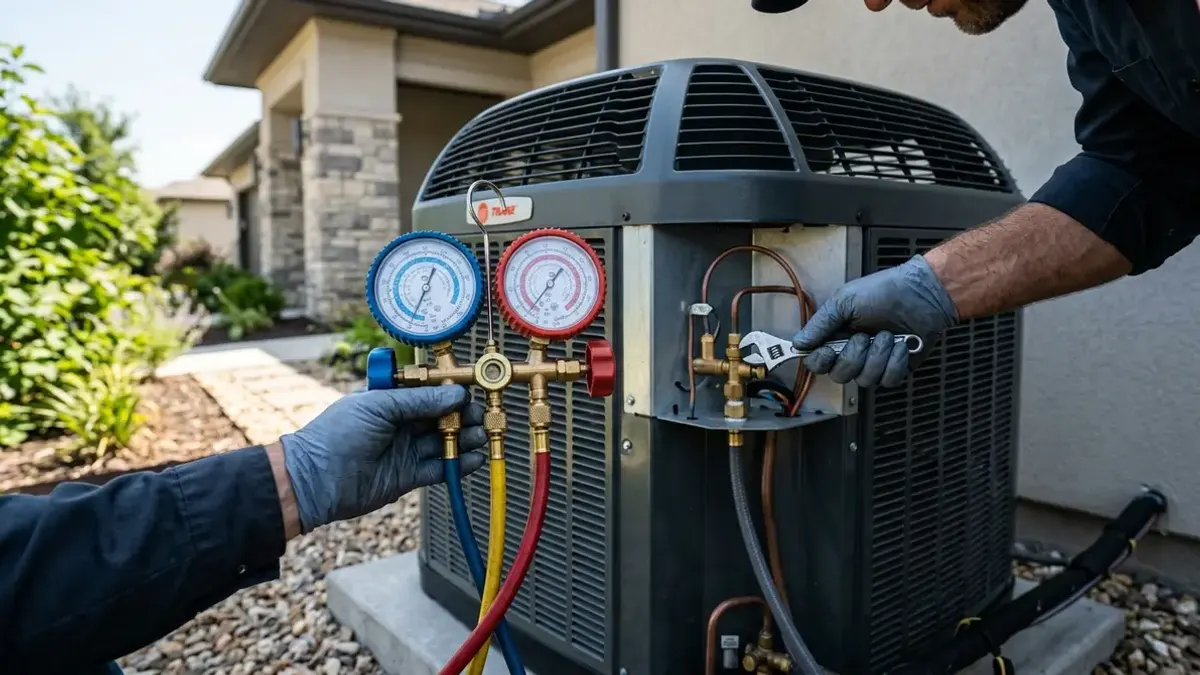
- Refrigerant charge by superheat and subcooling
Bring the three homeowner measurements to the conversation. They will get you a better answer than describing how the house feels.
One thing to rule out first: if your coils have never been cleaned, do that before diagnosing anything else. Our guide on dirty coils explains why a neglected coil produces symptoms identical to a capacity problem.
The Order Matters More Than the List
If you do these out of order you will waste money, and one sequence error is especially expensive.
- Free items first. Filter, fan on AUTO, vents open, coil rinsed, blinds closed, humidity measured.
- Maintenance. Get the coils, charge, and drain right so you are diagnosing a healthy system.
- Seal the ducts. Return side first.
- Air seal and insulate the attic.
- Then measure again. Steps 3 and 4 change your home's cooling load, sometimes substantially.
- Then size and buy equipment — based on a load calculation performed after steps 3 and 4.
- Add humidity control if humidity is still high.
- Add ductless zones for rooms still not served.
The expensive mistake is doing step 6 before steps 3 and 4. Seal and insulate a house and its cooling load drops — sometimes by a full ton. If you bought equipment first, sized to the old leaky load, you have just made your brand new system oversized, which means short cycling and poor dehumidification for the next fifteen years.
That is the single most common expensive mistake in residential cooling upgrades, and it happens because equipment is what contractors sell and insulation is not.
When you do reach the equipment step, our installation day walkthrough covers what a proper installation involves and the questions to ask.
What These Involve
Costs vary a lot from house to house, and duct and insulation work depends heavily on access, so treat this as a guide to relative cost and ask for a written quote for your home.
| Upgrade | Relative cost | Relative impact |
|---|---|---|
| The free checklist | About $15 for a hygrometer | Sometimes solves it outright |
| Coil cleaning and full tune-up | Low | Restores lost capacity |
| Return duct sealing | Varies widely with access | Highest for most homes |
| Attic air sealing and insulation | Varies with size and access | Highest for hot second floors |
| Correct sizing at replacement | No extra cost, just insist on it | Very high |
| Deep media filter cabinet | Low to moderate | Low for cooling, high for air quality |
| Whole-house dehumidifier | Moderate | High if humidity is the issue |
| Single-zone ductless | Moderate to high | Very high for one problem room |
| Variable-speed system upgrade | Adds meaningfully to a replacement | High, if ducts are already sealed |
| Smart thermostat | Low | Low, mostly data and convenience |
Check current PSEG Long Island and NY State Clean Heat incentives before committing. Some of these upgrades can qualify, terms change annually, and incentives are applied for through the program itself, so confirm the rules directly. Financing is available if the right answer is larger than one month's budget.
Find Out Before You Spend
The honest summary of this article: the biggest cooling upgrade for your house is whichever link in the chain is weakest, and you cannot know that from how the house feels.
Start with the free checklist and the three measurements you can take yourself — humidity, cycle timing, and room-by-room temperatures. Those three will point you at the right section of this page.
Then measure the rest properly, before buying anything.
K2 Cooling & Heating serves homes within about 15 miles of Deer Park. An assessment visit measures static pressure, duct performance, humidity and room-by-room temperature, and ends with a recommended order of work — including the times when the answer is that your equipment is fine and the money belongs in your attic.
Call (631) 414-7141, toll-free (800) 531-2160, or book an assessment. We serve Deer Park, Babylon, West Babylon, North Babylon, Dix Hills, Huntington, Farmingdale, Massapequa, and the surrounding Suffolk and Nassau communities.