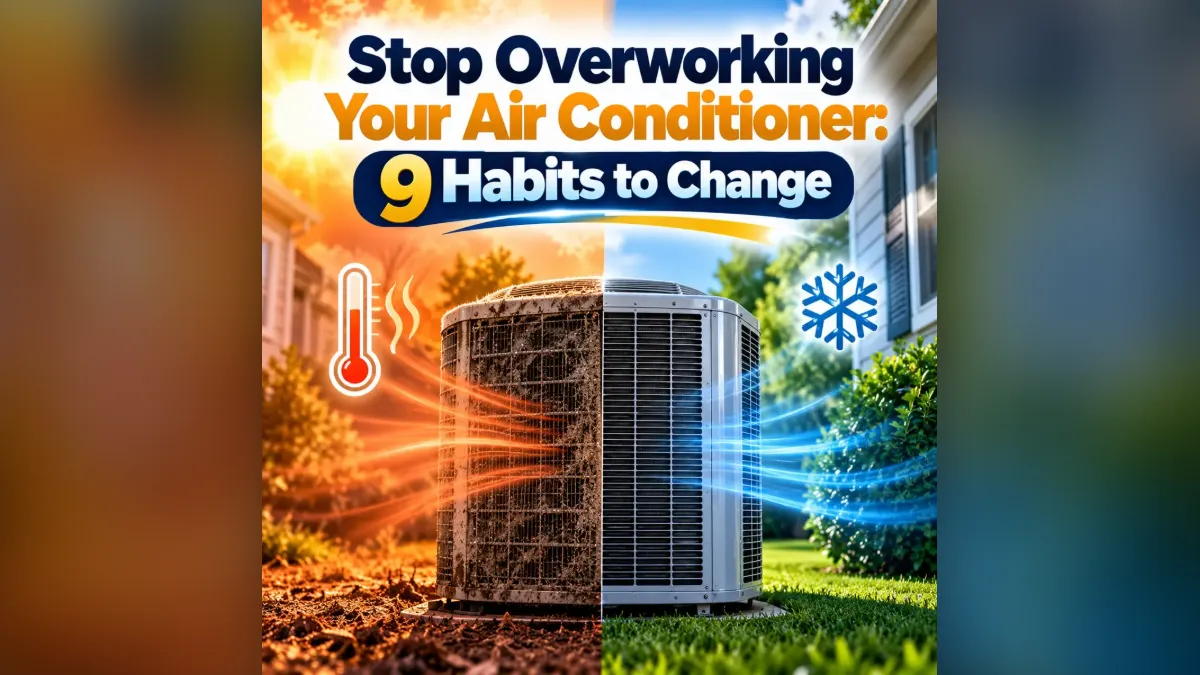
Stop Overworking Your Air Conditioner: 9 Habits to Change
Most
of the air conditioners we replace did not fail early because of a defect. They
failed early because they ran far more hours than they needed to, for years,
and nobody knew that was happening.
Some
of that is equipment condition, which we covered separately in our guide to
high electric bills. This article is about the other half: the habits.
Nine of them below. Seven are simply things people have never been told. Two are things people do specifically believing they save money, and both actually cost money and shorten equipment life. Those two are the reason this article is worth your time.
What "Overworking" Actually Means
Worth
defining, because it is not about how cold you keep the house.
Two
things wear out an air conditioner: run hours and starts.
Run
hours are straightforward. Every hour the compressor runs is wear, and it is
electricity. A system running 2,100 hours a season ages faster than the
identical system running 1,400 hours.
Starts
matter more than people realize. A motor draws its heaviest current at startup
several times its running draw, for a fraction of a second. That surge is
mechanically and electrically hard on the compressor. A system that cycles on
and off constantly accumulates wear faster than one running longer, steadier
cycles, even if the total run time is similar.
So the goal is not "run the AC less." It is longer, fewer, steadier cycles, which also happens to be what removes humidity properly and what costs least to run. Every habit below either extends run hours unnecessarily or multiplies starts.
Nine Habits, Two of Which Feel Like Saving Money
1. Cranking the thermostat down to cool the house faster
You
come home to a hot house and set the thermostat to 65, planning to bring it
back up once it cools down.
Here
is what most people do not know: your air conditioner has one speed. On a
standard single-stage system, the compressor is either on at 100% or off. There
is no faster. Setting 65 instead of 74 does not make the house cool any quicker
it produces exactly the same cooling rate.
What
it does is remove the stopping point. The system reaches 74, keeps going
because you asked for 65, and runs past the temperature you actually wanted. If
you forget to raise it, and people forget, it runs for hours more than
needed.
Variable-speed
equipment behaves differently, ramping capacity up and down, but even there the
lower setpoint mainly buys you longer run time rather than faster cooling.
What
to do instead: set the temperature you actually want and leave it. If the house
is hot when you arrive, it will take the time it takes either way.
2. Closing vents in rooms you do not use
This
is the other one people do believing it saves money, and it is the most
actively harmful habit on the list.
The
logic feels airtight: stop cooling the guest room, save the energy that would
have gone there. It does not work that way.
Your
blower is sized to move a specific volume of air against a specific resistance.
Close several vents and that air has nowhere to go. Static pressure rises
across the whole system, and several things follow:
•
Airflow across the evaporator coil drops, so the coil
runs colder than designed and can freeze
•
The blower motor works harder against higher
resistance, drawing more current, not less
•
Duct leakage increases, because higher pressure pushes
more air out through every gap, and if your ducts run through an attic, that
loss is total
•
The rooms still open get uneven airflow, so you end up
adjusting the thermostat to compensate
•
Closed-off rooms get humid, and in a Long Island summer
a closed unconditioned room can develop a moisture problem
The
energy you thought you saved is spent on a harder-working blower and a less
efficient system, and you have added a freeze risk.
What
to do instead: leave vents open. If you genuinely want to condition rooms
differently, that is what zoning or a ductless mini split does, properly, with
the system designed for it. Closing registers is not a poor man's zoning
system; it is a way to damage equipment.
One
narrow exception: closing one register slightly to balance a room that runs too
cold is fine. Shutting off multiple rooms is not.
3. Leaving the fan on ON instead of AUTO
Check
your thermostat. If the fan is set to ON, the blower runs twenty-four hours a
day whether or not the system is cooling.
That
is a motor running continuously, which is a direct and constant energy cost.
Worse, it works against you: when the compressor shuts off, the evaporator coil
is still wet with condensation it just collected, and the blower pushes house
air across that wet coil, re-evaporating the moisture back into your home.
You
paid to remove that water and then handed it back.
What
to do instead: AUTO. If you switched to ON to even out temperatures between
rooms, the real fix is addressing the airflow imbalance, not running the blower
all summer.
4. Chasing comfort with temperature when the problem is humidity
This
is the most expensive habit on the list, and it is not really a habit, it is a
reasonable response to a problem people have misdiagnosed.
At
65% indoor humidity, 74 degrees feels like 78. So you drop the thermostat to
70, then 68, chasing a comfort that temperature cannot deliver because the
problem was never temperature.
It
gets worse. Lower setpoints produce shorter, more frequent cycles, and short
cycles remove less humidity. So the thing you did to feel more comfortable
makes the humidity worse, which makes you drop the setpoint again.
What to do instead: buy a $15 hygrometer and find out what your actual humidity is. Target 45–55%. If you are above 60%, fix that and you will likely sit comfortably at 74 or 75 instead of 68, which is a substantial reduction in run hours across a Long Island summer.
5. Stretching the filter an extra month
Everyone knows to change the filter. Fewer people know what happens when they do not, or that the wrong filter causes the same problem as a dirty one.
A
restricted filter reduces airflow across the coil. Less airflow means the coil
runs colder, capacity drops, cycles lengthen, and in the worst case the coil
freezes, which then produces a puddle when it thaws. That is one of the most
common causes of water leaking around an indoor unit.
The
less obvious version: a high-MERV filter installed on a system not designed for
it. A dense filter chosen for allergy reasons can restrict airflow on a system
with marginal return ductwork, producing the same symptoms as a dirty one even
when brand new.
What
to do instead: change it monthly during heavy use. Hold it up to a light, if
light does not pass through, replace it. And if you want better filtration, ask
a technician whether your system's static pressure can handle the filter you
have in mind before buying a case of them.
6. Crowding the outdoor unit
The
outdoor condenser's entire job is rejecting your house's heat into the outside
air. It needs to breathe to do that.
Common
on Long Island's tighter lots: privacy fencing built too close, shrubs grown in
around it, a deck constructed over it, trash cans and bikes stacked against it,
a dryer vent discharging into it, and lawn crews blowing clippings into the
fins every week.
Restrict
that airflow and head pressure rises. The compressor works harder against more
resistance, draws more current, runs hotter, and runs longer for the same
result.
What
to do instead: two feet of clearance on all sides, five feet of open space
above, nothing stacked against it, and a freshwater rinse of the coil each
season, twice if you are near the water, where salt is corroding the fins
continuously.
7. Fighting the sun instead of blocking it
Solar
gain through windows is one of the largest cooling loads in a house, and it is
the one homeowners have the most direct control over.
West-facing
windows are the problem on Long Island. They take direct sun through the
hottest part of the afternoon, exactly when your system is already working
hardest and electricity demand peaks.
Every
watt of sunlight coming through that glass is heat your air conditioner has to
remove.
What
to do instead: close blinds or curtains on sun-facing windows during the day,
particularly west-facing ones from early afternoon. Cellular shades and
exterior awnings do more. This is free and it is one of the highest-impact
things on the list.
8. Generating heat at the worst time of day
Your
house does not only gain heat from outside. Ovens, dryers, dishwashers, and
even lighting all add heat your air conditioner then removes.
Doing
all of it between 3pm and 7pm means adding heat at the moment your system
already has the least margin, on the hottest part of the hottest days.
What
to do instead: shift the oven, dryer, and dishwasher to evening or early
morning where you can. Use the microwave, grill, or air fryer on very hot days.
Run the kitchen exhaust when cooking so the heat and humidity leave rather than
getting circulated.
One
correction to a related habit: run bathroom and kitchen exhaust fans during and
shortly after use, then turn them off. Leaving them running for hours pulls
conditioned air out of the house and draws humid outdoor air in through every
gap.
9. Skipping the annual visit
Every
habit above is about not making the system work harder than necessary.
Maintenance is about the system not being already compromised before you start.
Dirty
coils, low refrigerant, a weak capacitor, an incorrect blower speed, and a
partially clogged condensate drain all extend run time or multiply starts. None
of them announce themselves. They just quietly add hours.
It
is also the difference between catching a failing capacitor in May and losing a
compressor in August. A maintenance plan handles the timing so it does not
depend on remembering.
Changed the
habits and the system still runs constantly? Then it is the equipment, not the
behavior, and that is measurable. Book a tune-up or call (631) 414-7141.
The Short Version, in One Table
|
Habit |
What it actually does |
Do this instead |
|
Setting 65 to cool faster |
No faster, removes the stopping point, so it
runs past what you wanted |
Set the temperature you want and leave it |
|
Closing vents in unused rooms |
Raises static pressure, strains the blower, risks
freezing the coil, increases duct loss |
Leave vents open; use zoning or ductless for
real separation |
|
Fan on ON |
Blower runs 24/7 and re-evaporates moisture
back into the house |
AUTO |
|
Dropping the setpoint for comfort |
More run hours, shorter cycles, worse
dehumidification |
Measure humidity; target 45–55% and hold a
higher temperature |
|
Old or over-restrictive filter |
Reduced airflow, longer cycles, possible frozen
coil and water leak |
Change monthly in heavy use; check filter type
against your system |
|
Crowded outdoor unit |
Higher head pressure, more current, longer run
times |
Two feet clear all sides, rinse the coil
seasonally |
|
Blinds open on west windows |
Direct solar gain at peak load |
Close blinds on sun-facing windows in the
afternoon |
|
Oven and dryer at 4pm |
Adds internal heat at peak demand |
Shift to evening or early morning |
|
No annual maintenance |
Compromised system works harder from the start |
Annual cooling inspection |
What Actually Helps That Nobody Mentions
Four
things that make a real difference and rarely appear on tip lists.
Use
ceiling fans correctly. Moving air makes you feel several degrees cooler at the
same temperature, which means you can hold a higher setpoint. Counterclockwise
in summer, and turn them off when you leave the room, a fan cools people, not
rooms.
Raise
the setpoint rather than lowering it, if humidity is handled. Longer, steadier
cycles cost less and dehumidify better than short frequent ones. Once your
humidity is under control, 75 often feels better than 70 did before.
Moderate
your setback, do not eliminate it. Setting the thermostat back while you are
out does save energy. But an extreme setback in a humid climate means the
system has to remove both heat and a full latent load when you return, which
can take hours. A moderate setback of three to five degrees usually works
better here than ten.
Check your attic insulation. Not HVAC work, and frequently a bigger win than anything on this page. A 130-degree attic above marginal insulation loads your whole second floor all afternoon.
What Does Not Help (Despite What You Read)
Shading
the outdoor unit to make it more efficient. The gain is negligible, and the
shrubs or structure people build to do it usually restrict airflow, which costs
more than the shade saves. Clearance beats shade.
Turning
the system completely off while you are out on a very hot day. In a humid
climate the house absorbs a large latent load while the system is off, and
recovering it takes longer than the off period saved. Setback, not shutdown.
Covering
vents with magnetic covers. Same problem as closing them, plus a false sense
that it is different.
Refrigerant
"top-offs" as seasonal maintenance. Refrigerant is not consumed. If
you are low, you have a leak, and adding more each year without finding it is
paying repeatedly for the same problem.
When the Habits Are Not the Problem
If
you have worked through all nine and the system still runs almost constantly,
the behaviour is not the issue.
Time
a cooling cycle on a hot afternoon. Fifteen to twenty minutes or longer is
healthy. Seven to ten minutes repeatedly points to an oversized system.
Continuous running without reaching set point points to low refrigerant, dirty
coils, duct losses, or equipment that has simply aged past its capability.
And
sometimes the honest answer is age. A unit installed in 2008 at 13 SEER, after
fifteen years of wear, cannot be made to perform like current equipment by
changing habits.
Give Your System a Lighter Season
None of this is about being uncomfortable to save money. It is the opposite, most of these changes make the house feel better, because longer steadier cycles remove humidity properly and even out temperatures.
If
you only do three things: set the fan to AUTO, open every vent, and measure
your indoor humidity. Those three cost fifteen dollars total and they address
the largest items on the list.
K2
Cooling and Heating has served Long Island since 2002. Our cooling inspection
measures airflow, static pressure, refrigerant charge, and humidity performance
which tells you whether your system is working hard because of habits or
because of its condition.
Call
(631) 414-7141 or contact our team. We serve Deer Park, Babylon, West Babylon,
North Babylon, Dix Hills, Huntington, Farmingdale, Massapequa, and the
surrounding Suffolk and Nassau communities.
Bills
higher than the habits explain? Our guide on the hidden problem behind high
electric bills covers the equipment side, and a maintenance plan keeps the
condition side from drifting.
Need a technician rather than a guide? See our AC repair service, or read about HVAC repair in Deer Park, NY. K2 answers 24/7 at (631) 414-7141.