Written by the service team at K2 Cooling & Heating in Deer Park, NY: licensed and insured HVAC contractors serving Suffolk and Nassau County, rated 4.8 across 354 Google reviews.
The thermostat says 72. The air coming out of the vents is cold. And yet the house feels like the inside of a gym bag. Your skin does not dry after a shower, the bedsheets feel damp, and the whole place smells faintly like a basement.
This is one of the most common complaints we hear in August and September on Long Island, and it is also the one homeowners most often misdiagnose. They assume the air conditioner is underperforming and turn the thermostat down further, which usually makes the problem worse.
The house is not too warm. It is too wet. And those are two different problems with two different fixes.
This guide explains why an air conditioner that cools perfectly well can still leave you with a house humid with the AC on, covers the eight real causes, and tells you which ones cost nothing to fix.
Your Air Conditioner Has Two Jobs. Your Thermostat Only Measures One
An air conditioner removes two kinds of heat from your home.
Sensible heat is temperature. It is what a thermometer reads and what your thermostat responds to.
Latent heat is moisture. When humid air passes across the cold evaporator coil, water vapor condenses on the fins and drains away through the condensate line. That is the puddle-free version of the water dripping outside your car's AC.
Here is the part that explains almost everything below: condensation takes time. The coil has to get cold, stay cold, and keep running long enough for moisture to collect on it and drain off. A system that cools your house quickly and shuts off has removed the temperature but left the water behind.
Your thermostat cannot tell the difference. It sees 72 degrees, decides its job is done, and stops. Meanwhile you are standing in 72-degree air at 65% relative humidity, which feels roughly like 78.
That gap between what the thermostat reads and what your body feels is the entire subject of this article.
What Indoor Humidity Should Actually Be
Target range for a comfortable Long Island home in summer: 45% to 55% relative humidity.
- Below 40%dry. Uncommon here in summer, normal in winter.
- 45–55%the comfort zone. Air feels neutral, and 74 degrees at 50% humidity feels better than 70 at 65%.
- 55–60%noticeably muggy. You will feel it but may not name it.
- Above 60%the sticky zone. Dust mites thrive, condensation appears on windows and toilet tanks, and the musty smell starts.
- Above 65%mold territory. This is no longer a comfort issue.
Long Island makes this harder than most of the country. Our August dew points regularly sit in the low 70s, and coastal proximity means the outdoor air your house exchanges with is already saturated. A system that would keep a house in Denver at 45% can sit at 60% here doing the same work.
Before you diagnose anything, buy a hygrometer. They cost about fifteen dollars, and without one you are guessing.
8 Reasons Your House Is Humid With the AC On
1. Your air conditioner is too big for your house
This is the single most common cause, and it is completely counterintuitive. An oversized air conditioner makes humidity worse, not better.
Here is the mechanism. An oversized system blasts the house down to setpoint in eight or ten minutes and shuts off. In that short run, the coil barely got cold enough to start condensing, and almost no water drained away. Then the system sits idle while humidity creeps back up, kicks on again, and repeats.
This is called short cycling, and its signature is exactly what you are experiencing: a cold house that feels clammy. A correctly sized system runs longer, steadier cycles, which is what actually pulls moisture out.
Oversizing is rampant on Long Island for a specific reason. When a contractor replaces a 20-year-old system, the fast approach is to match the tonnage of the old unit. But if that unit was oversized in 1998, or if the home has since been insulated, had windows replaced, or had an attic air-sealed, the correct size today is smaller. Nobody wants the callback for a house that will not cool, so the safe move is to round up. That instinct is why so many Long Island homes are cold and damp at the same time.
How to tell: time your cycles on a hot afternoon. A properly sized system should run 15 to 20 minutes or longer per cycle on a design-day afternoon. If yours runs 7 to 10 minutes and shuts off repeatedly, it is oversized.
If the system is also near the end of its life, this becomes part of the repair or replace your AC conversation, because right-sizing at replacement fixes it permanently.
2. Your fan is set to ON instead of AUTO
This one is free to fix, takes four seconds, and solves more sticky-house complaints than any other single item on this list.
Look at your thermostat. If the fan setting says ON, the blower runs continuously, even when the compressor is off.
Here is why that creates humidity. When the compressor shuts off, the evaporator coil is still wet with the condensation it just collected. That water needs a few minutes to drain into the pan and out the line. If the blower keeps running, it blows house air across that wet coil and re-evaporates the moisture straight back into your home.
You spent electricity pulling water out of the air, then handed it right back.
The fix: set the fan to AUTO. The blower then runs only during cooling cycles and stops shortly after, letting the coil drain properly. Do it now and give it a day.
People switch to ON for a legitimate reason, more even temperatures between rooms. If that is why you did it, the right answer is fixing the airflow imbalance, not running the fan continuously through a humid Long Island summer.
3. Your ducts run through a hot, humid attic
Very common in Long Island ranches, Capes, and split-levels where ductwork was run through the attic rather than a basement.
On an August afternoon, a Long Island attic hits 130 degrees with humidity to match. Your ducts sit in that. Two things go wrong.
Return-side leaks are the serious one. Any gap in the return ductwork pulls superheated, saturated attic air directly into your system. You are actively air conditioning your attic, and every cycle imports a fresh load of moisture. A return leak can single-handedly defeat an otherwise healthy system.
Supply-side leaks waste the cooled air you paid for and depressurize the house slightly, which pulls humid outdoor air in through every gap in the building envelope.
How to tell: attic ducts that feel warm on the outside while the system runs, visible disconnected sections, crushed flex duct, or insulation that has fallen away. Rooms that never cool properly are another sign. If your AC is running but the house feels damp and your ducts are in the attic, this is high on the list.
4. The evaporator coil or filter is dirty
A dirty coil cannot condense moisture efficiently, because a layer of dust and biological film insulates the fins from the air passing over them.
A clogged filter restricts airflow, which reduces the system's total capacity and, in bad cases, causes the coil to freeze. A frozen coil does not dehumidify at all, it just blocks airflow while ice builds up, and then dumps water when it thaws.
There is also a drainage version of this problem. If the condensate pan is dirty or the drain line is partially clogged with algae, water sits in the pan instead of draining. That standing water evaporates back into your airstream, and it produces the specific musty smell people describe as "dirty sock."
How to tell: check the filter first. Then look for standing water in the drain pan or slow drainage at the condensate line. Coil cleaning is part of a standard maintenance plan visit and is not a DIY job, the fins bend if you look at them wrong.
5. The system is low on refrigerant
An undercharged system runs a warmer coil than it should. A warmer coil condenses less moisture, and the system runs longer without ever satisfying the thermostat.
The important point: refrigerant is not consumed. A sealed system does not use it up. If you are low, you have a leak, and adding refrigerant without finding that leak means paying for the same service again next summer at a higher price, since R-410A supply continues to tighten under the federal phasedown.
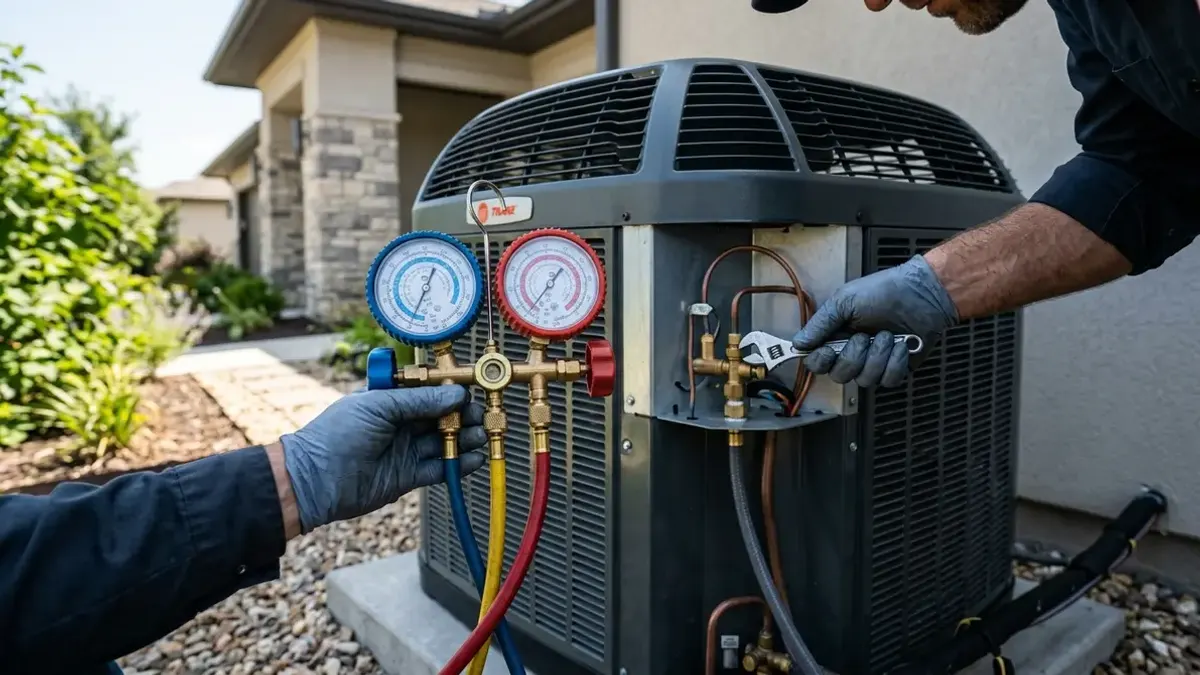
How to tell: ice on the refrigerant lines or the coil, a hissing or bubbling sound, longer run times with poor cooling, or an oily residue at any connection. This one needs an AC repair visit, refrigerant work is legally restricted to certified technicians.
6. Moisture is coming up from the basement or crawlspace
Your air conditioner is fighting a losing battle if the house has an internal water source.
A significant share of Long Island homes have unfinished basements or vented crawlspaces sitting on damp soil. Water vapor moves up through concrete, in through foundation walls, and through the rim joist. Because warm air rises, that moisture distributes through the whole house.
Crawlspaces are worse than basements. A vented crawlspace in August is drawing in outdoor air at a 72-degree dew point, which then condenses on every cool surface underneath your floor.
How to tell: put a hygrometer in the basement or crawlspace and compare it to upstairs. If the basement reads significantly higher, or if you see efflorescence on the walls, musty smells, or condensation on cold-water pipes, you have found a moisture source your AC was never designed to handle.
The fix here is not HVAC. It is a dedicated basement dehumidifier with a drain line, sealing the rim joist, and in a crawlspace, encapsulation.
7. Exhaust fans are missing, weak, or vented indoors
Everyday household activity generates a surprising amount of water. Showers, cooking, dishwashers, and laundry all release moisture, and a family of four can put well over a gallon of water into the air per day.
Common failures we find in older Long Island homes:
- Bathroom fans that vent into the attic instead of outside, which creates an attic moisture problem on top of a house one
- Fans too weak to move meaningful air, or so noisy nobody turns them on
- Range hoods that recirculate through a charcoal filter instead of venting outdoors
- Dryers venting indoors, or with a disconnected or crushed duct
How to tell: run the bathroom fan and hold a square of tissue against the grille. If it does not hold, the fan is not moving enough air. Then go into the attic and confirm the duct actually terminates at a roof or gable vent rather than just ending in the insulation.
Run bathroom fans for twenty minutes after a shower, not two.
8. You are setting the thermostat lower to compensate
This is the natural response, and it usually backfires.
Dropping from 74 to 68 makes the system reach setpoint faster, which produces shorter cycles, which means less dehumidification. You get a colder, still-damp house and a much larger PSEG bill. In extreme cases, the coil runs cold enough to frost over, and then it stops dehumidifying entirely.
The counterintuitive move that actually works: raise the setpoint slightly and let the system run longer. A house at 74 and 48% humidity feels better than one at 69 and 62%. Longer, steadier cycles are what remove water.
How to Measure It Before You Spend Anything
Fifteen minutes of measuring will narrow this down more than any amount of guessing. Do these four things.
- Buy a hygrometer and place it in your main living area, away from vents and exterior doors. Read it at the hottest part of the afternoon. Note the number.
- Time a cooling cycle. Sit with a timer on a hot afternoon and record how long the system runs before shutting off, and how long it stays off. Under 10 minutes of run time points to oversizing.
- Check the fan setting. ON or AUTO. Write it down.
- Put a second hygrometer in the basement or crawlspace and compare after a few hours.
Those four data points, given to a technician on the phone, will tell them more than any description of how the house feels. Bring the numbers to the conversation.
What Actually Fixes It
The free fixes
- Set the fan to AUTO
- Raise the thermostat one or two degrees and let cycles run longer
- Run bathroom exhaust fans for a full twenty minutes after showering
- Use the range hood every time you cook, and confirm it vents outside
- Change the air filter
- Keep windows closed on humid days, opening them on a 72-degree dew point morning imports far more moisture than it removes
The service fixes
- Coil cleaning and condensate drain clearing. Standard maintenance work, immediate effect if the pan holds water.
- Duct sealing, particularly on the return side in attics. Often the highest-impact repair on this list.
- Leak detection and proper refrigerant charge, if the system is undercharged.
- Blower speed adjustment. Many systems are set faster than ideal for a humid climate. Slowing the blower slightly increases moisture removal, and it is often a settings change rather than a parts change.
- Thermostat with humidity control, which can extend run times specifically to hit a humidity target rather than only a temperature one.
The equipment fixes
- A whole-house dehumidifier ducted into the system. This is the definitive answer for Long Island homes that stay damp despite everything else being right. It works independently of cooling, so it handles the mild, humid days in June and September when the AC barely runs at all, which are the worst days of the year for indoor humidity.
- Two-stage or variable-speed equipment at replacement time. A variable-speed system runs long, low cycles instead of short, hard ones, and dehumidifies dramatically better. If you are replacing anyway, this is the upgrade that matters most in our climate.
- Right-sizing at replacement, based on an actual Manual J load calculation rather than matching the old unit's tonnage.
- Crawlspace encapsulation or a basement dehumidifier, if that is where the moisture originates.
Financing is available if the answer turns out to be equipment rather than a settings change.
Why This Matters Beyond Comfort
Sustained indoor humidity above 60% is not just unpleasant.
- Mold and mildew grow on drywall, in closets, behind furniture on exterior walls, and inside ductwork
- Dust mites multiply rapidly above 60% RH, and they are one of the most common household allergy triggers
- Wood damageflooring cups, doors stick, cabinetry and trim swell
- Higher bills, because you are running the system harder and longer to chase a comfort level that temperature alone cannot deliver
- Musty odor absorbs into fabric and stays there
Solving humidity often means you can sit comfortably at 74 or 75 rather than 69, which is a meaningful reduction in cooling cost across a Long Island summer.
When the Condensate Drain Backs Up
On a humid Long Island day, the condensate line carries water out of your system almost every minute the AC runs. That steady flow is also why the line clogs. Algae and sludge build up inside the pipe, the water slows, and eventually it backs up into the drain pan.
Where that water goes depends on where your equipment sits:
- Basement air handler: a puddle around the base of the unit or a damp floor nearby.
- Attic or closet air handler: a stain on the ceiling or wall below. In Capes and ranches with attic equipment, this is often the first sign anyone notices.
- System with a safety float switch: the AC simply shuts off on a hot afternoon even though the thermostat is still calling for cooling. The switch is doing its job.
If you see any of these, turn the cooling off and check the pan before running it again. Equipment above finished space should have a secondary pan or a float switch. If yours has neither, ask about it at your next visit. Clearing and flushing the line is part of a standard maintenance visit.
Get an Honest Answer About Your System
Start with the free fixes. Set the fan to AUTO, put a hygrometer in the living room, and time a cooling cycle on the next hot afternoon. Those three steps cost fifteen dollars and identify the cause in a large share of cases.
If the numbers point to short cycling, duct leakage, or a system that cannot keep up, that is where we come in. We will measure rather than guess, and if the honest answer is a settings change instead of new equipment, that is what we will tell you.
K2 Cooling & Heating serves homes within about 15 miles of Deer Park. On a humidity visit we measure indoor humidity, cycle times, airflow and duct performance, and explain what we found before recommending anything.
Call (631) 414-7141, or contact our team. We serve Deer Park, Babylon, West Babylon, North Babylon, Dix Hills, Huntington, Farmingdale, Massapequa, and the surrounding Suffolk and Nassau communities, see our service areas for full coverage.
Heading into fall? Once the humidity is handled, work through our AC winterizing checklist before the first freeze, and consider a maintenance plan so the coil and drain are cleaned before next summer rather than during it.
Need a technician rather than a guide? See our AC repair service, or read about HVAC repair in Deer Park, NY. K2 answers 24/7 at (631) 414-7141.