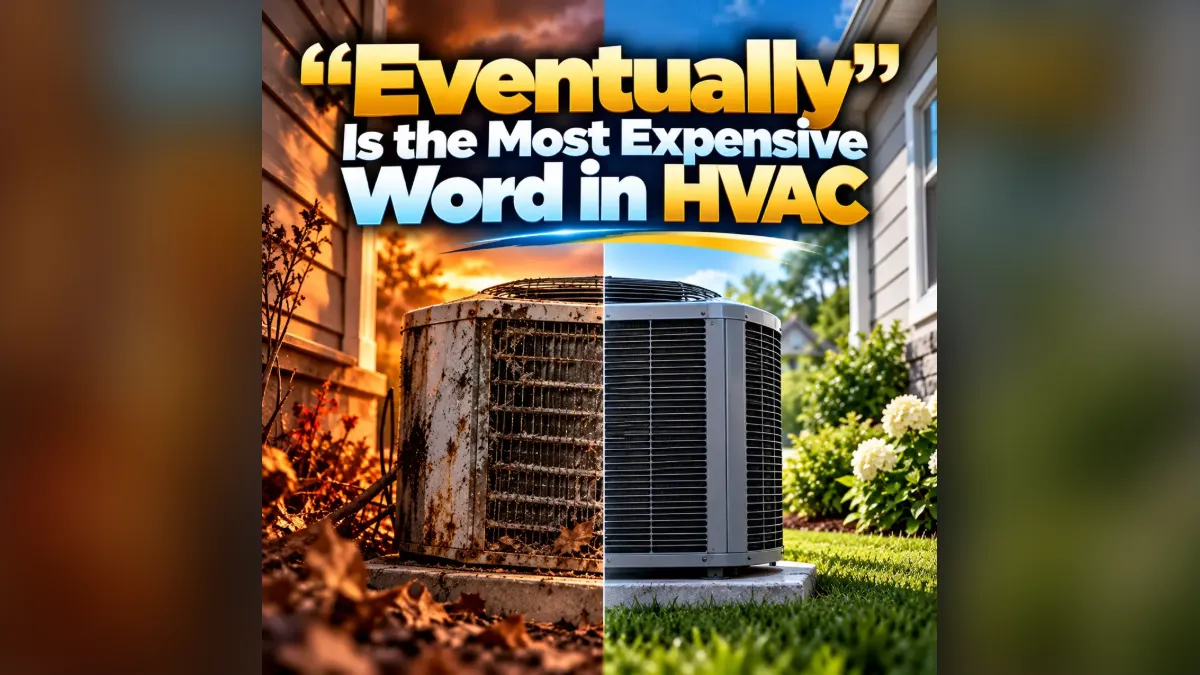
"Eventually" Is the Most Expensive Word in HVAC
"I'll
get to it eventually."
We
hear it about a noise that started in July, a room that has never cooled
properly, a filter that has not been changed since spring, a tune-up that got
skipped two years running. And it is a completely reasonable thing to say,
because nothing is broken yet and there is always something more urgent.
The
problem is that HVAC does not wait politely. Delay costs money in two specific,
separate ways, and understanding both is what lets you decide whether to fix
something now or waitrather than guessing.
This
article also does something most HVAC articles will not: it names the things
where waiting is genuinely fine. Not everything is urgent, and a contractor who
tells you it is should be treated with suspicion.
Delay Costs You Two Different Ways
Escalation.
The fault itself gets worse, or takes something else with it. A $200 part
becomes a $2,000 part because it was left running.
Timing.
The exact same repair costs more when it happens on a Sunday night in January
than on a Tuesday morning in October. Nothing about the fault changed, only
when you found it.
Most people think about the first and ignore the second. The second is usually the larger number.
Way One: Small Faults Become Big Faults
The escalation ledger
These
are real chains, and every one of them is common. Costs are rough Suffolk and
Nassau ranges, not quotes.
|
What it is now |
What it becomes |
Cost then vs. later |
|
Weak capacitor |
Compressor struggling on every start, then
failing |
Small part vs. four figures, often a full
replacement |
|
Dirty filter |
Frozen coil, water damage, liquid refrigerant
reaching the compressor |
$15 vs. a repair plus possible ceiling work |
|
Clogged condensate drain |
Overflowing pan, ruined ceiling below an attic
unit |
A cleaning vs. drywall, insulation, and paint |
|
Small refrigerant leak |
Low charge all season, overheated compressor,
rising R-410A prices |
Leak repair vs. compressor or system |
|
Dirty coils |
Years of raised head pressure and higher
bills, shortened compressor life |
A cleaning vs. equipment life you cannot get
back |
|
Dirty flame sensor |
No heat on the coldest night, at emergency
rates |
A cleaning vs. an after-hours call |
|
Cracked heat exchanger |
A safety problem that ends the system, not a
repair |
Detection at inspection vs. a forced winter
replacement |
|
Leaking attic ducts |
Every summer bill, every winter bill,
indefinitely |
Sealing once vs. paying forever |
The
pattern across all of them: the expensive component almost never fails
first. It fails because something cheap failed and was left in service.
That is the whole argument in our guide on why
maintenance saves thousands.
Why HVAC compounds when other things don't
A
leaky faucet drips at the same rate in March as it does in September. HVAC is
not like that, for three reasons.
It
is a connected system. Airflow, refrigerant, and electrical all depend on
each other. Restrict one and you stress the others. A filter problem becomes a
coil problem becomes a compressor problem, and none of those steps are optional
once the first one is in place.
It
runs on a duty cycle. A fault does not wait; it repeats. A weak capacitor
makes a hard start every single cycle, several times an hour, all season.
Damage accumulates by the thousand.
It
carries water and combustion. Condensate becomes property damage. A condensate clog over a finished ceiling turns
a cleaning into a construction job. On the heating side, a combustion fault is
a safety issue rather than a cost issue.
Way Two: The Same Repair Costs More Later
This
is the part people underestimate, and it has nothing to do with the equipment.
•
Emergency and after-hours rates. Every company
on the Island, ours included, prices a 9pm January call differently from a
Tuesday morning. A technician is leaving his home at night.
•
Parts availability. In September, common parts
sit on supply house shelves. After the first regional cold snap, they go out of
stock and a one-day repair becomes a week, a week without heat.
•
No time to compare. Three quotes take a week you
do not have when the house is 55 degrees.
•
No time for rebates or financing. Incentive
paperwork and financing approvals take days. In a crisis you pay cash or
whatever is fastest.
•
No time for a load calculation. Correct sizing
requires measurement. Under pressure, contractors match the old tonnage, locking in whatever sizing error already existed.
• Install backlog. In peak season the wait for installation is longest exactly when you least want to wait.
None of that is about the part. It is the premium you pay for having no options.
Something on your list you have been meaning to get to? A scheduled visit costs less than the same visit in January. Book a visit or call (631) 414-7141.
The Worst Version: Buying a System in a Crisis
The most expensive "eventually" is not a repair at all. It is the system that has been declining for three summers and finally quits in August, so a five-figure decision gets made in two days, in a hot house. Our guide to emergency vs. planned replacement covers what you lose in a crisis and how to see it coming.
When the Cheap Fix Is the Expensive One
The other way "eventually" costs money is the repair that treats the symptom and leaves the cause. It looks cheaper on the day and costs more by the end of the season. The common versions:
- Replacing the same capacitor every summer. A capacitor that keeps failing is a sign of something else, such as high heat at the outdoor unit, a weak condenser fan motor or a loose connection. Left alone, the cause eventually takes out the compressor.
- Adding refrigerant instead of finding the leak. A sealed system does not use refrigerant up. Topping it off every year is paying for the same leak again, at a rising price, while the compressor runs short of charge.
- Stop-leak sealant in the refrigerant circuit. These products can clog metering devices and contaminate recovery equipment, and many manufacturers treat them as grounds to deny a warranty claim.
- Ignoring a new noise. Squealing, grinding or buzzing usually starts as a bearing, belt or electrical part. Left running, it becomes a motor or a blower assembly.
- Choosing the visit that skips the diagnosis. A low price is fine when the scope is the same. When it is low because nobody measured the charge, the airflow or the electrical readings, the repair you paid for may not be the one you needed.
None of these mean the cheapest option is always wrong. They mean the question to ask is "what caused this, and will it happen again?" before you approve the repair.
When "Eventually" Is Genuinely Fine
Now
the other side, because a contractor who tells you everything is urgent is
selling fear.
These
can wait:
•
Cosmetic rust on a cabinet or pad that is not
flaking through
•
A one or two degree difference between rooms, if
it has always been that way and nobody is uncomfortable
•
Slightly noisy ductworkexpansion ticks and
airflow noise that have never changed
•
A 14-year-old system running well, with no
repairs and no efficiency complaints. Plan for replacement; do not panic into
it.
•
Cosmetic insulation wear on a line set that is
intact
•
A thermostat you find annoying but that controls
the system correctly
These
cannot wait, and the reason is safety rather than money:
•
Any gas smell, leave the house and call from outside
•
A carbon monoxide alarm
•
Burning plastic or electrical smells
•
Water reaching electrical components
•
A breaker that trips repeatedly
•
Ice on the system, because running it frozen risks the
compressor
Everything
in between is a scheduling question, not an emergency. Which is the actual
point of this article: most things are neither ignore-forever nor fix-tonight.
They are "pick a month."
The 20-Minute Audit
Walk
through this once and you will know what is on your list.
1.
Pull the filter and hold it to a light. If light
does not pass, replace it now.
2.
Look at the indoor unit. Any water, any rust
stains, any standing water in the pan.
3.
Check the condensate drain. Is it flowing
outside while the system runs?
4.
Look at the outdoor unit. Two feet of clearance?
Fins matted with debris or visibly dirty?
Any oily residue at the connections?
5.
Time one cooling cycle. Under 10 minutes
repeatedly, or continuous without reaching setpoint, both mean something.
6.
Read your indoor humidity. Above 60% is a
problem worth solving.
7.
Note the equipment age from the data plate.
8.
Write down every noise or complaint you have
been ignoring. The list is usually shorter than it feels.
Anything you found now has a date attached instead of the word eventually.
Turning "Eventually" Into a Date
The
fix for this whole problem is a calendar, not more urgency.
|
Month |
What to handle |
|
March–April |
Cooling inspection, coil cleaning, condensate
drain, filter. Best window for a planned replacement, open schedules,
off-peak pricing, time for quotes and incentives. |
|
May–August |
Monthly filter checks. Repairs only. Not the
season to make a replacement decision. |
|
September–October |
Heating inspection before the first cold night.
Address anything the summer revealed. Second-best replacement window. |
|
November–February |
Monthly filter checks. Emergency work only. |
Two dates a year, both in shoulder seasons, both chosen rather than forced. Our guide on why September beats November explains the heating side of that timing in detail.
Pick the Month Instead of Letting It Pick You
Almost
nothing in HVAC needs to be fixed tonight. But almost everything gets more
expensive the longer it waits, in ways that have nothing to do with the part
itself.
The
homeowners who spend the least on HVAC are not the ones who ignore problems,
and they are not the ones who panic about every noise. They are the ones who do
the twenty-minute audit, put two dates in the calendar, and handle things in
March and September instead of in August and January.
K2 Cooling & Heating has served Long Island since 2002. We will
tell you what needs attention now, what can wait until spring, and what does
not need doing at all.
Call
(631) 414-7141 or contact our team.
We serve Deer Park, Babylon, West Babylon, North Babylon, Dix Hills,
Huntington, Farmingdale, Massapequa, and the surrounding Suffolk and Nassau
communities.
Need a technician rather than a guide? See our HVAC tune-up service, or read about HVAC repair in Deer Park, NY. K2 answers 24/7 at (631) 414-7141.