On Long Island, gas service can change from one block to the next, so it's easy to guess wrong about your own street. Before you price a gas furnace or boiler, find out whether National Grid can actually serve your house. Here's how to check, what new service involves and what to do if the answer is no.
How do you check if natural gas is available on your street?
Fill out the online form on National Grid's Connect to Natural Gas page. As of October 2026, National Grid says it confirms availability within 1 to 2 business days and checks the distance requirements to your home. A gas main in your street is a good sign, but it isn't the whole answer.
Gas meters on your neighbors' houses tell you a main is nearby. They don't tell you how far the service line has to run to reach your foundation, or whether that run fits National Grid's allowance. The form is free and quick, so start there before you collect any equipment quotes.
What are the steps to get new gas service from National Grid?
As of September 2024, National Grid's Long Island forms list the order: sign the Non-Fossil Alternatives Acknowledgment first, open a customer account at 1-800-930-5003, then send in a Residential Gas Service Agreement signed by both the homeowner and a licensed plumber. National Grid then plans the service line work.
- Sign the Non-Fossil Alternatives Acknowledgment. Questions about it go to 1-877-696-4743.
- Set up your gas customer account at 1-800-930-5003.
- Complete the Residential Gas Service Agreement with your licensed plumber and send it to gaslongislandgrowth@nationalgrid.com or to National Grid at 1650 Islip Ave, Brentwood.
- Pay any contribution National Grid invoices, then wait for the service line.
One instruction on the service agreement form is worth repeating: don't remove your existing heating equipment or cancel your oil until the gas line is installed. A Long Island January with no heat source is not where you want to be.
How long does it take to get a gas line installed?
As of September 2024, National Grid's Long Island forms put a new service at about 10 to 14 weeks. Add about 4 to 6 weeks where the work involves state or county roads. If you want gas heat before winter, start the paperwork in spring or early summer, not in October.
That window is National Grid's, and it's separate from the time your heating contractor needs for the furnace or boiler swap. The two can be planned together, but the new equipment can't run on gas until the line is in and the meter is set.
Will you have to pay for the gas main or service line?
Possibly. As of September 2024, National Grid's service agreement says that if the service line or main needed to reach you runs longer than the tariff allowance, you pay a contribution in aid of construction. National Grid invoices that amount before the work starts, so you'll see the number before anything is dug.
We didn't find the footage allowances published on the form itself, so ask National Grid what your address would need. A house set far back on a deep lot, or at the end of a street the main doesn't reach, is where the run is more likely to go past the allowance.
Does your house have to meet efficiency standards to convert?
Yes. For conversions, National Grid's form includes a Public Service Commission efficiency checklist. As of September 2024 it lists at least 6 inches of attic insulation rated R-19 or better, storm or thermal windows, and storm or thermal doors. Check your attic and windows before you apply, so nothing surprises you later.
On a lot of Long Island Capes and ranches, the attic is the easiest item to check: go up with a tape measure. If the insulation falls short, adding it is usually a straightforward job, and it lowers your heating bill whatever fuel you end up using.
Do you need a chimney liner when switching from oil to gas?
We can't point you to one rule that covers every house. Venting has to be checked when you move from oil to gas, and it often has to change. Your installer and your town building department decide what's required for your home, so settle the venting plan before the work starts.
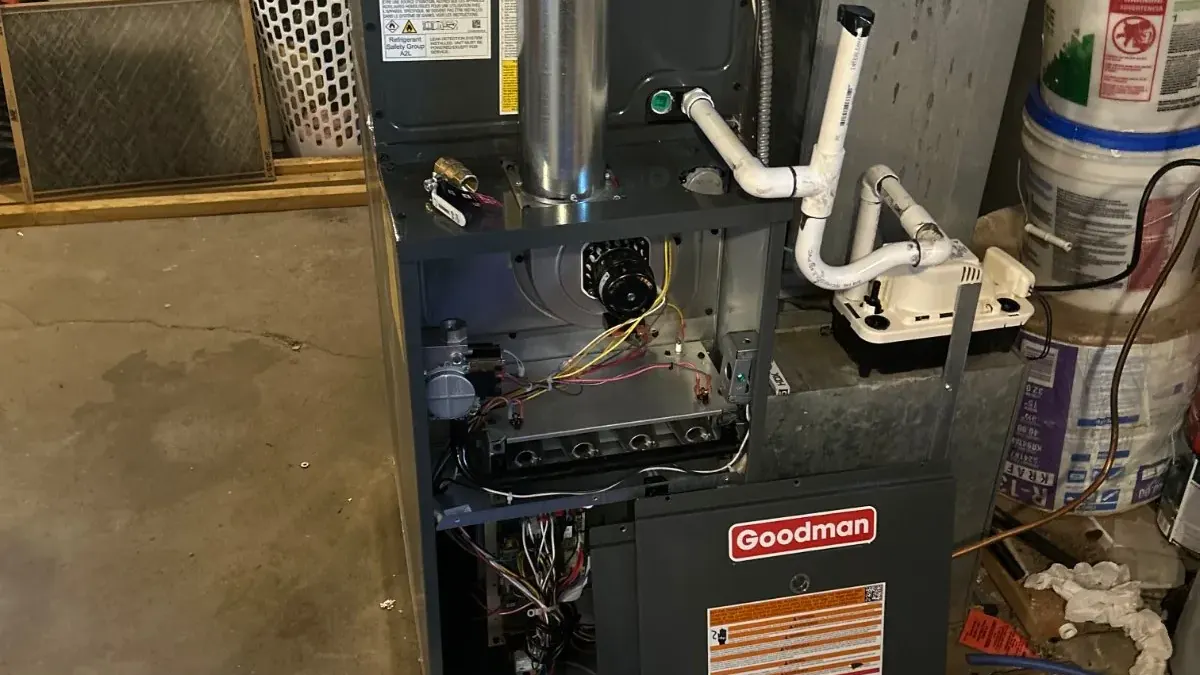
In October 2026 in West Babylon, our crew replaced an oil furnace with a gas furnace, central air and a new water heater. They removed the oil furnace and oil tank, ran the gas line, and connected the flue for the new 80,000 BTU furnace. Some equipment skips the chimney entirely: the direct-vent gas water heater we installed in East Meadow vents through the wall, which suits a basement without a chimney connection. Wall vents need watching, though; in Huntington Station, a snack bag blocking the vent shut a brand-new water heater down.
K2 doesn't file town permits. Ask your town building department what it requires for the conversion and who files it.
Tip from Waseem Shahzad, Lead Technician: On the West Babylon job, the first thermostat only ran the cooling, so Waseem went back and replaced it with one that controls both heating and cooling. If you add central air during a gas conversion, test the heat from the thermostat before the crew leaves, not on the first cold night.
Our oil to gas conversion page covers the equipment side, and our furnace and boiler replacement cost guide covers pricing.
What if natural gas isn't available on your street?
Then a heat pump is the usual next step for an oil home. A whole-house heat pump replaces the oil system outright, while a dual-fuel setup pairs a heat pump with a furnace or boiler for the coldest days. Either way, you aren't waiting on a gas main or paying to extend one.
Start with our oil to heat pump conversion and dual-fuel heat pump pages. For a sense of running costs, the EIA's Winter Fuels Outlook (released October 2026) forecasts that Northeast gas-heated homes will use about 55 Mcf from November 2026 through March 2027 for all uses; our oil vs gas vs heat pump calculator turns numbers like that into a yearly cost for your house.
Whatever you decide, keep the oil system healthy until the change is made. If baseboard rooms are running cold in the meantime, our guide to baseboard heat not working walks through the usual causes.
Our recommendation: submit National Grid's availability form before you get equipment quotes, and if the answer is yes, start the paperwork months ahead of the heating season. Keep your oil system running until the gas line is in. If the answer is no, or the main extension cost is high, price a heat pump next.
Want to talk through gas, a heat pump or dual fuel for your house? Call K2 Cooling & Heating at (631) 414-7141. We serve homes within about 15 miles of Deer Park, and we'll look at your current system, your venting and your ductwork before we recommend anything.
Need a technician rather than a guide? See our HVAC tune-up service, or read about HVAC repair in Islip, NY. K2 answers 24/7 at (631) 414-7141.