Thousands of Long Island homes, especially older Capes, ranches and colonials, heat with a hot water boiler and baseboard. It's comfortable, quiet heat, but it has a common complaint: one room or one floor stays cold while the rest of the house is warm. In most cases, the cause is one of three things: air trapped in the pipes, low boiler pressure, or a zone that isn't opening. Here's how to tell which one you have, what you can safely check yourself, and when to call a professional.
How hot water baseboard works
Your boiler heats water and a circulator pump pushes it through copper pipes and finned baseboard in each room, then back to the boiler. Homes with more than one zone (one thermostat per floor or area) use either a separate circulator pump for each zone or zone valves that open when that thermostat calls for heat. When any part of that loop stops moving water, the baseboard downstream stays cold.
Cause 1: Air trapped in the system
Air is the most common reason a single baseboard or the end of a run stays cold, especially at the start of heating season or after any repair that drained water from the system.
Signs: gurgling or "running water" sounds in the baseboard, a baseboard that's warm at one end and cold at the other, or a cold top-floor run.
What you can check: some baseboard has small bleeder valves at the end of the run, under the end cap. With the system running and a cup and rag ready, open the bleeder slowly with a radiator key or screwdriver until water, not air, comes out, then close it.
Many Long Island homes don't have bleeders on each baseboard. They are "series loop" systems that are purged at the boiler using a set of valves and a hose. Purging properly takes knowing which valves to close, and doing it wrong can push more air in or drop pressure too low. If you don't see bleeders, that's a job for a technician.
Cause 2: Low boiler pressure
A hot water boiler needs enough pressure to push water up to the highest baseboard in the house. When pressure drops, top-floor rooms go cold first.
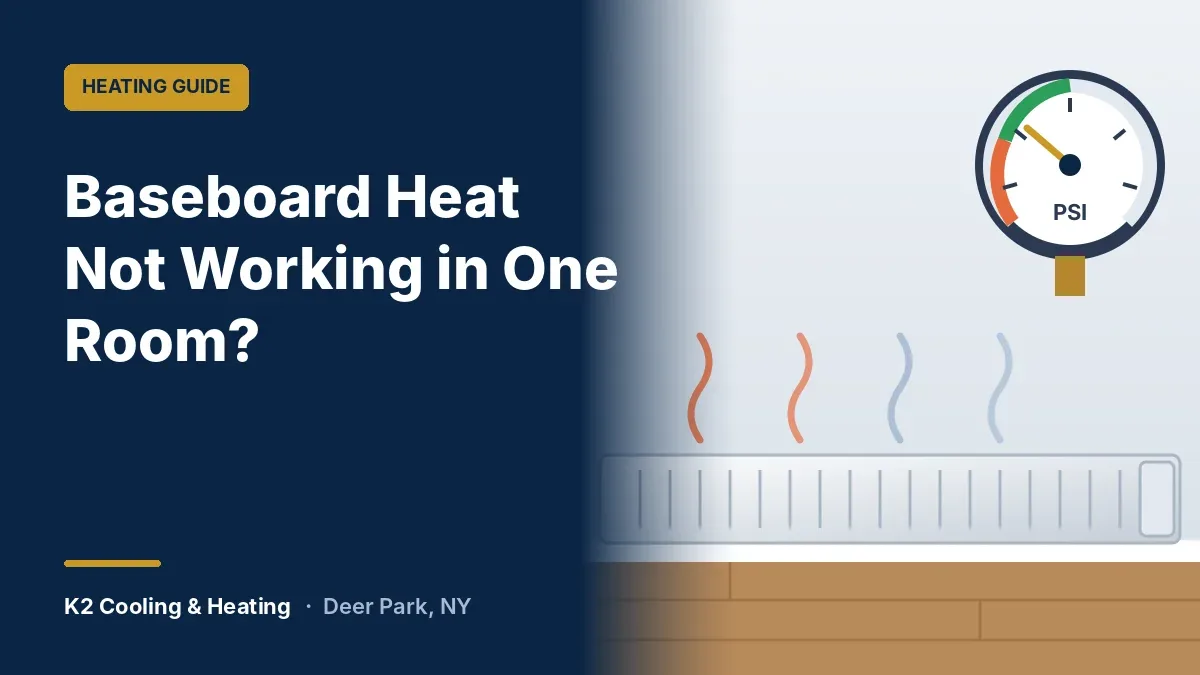
What you can check: find the pressure and temperature gauge on the boiler. In a typical two-story house, cold pressure usually sits around 12 to 15 psi and rises somewhat as the water heats. A reading near zero, or a top floor that's cold while the gauge reads low, points to a pressure problem.
Why pressure drops: a slow leak somewhere in the system, a failed automatic fill valve, or water released by the relief valve. The relief valve is the brass valve with a pipe running down toward the floor, usually rated at 30 psi. If that pipe is dripping or there's water on the floor under it, the boiler may be over-pressurizing. That often points to a failed expansion tank or fill valve and needs a professional.
Don't add water to a boiler or change fill-valve settings unless you know your system. Too much pressure is as much of a problem as too little.
Cause 3: A zone that isn't opening
If an entire floor or area controlled by one thermostat is cold, while the rest of the house heats normally, the problem is usually that zone's control:
- Zone valve: the motor head on a zone valve can fail, leaving the valve closed. Some have a manual lever you can open temporarily; a technician should replace the head.
- Circulator pump: in pump-per-zone systems, a failed pump or its relay stops water moving in that zone. A pump that's hot to the touch but not moving water, or one that hums without running, needs service.
- Thermostat: check the obvious first. Fresh batteries, the right mode (Heat), and a setpoint above room temperature.
Other things that make one room cold
- Furniture, curtains or deep carpet blocking the baseboard. Baseboard needs air to flow under it and up through the fins.
- Bent or dust-packed fins. Gently straighten and vacuum them with the heat off.
- A room over a garage or crawlspace, or with older windows, may simply need more baseboard than it has.
- A dampener or air vane on the baseboard cover may be closed. Open it.
When to call a professional
- No heat anywhere in the house
- Boiler pressure near zero, or water dripping from the relief valve
- Water leaking from the boiler, pipes or baseboard
- Banging, loud gurgling or kettling sounds from the boiler
- A system that needs bleeding more than once a season, which means air or water is getting in somewhere
- Any smell of gas or oil, or a carbon monoxide alarm. Leave the house and call 911 first.
Cold room or no heat? Call K2 Cooling & Heating at (631) 414-7141. Our technicians service hot water and steam boilers across Long Island. Learn about boiler repair.
Need a technician rather than a guide? See our boiler repair service, or read about HVAC repair in Deer Park, NY. K2 answers 24/7 at (631) 414-7141.