Steam heat still warms plenty of older Long Island houses, and when it works it's quiet and even. When it doesn't, you hear about it: pipes that bang like a hammer when the boiler starts, radiators that hiss and spit, or one room that stays cold while the rest of the house is fine. Almost every one of those problems traces back to water where steam should be, air that can't get out, or a boiler running outside its settings. Here's how to sort them out.
Why do steam pipes and radiators bang?
Banging is water hammer. Steam condenses back to water as it gives up heat, and that water is supposed to drain back to the boiler. When it pools in a pipe or radiator, incoming steam hits the puddle, picks up a slug of water and slams it into the next fitting. The noise is that slug hitting metal.
Water pools for a few reasons. Pipes sag over the years as houses settle, so a main or a run to a radiator loses its pitch and holds water. Radiators on one-pipe systems get knocked level, or tipped the wrong way, so condensate can't flow back out the same valve the steam comes in. Banging that comes from the same spot every cycle usually points to a pipe or radiator that needs re-pitching.
Can a radiator valve cause banging?
On a one-pipe steam system, yes. Steam enters and condensate leaves through the same valve, so the valve must be fully open or fully closed. Half open, it lets steam in but blocks the water trying to drain out, and the trapped water bangs. One-pipe valves are not meant to control the heat in a room.
If a room is too warm, the fix on one-pipe steam is a smaller or adjustable air vent on that radiator, or a thermostatic radiator valve made for steam, not a half-closed supply valve. Two-pipe systems are different: they have a separate return line and a steam trap at each radiator, and the supply valve can be used to throttle.
Why is one steam radiator cold?
A single cold radiator on one-pipe steam is usually a stuck air vent. Steam can only enter a radiator as fast as air leaves, through the small vent on the side. When that vent clogs or fails closed, air stays trapped and steam never arrives. A closed supply valve or a water-logged radiator are the other common causes.
On a two-pipe system, a cold radiator often means a failed steam trap that is letting steam into the return, which then pressurizes the return and blocks other radiators from draining. Replacing a radiator vent is a simple job; finding a failed trap takes more testing. Our steam and hot-water boiler page covers how the two kinds of system differ.
Why do steam radiators hiss or spit water?
Some hissing while air leaves the vent at the start of a cycle is normal. Water spitting from the vent is not. It usually means the vent has failed open, the radiator is pitched the wrong way and holding water, or the boiler is sending wet steam because its water level is too high or the water is dirty.
A vent that keeps spitting will stain floors and walls and waste water the boiler then has to replace. Replace the vent first. If the new one spits too, look at the radiator's pitch and the boiler's water level and condition, since an oily or dirty boiler can surge and carry water up into the pipes.
What should the boiler's water level and pressure be?
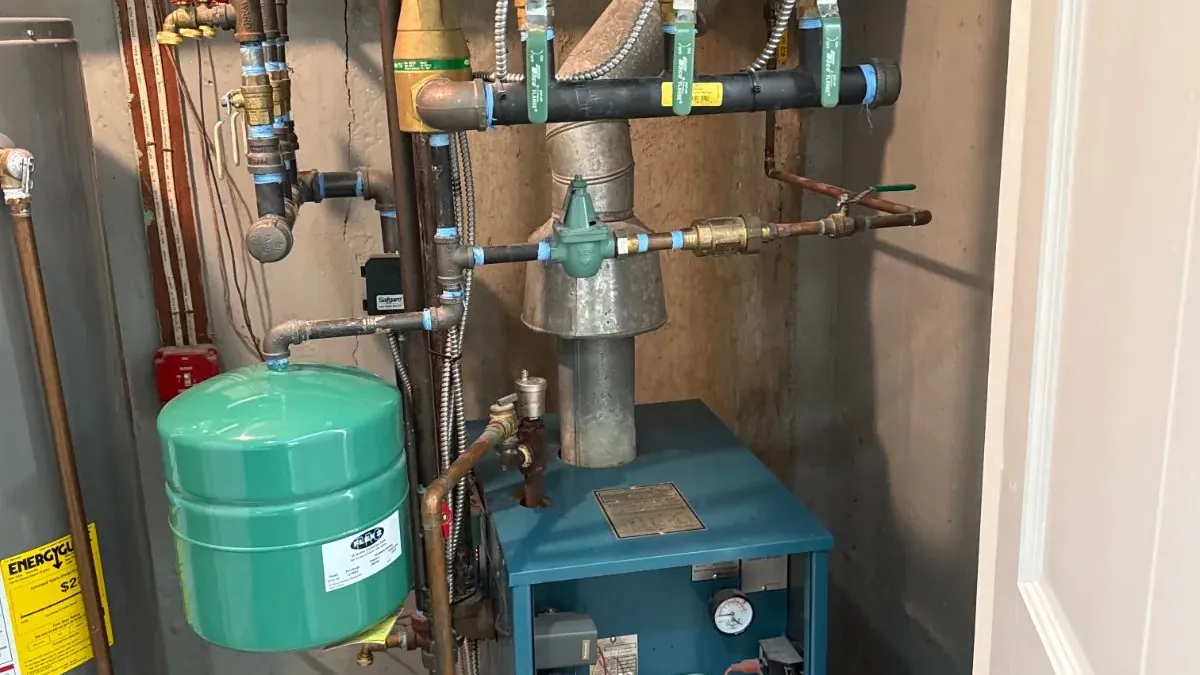
Check the sight glass on the side of the boiler. With the boiler cool, the water should sit at the level the manufacturer marks, often around the middle of the glass. Most residential steam systems are designed to run at low pressure, typically under 2 psi, and running higher can make radiators heat unevenly and pipes bang.
A boiler that is overfilled throws water into the mains, which shows up as banging and spitting vents. One that runs low can trip its low-water cutoff and shut down. If the glass is empty while the boiler is hot, shut it off and let it cool before adding water, then call. Never adjust the pressure control without knowing what the system was designed for.
What does the low-water cutoff do?
The low-water cutoff shuts off the burner if the boiler's water drops too low, which protects the boiler from firing dry and cracking. Many float-type cutoffs are meant to be flushed on a regular schedule to clear sediment, following the instructions tagged on the device. A cutoff that fails can leave the boiler unprotected.
We replaced the mechanical low-water cutoff on a Deer Park steam boiler in February 2026, along with an air bleeder, during a heating tune-up. On another Deer Park steam boiler in October 2025, the first visit of a new service agreement covered a steam boiler tune-up, a new expansion tank and an air bleeder. Safety controls get checked at every tune-up.
When should you call a technician?
Call when banging comes back after you've checked valves and vents, when several radiators stay cold, when the sight glass keeps dropping or the boiler keeps adding water, or when the pressure gauge reads high. Those point to pitch problems, failed traps, leaks or controls that need testing.
A technician will check the water level, pressure control and low-water cutoff, flush the boiler if the water is dirty, and walk the system for sagging pipes and failed vents or traps. Our steam and hot-water boiler service and boiler repair cover homes within 15 miles of Deer Park. For no heat at all, see our no-heat page or call (631) 414-7141, and read about boiler repair across Long Island.
Need a technician rather than a guide? See our heating repair service, or read about HVAC repair in Deer Park, NY. K2 answers 24/7 at (631) 414-7141.