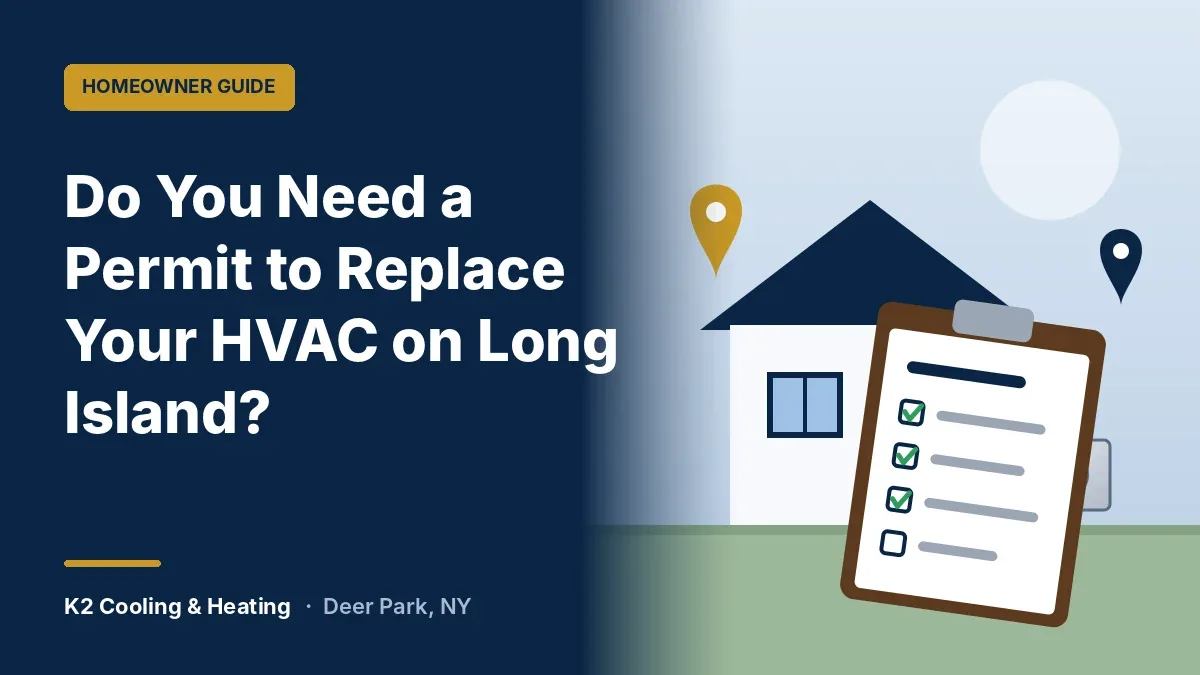
Replacing a furnace, boiler, central air system or heat pump on Long Island often needs a permit, and which office issues it depends on where your home sits. If you live in an unincorporated hamlet like Deer Park, Commack or Bay Shore, your town handles it. If you live inside an incorporated village like Amityville, Lindenhurst or Massapequa Park, the village usually does. This guide explains how to tell which applies to you and who to call in each town K2 serves.
Why permits matter for heating and cooling work
A permit is how your town confirms that gas piping, venting, electrical connections and equipment placement meet the New York State Uniform Fire Prevention and Building Code. For heating equipment, that inspection protects against the problems that actually hurt people: a flue that doesn't draft properly, a gas connection that leaks, or a heat exchanger venting carbon monoxide into the house.
Permits also matter when you sell. Buyers' attorneys and title searches routinely turn up equipment that was installed without a permit. An open or missing permit can delay a closing while you file after the fact, and a "legalization" filing is usually slower and more expensive than doing it up front.
Step 1: Find out if you live in a hamlet or a village
Long Island is split into towns, and inside those towns are two kinds of communities:
- Hamlets (unincorporated) have no local government of their own. Deer Park, North Babylon, West Babylon, Commack, Dix Hills, Bay Shore, Brentwood, Hicksville and Levittown are all hamlets. The town issues permits.
- Incorporated villages have their own building department. Amityville, Lindenhurst, Babylon Village, Brightwaters, Farmingdale and Massapequa Park are villages. The village usually issues permits, not the town.
The quickest check is your property tax bill. If it lists village taxes, you are in a village. Your mailing address is not a reliable guide, because many hamlets share a post office name with a neighboring village.
Step 2: Contact the right office
Town of Babylon
Deer Park, North Babylon, West Babylon, Wyandanch, Wheatley Heights and Copiague are all in the Town of Babylon. The town's Building Department, part of Planning & Development, is at Babylon Town Hall, 200 East Sunrise Highway in Lindenhurst. HVAC work falls under its Plumbing Division. The town is moving all building applications to its Online Permit Center. Homes inside the Villages of Babylon, Lindenhurst and Amityville go to their village building department instead.
Town of Islip
Bay Shore, Brentwood, Central Islip, Sayville, West Islip, East Islip and Islip Terrace are in the Town of Islip. Permits go through the Building Division of the Department of Planning and Development, at One Manitton Court in Islip. The Village of Brightwaters handles its own permits.
Town of Huntington
Huntington Station, Dix Hills, Melville, Elwood, Greenlawn and the western part of Commack are in the Town of Huntington. Permit applications go to the town's Building & Housing Department, Room 115 at Town Hall, 100 Main Street, Huntington.
Town of Smithtown
The eastern part of Commack and part of Hauppauge are in the Town of Smithtown, which runs its own building department. Commack and Hauppauge both straddle town lines, so check your tax bill to confirm which town your home is in before you call.
Town of Oyster Bay
Hicksville, Massapequa, Plainview, Syosset, Bethpage, Old Bethpage and South Farmingdale are in the Town of Oyster Bay. Its Building Division now takes many permit types through an online permit portal. The Villages of Farmingdale and Massapequa Park issue their own permits.
Town of Hempstead
Levittown and other unincorporated Hempstead communities file with the Town of Hempstead's building department. Hempstead has many incorporated villages, so confirm your village status first.
What usually needs a permit
Every town and village sets its own list, but these are the jobs most likely to need one:
- Replacing a gas or oil furnace or boiler
- Converting from oil to gas, which also involves the gas utility and the old oil tank
- Installing a new central air system or a heat pump, including ductless mini-splits
- Moving or adding an outdoor condenser, especially near property lines or in flood zones
- New gas piping, new venting, or a new chimney liner
- New electrical circuits for HVAC equipment, which may need a separate electrical inspection
Routine repairs, such as replacing a capacitor, a motor or a thermostat, generally do not need a permit. If you are unsure, call the building department before work starts. A phone call costs nothing; filing after the fact can cost a lot.
Waterfront and flood-zone homes
South Shore homes in FEMA flood zones often face extra rules on where equipment can sit. Outdoor condensers, boilers and furnaces may need to be raised above a set flood elevation. If you're in Lindenhurst, Copiague, Amityville, West Islip, East Islip, Massapequa or another waterfront community, ask about elevation requirements before choosing where new equipment goes. It can change both the design and the price.
Who files the permit?
Ask this before you sign any contract. Some contractors file permits as part of the job; others leave it to the homeowner. K2 does not file town permits. We'll tell you up front which equipment we're installing, where it will go and what it connects to, so you or your expediter have what the building department asks for. Confirm the requirements with your building department before your installation is scheduled.
Planning a furnace, boiler, AC or heat pump replacement? Call K2 Cooling & Heating at (631) 414-7141 for an in-home assessment. We'll size the system properly and walk you through what your town will want to see.
Need a technician rather than a guide? See our AC installation service, or read about HVAC repair in Deer Park, NY. K2 answers 24/7 at (631) 414-7141.