Why HVAC Maintenance Saves Thousands: and When It Doesn't
Every HVAC company on Long Island sells maintenance, and every one of them tells you it saves money. We sell it too, so treat what follows with appropriate skepticism and check the reasoning rather than the conclusion.
Here is what is actually true: maintenance does save money, but almost never for the reason it gets advertised. The efficiency pitch, the one about lower energy bills, is the weakest part of the argument and it is the part companies lead with.
The real savings sit somewhere else entirely, and once you see where, you can judge for yourself whether HVAC maintenance is worth it for your particular system.
The Efficiency Argument Is the Weakest One
The standard pitch goes: a clean, tuned system uses less energy, so maintenance pays for itself in lower bills.
That is directionally true and it is oversold. A dirty coil, a clogged filter, and an incorrect refrigerant charge all reduce efficiency, and correcting them all helps. But on a system that was in reasonable shape to begin with, the energy savings from a single visit are modest, real, but not the number that justifies the visit.
If a company's entire case for maintenance is your electric bill, they are making the weakest available argument. The strong arguments are about what does not happen to you.
Where the Money Actually Is
1. Catching cheap failures before they become expensive ones
This is the largest and most immediate saving, and it works because of a specific characteristic of HVAC equipment: most catastrophic failures are downstream of a cheap component that failed first.
A capacitor is a small, inexpensive part that degrades measurably before it dies. A technician tests it under load, sees it reading below spec, and replaces it during a routine visit.
Left alone, that weak capacitor makes the compressor struggle on every start. Do that a few hundred times and you can lose the compressor, which on most systems means replacing the outdoor unit or the whole system.
That pattern repeats across the equipment. Small parts fail cheaply and predictably. Big parts fail because small parts were not caught.
2. Getting more years out of the equipment
This is the biggest number in the entire discussion, and it is the one nobody puts on a flyer because it takes years to show up.
A central AC on Long Island typically lasts 12 to 15 years. The gap between the bottom and the top of that range is not luck. It is airflow, coil cleanliness, refrigerant charge, electrical health, and coastal corrosion management, every one of which is what a maintenance visit addresses.
Getting three additional years out of a system that would otherwise be replaced is worth more than every repair you avoid combined. Replacement is the largest HVAC expense a homeowner faces, and deferring it is the largest saving available.
3. Never paying an emergency rate
A scheduled visit in September is booked at a normal daytime rate on a day that suits you.
The
same repair at 9pm on a January Tuesday is an emergency call, priced
differently by every company on the Island, because a technician is being
pulled out of his home at night.
Parts
availability compounds it. In September, supply houses have common parts on the
shelf. After the first regional cold snap, they go out of stock and a one-day
repair becomes a week, a week you are either without heat or running space
heaters.
4. Keeping your parts warranty valid
This is the one almost nobody knows about, and it is the single largest avoidable loss in the article.
Most
manufacturers require documented annual professional maintenance as a condition
of the parts warranty. Not a suggestion, a condition, written into the
warranty terms.
If
a control board or a compressor fails inside the warranty period and you cannot
produce service records, the claim can be denied. A homeowner with a
five-year-old system and no maintenance history can end up paying full price
for a part that should have cost them nothing.
Go read your own warranty document. Look for the maintenance clause. If your system is under warranty and has never been professionally serviced, that single fact is a stronger argument than anything else on this page.
How
a $15 Filter Becomes a $2,500 Repair
Three real chains. Each starts with something trivial and ends somewhere expensive, and each is common enough that we see it every season.
The
airflow cascade
A filter goes unchanged. Airflow across the evaporator coil drops. With less warm air moving over it, the coil gets too cold and ice forms. Ice blocks airflow further, which makes it colder still.
Now
the compressor, which is designed to compress vapor, not liquid, starts
receiving liquid refrigerant that failed to evaporate in the iced-over coil.
Liquid does not compress. That is called slugging, and it damages compressors.
$15
filter → frozen coil → compressor damage. Every step in that chain is
preventable at the first one.
The capacitor cascade
Eventually something gives, and what gives is rarely the capacitor. A technician measuring capacitance under load catches this in about ninety seconds.
The condenser coil cascade
The outdoor coil gets dirty, cottonwood, grass clippings, and on the South Shore, salt. The system cannot reject heat properly. Head pressure rises. The compressor runs hotter and longer to do the same job, and every hour of that shortens its life.
This one matters more here than almost anywhere else in the country. Salt air corrodes aluminum fins from the inside out, and a coil that would last fifteen years inland can fail in ten along the South Shore. Rinsing it is a fifteen-minute job that meaningfully changes that outcome.
None of these chains involve bad luck. They are all sequences, and sequences can be interrupted. That is what an AC repair visit does when it happens early, and what it cannot do when it happens late.
Not sure what shape your system is in? A single visit tells you, with no commitment to a plan. Book a visit or call (631) 414-7141.
What Maintenance Actually Costs on Long Island
Rough ranges for Suffolk and Nassau. These are estimates, not quotes, and they vary with system type. Final pricing may vary depending on the system’s condition and any additional service required.
|
Service |
Typical range |
|
Single heating inspection (gas) |
$150 |
|
Single heating inspection (oil, includes parts) |
$199 |
|
Single cooling inspection |
$150 |
|
Annual plan (both visits, priority scheduling, repair discount) |
$279 |
Set that against what it prevents. A capacitor replacement is a small repair. A control board is several hundred dollars. A compressor replacement runs well into four figures, and on an older system usually triggers a full replacement instead.
The arithmetic is not subtle. One avoided compressor failure across the life of a system pays for a decade of maintenance, and that is before counting the warranty claim you kept valid and the three extra years you got out of the equipment.
What a Real Maintenance Visit Includes
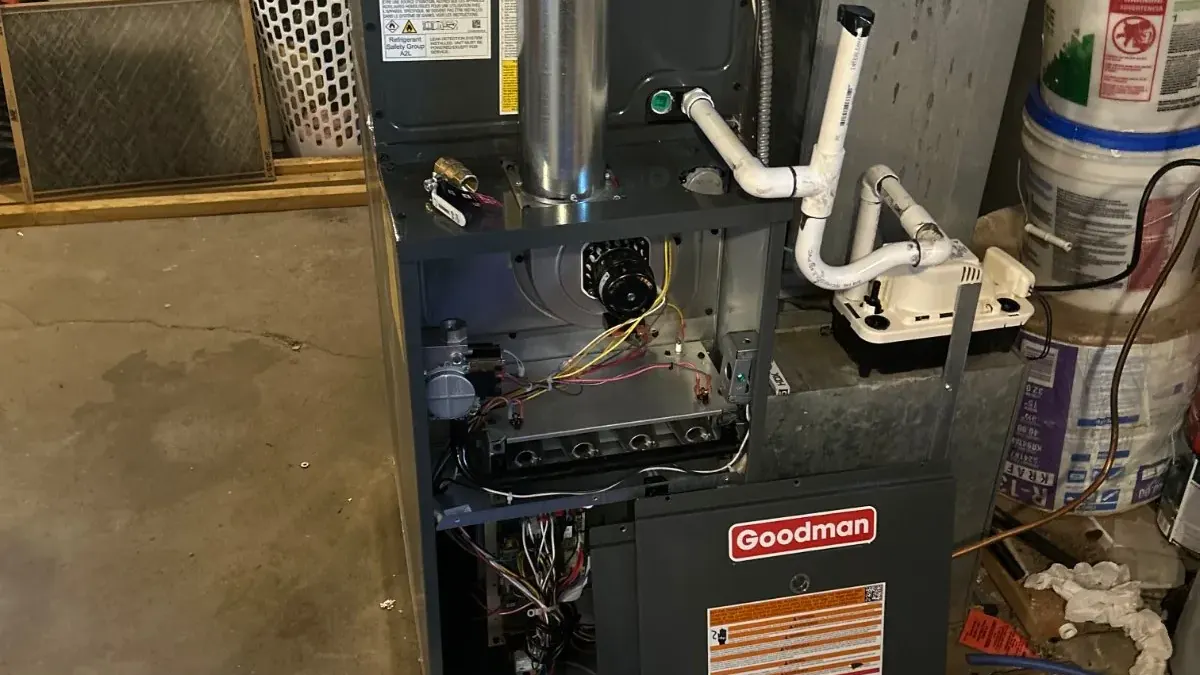
"Maintenance" means very different things depending on who you call. There is a version that takes eighteen minutes: change the filter, look at the flame, leave a quote for a new system.
Here is what a genuine visit covers, so you can tell whether you are getting one.
Heating side:
• Heat exchanger inspection, visual and with a camera where access allows
• Combustion analysis with a calibrated analyzer
• Carbon monoxide test in the living space
• Flue and vent inspection end to end
• Gas pressure verified at the manifold
• Safety controls tested for function, not just continuity
• Ignitor resistance measured, flame sensor cleaned and signal measured
• Burner cleaning
• Static pressure measured across the system
Cooling side:
• Condenser and evaporator coil cleaning
• Refrigerant charge verified by superheat and subcooling, not by guesswork
• Capacitor tested under load
• Contactor inspected for pitting
• Condensate drain cleared and float switch tested
• Blower wheel cleaned, amp draw measured against nameplate
• Temperature split measured
The equipment tells you everything. A real visit requires a combustion analyzer, a manometer, refrigerant gauges, and a multimeter. If a technician arrives with a screwdriver and a filter, none of the measurements above happened.
Ask before you book: does this include a combustion analysis and a static pressure reading? The answer tells you what kind of visit you are buying.
How to Evaluate a Maintenance Plan
Plans vary enormously in value. Four questions separate a good one from a marketing device.
1. What specifically is included in each visit? Ask for the task list in writing. If it is vague, that is the answer.
2. Is priority scheduling contractual or promotional? In January this is the clause that determines whether you wait two hours or two days. Get it in writing.
3. What is the repair discount, and does it apply to parts, labor, or both?
4. Does it include the diagnostic fee if you call with a problem between visits?
Two more things worth knowing. Ask whether the plan auto-renews and how to cancel, you should be able to leave without a fight. And ask whether they provide the service documentation your manufacturer warranty requires, because that paperwork is part of what you are buying.
A plan is generally better value than paying per visit if you would book both visits anyway. If you would realistically only book one, price the single visit and skip the plan. Our own maintenance plan is built around both visits plus priority scheduling, but the questions above apply to anyone's.
When Maintenance Is Not Worth It
There are situations where we will tell you not to spend the money, and it is worth being direct about them.
The system is at end of life anyway. A twenty-year-old furnace with a cracked heat exchanger cannot be made safe by maintenance. Spending on a tune-up for equipment being replaced within the year is money into a system that owes you nothing. That is a repair or replace conversation instead.
You are selling within a year. Maintenance protects long-term equipment life, and long-term is not your horizon. A pre-listing inspection may still be worth it for disclosure purposes, but that is a different service with a different purpose.
The plan is more expensive than the visits it contains. Some plans price above the sum of two individual visits and justify it with benefits you will not use. Do the arithmetic.
You genuinely only need one side serviced. If you heat with a boiler and cool with window units, you do not need a plan built around a central AC visit.
Maintenance is a good investment on functional equipment you intend to keep. It is not a rescue for equipment that is finished, and no honest contractor should sell it that way.
The Long Island Factors Nobody Accounts For
National maintenance advice underrates several things that matter here.
Salt air. From Long Beach through Massapequa, Amityville, and Babylon, airborne salt corrodes condenser coils continuously. An annual freshwater rinse is one of the highest-value, lowest-cost items on the entire list, and it does not appear in most national checklists.
Two full systems, two seasons. We run hard cooling from June through September and hard heating from November through March. That is more equipment stress per year than milder climates put on their systems, and both sides need attention.
Damp basements. Most furnaces and air handlers here sit in unfinished basements. Humidity accelerates corrosion on electrical components and encourages growth on evaporator coils, which is the same problem that makes a house feel sticky in summer.
Frequent power interruptions. Overhead lines through mature tree canopy mean outages, and the surge that damages equipment usually arrives when power is restored, not when it goes out. Surge protection is worth discussing at a maintenance visit, our storm prep guide covers why.
Oil systems. Oil heat remains common across Suffolk, and oil equipment genuinely requires annual service. Nozzle replacement, filter changes, and combustion chamber cleaning are not optional maintenance on an oil burner, they are how it keeps running.
The Honest Version
Maintenance
is not magic and it does not make equipment immortal. Things still fail. What
it does is change which things fail and when you find out.
A
capacitor caught in September is a small repair on a Tuesday. The same
capacitor left alone becomes a compressor in January, on the coldest night of
the year, at an emergency rate, with parts a week out.
That is the whole argument. Not the electric bill.
And if your system is old enough that replacement is the honest answer, we would rather tell you that than sell you a tune-up on equipment that will not see another summer.
K2
Cooling and Heating has served Long Island since 2002, on gas, oil, and steam
systems. Our inspections include everything in the checklist above, and we will
tell you plainly if maintenance is not the right spend on your system.
Call (631) 414-7141 or contact our team. See what our maintenance plan covers, or book a single visit with no commitment. We serve Deer Park, Babylon, West Babylon, North Babylon, Dix Hills, Huntington, Farmingdale, Massapequa, and the surrounding Suffolk and Nassau communities.
If heating season is your immediate concern, our guide on why September beats November for booking covers the timing.
Closer to home, we handle HVAC service in East Islip and HVAC service in Amityville.
Need a technician rather than a guide? See our HVAC tune-up service, or read about HVAC repair in Deer Park, NY. K2 answers 24/7 at (631) 414-7141.