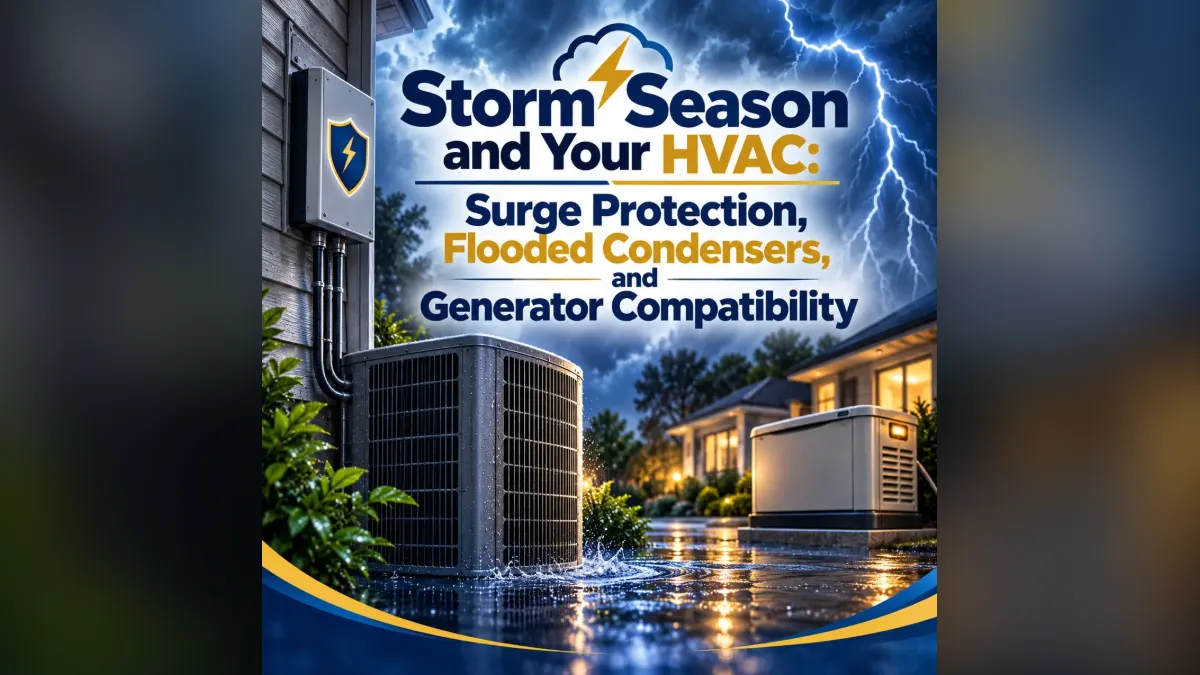
Storm Season and Your HVAC: Surge Protection, Flooded Condensers, and Generator Compatibility
Three things
kill people after storms. All three are preventable.
Never run a
generator indoors, in a garage, in a crawlspace, or near an open window. Carbon
monoxide from a portable generator can be fatal in minutes. Outdoors only, at
least twenty feet from the house, exhaust pointed away.
Never plug a
generator into a wall outlet to power your house. This is called backfeeding.
It sends current onto the utility lines and can kill the crews working to
restore your power. A generator connects to a house only through a transfer
switch installed by a licensed electrician.
Never stand in
standing water near electrical equipment. If water has reached your outdoor
unit, indoor unit, or electrical panel, do not touch anything until power is
confirmed off at the main.
Long
Island sits in an unusual position. We get the tail end of tropical systems in
September and October, nor'easters through the winter, and coastal flooding
that reaches homes miles from open water. We also have some of the oldest
residential electrical infrastructure in the region and a lot of outdoor
equipment sitting at grade in flood-prone neighborhoods.
Every
storm season we replace equipment that could have been saved and repair damage
that could have been prevented. Most of it comes down to three things: surges
nobody protected against, flooding nobody prepared for, and generators that
could not do what their owners assumed they could.
This
guide covers all three. It is worth reading before a storm is in the forecast,
because the useful window for most of it closes about 48 hours out.
Why Long Island HVAC Takes More Storm Damage Than Most
Three
local factors compound.
Overhead distribution and frequent outages. Most of our power runs on poles through mature tree canopy. Outages are common, and it is not the outage that damages equipment, it is the restoration. When power comes back, it does not come back smoothly.
Equipment
at grade. Long Island condensers typically sit on a pad on the ground, often on
the low side of a house. In much of Nassau and southern Suffolk, that ground
floods.
Saltwater exposure. Storm surge along the South Shore, from Long Beach through Massapequa, Amityville, and Babylon, does not deposit fresh water. Salt changes the entire outcome, and this is the single most misunderstood point in post-storm HVAC.
Part 1: Surge Protection
What a surge actually does to a modern system
A
power surge is a brief voltage spike far above normal. Lightning is the
dramatic version, but the more common cause on Long Island is far less
dramatic: the moment power is restored after an outage.
When PSEG re-energizes a circuit, the returning voltage is not clean. It can spike, sag, and oscillate for several seconds. Every appliance on that circuit takes the hit at once, and HVAC equipment sits on the largest circuits in the house.
What
fails, roughly in order of frequency:
•
Control boards, the most common casualty, and often
the most expensive single part in the system
•
Capacitors, a surge can degrade one without killing it
outright, which then fails weeks later and looks unrelated
•
Contactors, welded closed, so the system runs
continuously and will not shut off
•
ECM and variable-speed blower motors, these contain
their own electronics and are expensive to replace
•
Compressors, less common, but a hard start into an
unstable voltage can cost you the entire outdoor unit
Why newer equipment is more vulnerable, not less
This
surprises people. A 1995 air conditioner was mostly a motor, a compressor, a
relay, and a capacitor. There was very little in it that a voltage spike could
hurt.
A
2024 high-efficiency system is a computer with a compressor attached.
Variable-speed compressors, ECM blower motors, communicating thermostats, and
inverter-driven outdoor units all contain sensitive electronics.
The
better your equipment, the more a surge costs you. A homeowner who just spent
$14,000 on a variable-speed system has far more to lose from a $300 surge
protector they did not install than the neighbor running a twenty-year-old
builder-grade unit.
What actually protects it
Two
layers, and you want both.
A
whole-home surge protector installs at your electrical panel and clamps
incoming spikes before they reach anything. This is an electrician's job, it
typically takes under an hour, and it protects the whole house including the
HVAC circuits.
A
dedicated HVAC surge protector installs at the outdoor disconnect or the air
handler. It handles surges that originate inside the house or slip past the
panel unit, and it is sized specifically for the equipment. This is HVAC work
and often gets added during a service visit.
Neither
is expensive relative to what they protect. A control board replacement alone
typically costs more than both devices combined.
Check
your warranty documentation as well. Some manufacturers require or discount
surge protection, and some exclude surge damage entirely if none was installed.
What a surge protector will not do
It
will not protect against a direct lightning strike to the house or the
equipment. Nothing residential will.
It
will not protect against flooding, which is a separate problem entirely and
gets its own section below.
It
is also a consumable. Surge protectors absorb energy and degrade doing it. Most
have an indicator light, after any significant electrical event, check that it
is still showing protected. A dead surge protector looks exactly like a live
one.
Part 2: Flooding
Before the water arrives
If
flooding is forecast and you have 24 hours, these steps are worth doing.
1.
Photograph everything. Your outdoor unit, the data
plate with model and serial numbers, the indoor air handler or furnace, and the
surrounding area. Timestamped pre-storm photos make an enormous difference in
an insurance claim.
2.
Shut the system down at the outdoor disconnect and at
the furnace switch. Equipment that is de-energized when water reaches it fares
better than equipment that is running.
3.
Clear the area. Remove anything that could become
debris, patio furniture, planters, trash cans, loose fencing.
4.
Do not wrap or cover the unit in plastic. It will not
keep floodwater out and it traps moisture afterward.
5.
Improve what you can indoors. If your furnace or air
handler is in a basement that has flooded before, this is the moment to move
anything stored around it.
If
you are in a repeat flood zone, the longer-term fix is raising the outdoor unit
on a stand above your historical high-water mark. That is a job for a calm
week, not a storm week, but it is worth pricing.
How high the water got determines everything
This
is the question a technician will ask first, so measure it before anything gets
cleaned up. Look for the mud line on the cabinet.
•
Water reached the pad only, not the cabinet, usually
fine. The unit needs inspection and a rinse, but the components sit above that
level.
•
Water into the bottom of the cabinet, the electrical
compartment, contactor, and wiring may have been submerged. Repairable, but it
must be inspected and dried before power is restored.
•
Water above the electrical compartment, control board,
contactor, capacitor, and wiring were all submerged. Frequently a total loss on
an older unit, sometimes repairable on a newer one.
•
Water over the top of the unit, the compressor
windings and the sealed system were submerged. Almost always a replacement.
For
indoor equipment the thresholds are tighter. A furnace or air handler that took
water into the burner compartment, the blower, or the control board should not
be restarted under any circumstances. Gas valves and safety controls that have
been submerged cannot be trusted, and a gas appliance with a compromised safety
control is a serious hazard.
Saltwater is a different problem entirely
This is the point most homeowners and a fair number of contractors get wrong.
Fresh water can be dried out. Components can be cleaned, tested, and returned to service in many cases.
Salt
water cannot. Salt is conductive and it is corrosive, and it does not leave
when the water does. It stays in every crevice of every circuit board,
connector, and winding, drawing moisture from the air and corroding metal
continuously for months afterward.
Saltwater-flooded
equipment very often runs fine for a few weeks and then fails, and it fails
progressively, one component after another as corrosion spreads. Homeowners
who paid to have it dried out and restarted end up paying twice.
If
you took storm surge rather than rainwater, anywhere along the South Shore, or
in the low-lying areas of the North Shore harbors, assume affected equipment
is a replacement rather than a repair, and get that assessment in writing early
for your claim.
Never restart a flooded system
The
instinct after a storm is to flip everything back on and see what works. Do
not.
Energizing
a submerged system can destroy components that survived the flood, create a
shock hazard, start a fire, or, on gas equipment, produce a far worse outcome.
It can also complicate an insurance claim, because you introduced damage after
the covered event.
Leave
it off. Have it assessed. An AC repair visit after flooding is a diagnostic and
safety evaluation, not a guess.
Documenting it for insurance
Do
this before cleanup begins.
•
Photograph the water line on the equipment cabinet from
several angles
•
Photograph the data plate showing make, model, and
serial number
•
Photograph the surrounding area showing the flood
extent
•
Note the date, time, and approximate water depth in
writing
•
Keep every service invoice and written assessment
•
If it was saltwater, make sure that word appears in the
technician's written assessment, it materially changes the
repair-versus-replace determination
Standard
homeowners policies treat flood and wind damage very differently, and flood
coverage is usually a separate policy. Check before you assume, and ask your
adjuster directly rather than guessing.
Equipment took
water, or the power came back hard? We assess storm-damaged systems and provide
written documentation for insurance. Book a storm assessment or call (631) 414-7141.
Part 3: Generator Compatibility
This
is where the most expensive assumptions get made, usually in the middle of a
four-day outage.
Running watts versus starting watts
Every
motor draws far more power to start than to run. For an air conditioner
compressor, the starting draw, locked rotor amperage, can be five to seven
times the running draw, for a fraction of a second.
Generators
are advertised by running watts, with a smaller surge rating. That gap is why a
generator that looks big enough on paper fails in practice: it can carry the
load easily, but it cannot get the compressor moving in the first place.
What it actually takes to start a central AC
Rough
figures for planning. Your equipment's data plate has the real numbers and they
vary.
|
System |
Running watts |
Starting watts |
|
2-ton central AC |
2,000 – 2,500 |
6,000 – 9,000 |
|
3-ton central AC |
3,000 – 3,500 |
9,000 – 13,000 |
|
4-ton central AC |
4,000 – 5,000 |
12,000 – 18,000 |
|
Ductless mini split |
600 – 1,500 |
Much gentler, most ramp rather than slam on |
|
Gas furnace |
600 – 800 |
1,500 – 2,000 |
This is why the common 7,500-watt
portable generator will run your refrigerator, lights, sump pump, and furnace
comfortably, and still fail to start a 3-ton condenser. The generator is not
undersized for the load. It is undersized for the inrush.
Note
the mini split line above. If you are considering ductless anyway, generator
compatibility during an outage is a real and rarely mentioned advantage.
Soft starters change the math
A
soft starter is a device installed at the condenser that ramps the compressor
up instead of slamming it on. It typically reduces starting current
substantially, often by half or more.
Practically,
that can bring a 3-ton system from needing 13,000 starting watts down into the
range a mid-size portable generator can actually deliver. For homeowners who
lose power regularly and want cooling during outages, it is usually far cheaper
than buying a bigger generator.
It
also reduces electrical stress on the compressor every single start, storm or
not, which extends equipment life.
This
is HVAC work, not a plug-in accessory. It needs to be matched to your specific
compressor.
Your furnace is the easy part
Good
news for winter outages. A gas furnace uses electricity only for the blower,
the ignitor, and the controls, the heat itself comes from gas.
Most
residential gas furnaces run on roughly 600 to 800 watts, with a startup draw
in the range of 1,500 to 2,000. Almost any portable generator handles that. Oil
systems draw somewhat more because of the burner motor and pump, but they
remain well within reach of a modest generator.
The
practical implication: in a winter outage, running your heat is usually
achievable. In a summer outage, running your air conditioning usually is not,
without either a large standby unit or a soft starter.
Clean power matters for modern equipment
One
more consideration that catches people out.
Modern
furnaces and air handlers with ECM variable-speed blower motors contain
electronics that expect reasonably clean power. Older contractor-grade portable
generators produce a rougher waveform than utility power, and some ECM motors
and control boards do not tolerate it well, they run erratically, or fail.
Inverter
generators produce much cleaner output and are the safer choice if you have
variable-speed equipment. If you already own a conventional generator and a
modern furnace, it is worth asking a technician whether your specific equipment
is rated for it before you find out during an outage.
And the point from the safety box bears repeating: a generator connects to your house through a transfer switch installed by a licensed electrician. Never through a wall outlet.
Your Storm Checklist
Before the season
•
Install a whole-home surge protector and a dedicated
HVAC surge protector
•
Photograph your equipment and data plates, and store
the photos somewhere off-site
•
Confirm your generator's actual starting capacity
against your equipment's actual requirements
•
Have a transfer switch installed if you have a generator
and no safe way to connect it
•
If you are in a flood zone, price out raising the
condenser on a stand
•
Check whether your insurance covers flood, and what it
covers for HVAC specifically
48 hours out
•
Photograph everything again, timestamped
•
Clear debris from around the outdoor unit
•
Shut the system off at the outdoor disconnect and the
furnace switch if flooding is expected
•
Test your generator and confirm you have fuel
•
Test your carbon monoxide detectors, they matter more
than usual when generators are running in a neighborhood
•
Charge everything, and note that a full furnace tune-up
before storm season means one less thing that can fail when the power comes
back
After it passes
•
Do not restore power to anything that was underwater
•
Measure and photograph the water line before cleanup
•
Check your surge protector's indicator light
•
Clear debris from the condenser before restarting, if
it was not flooded
•
Listen carefully on the first restart, unusual noises
after a storm are not coincidence
• Get a written assessment if there is any question, particularly if the water was salt
When It Is a Total Loss
Sometimes
the honest assessment is that the equipment cannot be safely returned to
service. Saltwater submersion, water over the top of a condenser, or a flooded
gas furnace generally fall into that category.
Two things worth knowing if that is where you land.
Get
the assessment in writing, with the cause named. "Saltwater submersion to
a depth of X inches" carries weight with an adjuster that "flood
damage" does not.
A
forced replacement is still a decision. If the unit was fifteen years old
anyway, this is the moment to size it correctly, consider higher efficiency,
and think about whether raising it or relocating it makes sense. Our guide on
how to repair or replace your AC covers the reasoning, and financing is
available so an unplanned replacement does not have to be paid in one piece.
We Answer the Phone After Storms
Most
of what is in this article costs very little and only works if it is done in
advance. A surge protector installed in September protects everything that
follows. One installed the week after an outage protects nothing that already
happened.
And
when a storm does come through, the most valuable thing you can do is the least
intuitive one: leave the system off until someone has looked at it.
K2
Cooling and Heating has served Long Island since 2002, with 24/7 emergency
service and written assessments for insurance claims on storm-damaged
equipment.
Call
(631) 414-7141 or contact our team. We serve Deer Park, Babylon, West Babylon,
North Babylon, Dix Hills, Huntington, Farmingdale, Massapequa, and the
surrounding Suffolk and Nassau communities.
Storm season runs straight into heating season here. Once you are through it, our AC winterizing checklist covers shutting the cooling side down properly, and a maintenance plan keeps both systems inspected before the weather turns.
Need a technician rather than a guide? See our 24/7 emergency HVAC service, or read about HVAC repair in Deer Park, NY. K2 answers 24/7 at (631) 414-7141.