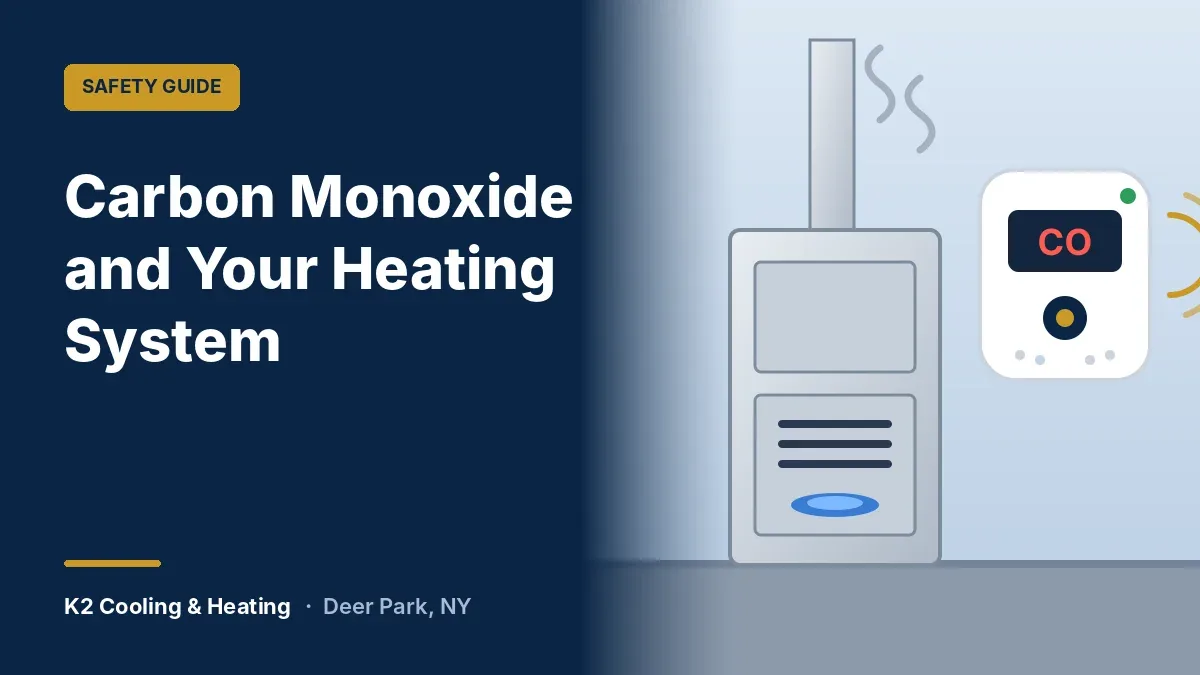
If your Long Island home has a gas or oil furnace, boiler or water heater, New York State law requires working carbon monoxide alarms. Carbon monoxide (CO) is colorless and odorless, and the heating season is when the risk goes up. Equipment runs for hours, windows stay shut, and a cracked heat exchanger or blocked flue can push CO into living space without any sign you'd notice. Here's what the law requires, where alarms belong, what causes CO problems, and what to do if an alarm goes off.
What New York's Amanda's Law requires
Amanda's Law took effect in New York on February 22, 2010. It's named for Amanda Hansen, a 16-year-old who died of carbon monoxide poisoning at a friend's house. The law requires CO alarms in one- and two-family homes, condominiums, co-ops and multiple dwellings that have fuel-burning heating or cooking appliances.
- Existing homes can use battery-operated CO alarms.
- New construction must have hardwired CO alarms.
- Owners of rental properties are responsible for installing them, and tenants can report a missing alarm.
Even an all-electric home with an attached garage benefits from a CO alarm. A car left running in the garage can push CO into the house.
Where to put carbon monoxide alarms
- Outside every sleeping area, in the hallway near the bedrooms. CO is most dangerous when people are asleep and can't notice symptoms.
- On every level of the home, including the basement.
- Near, but not right next to, fuel-burning equipment. Keep alarms a few feet from the furnace, boiler or water heater so normal start-up puffs don't cause false alarms.
- Not in a garage, kitchen or bathroom, where fumes and humidity cause false readings.
Follow the manufacturer's instructions for mounting height. Test alarms monthly, replace batteries at least once a year, and replace the whole alarm when it reaches its end-of-life date, usually 7 to 10 years. Many units chirp when they expire.
Heating problems that cause carbon monoxide
A furnace or boiler that's burning and venting properly sends CO up the flue and out of the house. Problems start when combustion goes wrong or the exhaust path gets blocked:
- Cracked heat exchanger. In a gas or oil furnace, the heat exchanger keeps combustion gases separate from the air you breathe. Age, overheating and short-cycling can crack it.
- Blocked or disconnected flue. Bird nests, fallen chimney liner pieces, leaves, or a vent pipe knocked loose can stop exhaust from leaving.
- Back-drafting. When a powerful kitchen hood, dryer or bath fan pulls air out of a tight house, exhaust can be drawn back down the chimney.
- Poor combustion. Dirty burners, a bad oil nozzle or an incorrect gas pressure setting can make equipment produce more CO than normal.
- Old chimneys after an oil-to-gas switch. Gas exhaust is cooler and wetter than oil exhaust. An unlined masonry chimney can corrode and block over time, which is why gas conversions often need a liner.
- Snow-blocked vents. High-efficiency furnaces and boilers often vent through a side wall with PVC pipe. After a Long Island snowstorm, check that those intake and exhaust pipes aren't buried.
Warning signs to take seriously
- Headaches, dizziness, nausea or tiredness that improve when you leave the house
- Several people, or pets, feeling sick at the same time
- Yellow or flickering burner flames on gas equipment instead of steady blue
- Soot around the furnace, boiler or water heater, or streaks around the flue
- Heavy condensation on windows near heating equipment
- A furnace that runs constantly but never seems to warm the house
What to do if your CO alarm goes off
- Get everyone, including pets, outside into fresh air right away.
- Call 911 from outside, especially if anyone has symptoms. The fire department can measure CO levels in the home.
- Don't go back in until responders tell you it's safe.
- Have the equipment checked before using it again. If the source was your heating system, call a heating professional to inspect it.
Never ignore a CO alarm or assume it's a false alarm because you feel fine. Low-level exposure doesn't always cause obvious symptoms right away.
How a heating tune-up helps
An annual heating tune-up is the best way to catch CO problems before they become dangerous. During a K2 maintenance visit, the technician inspects the burners, the flue and venting, safety circuits and the overall operation of the system, and cleans the burners. If we find signs of a cracked heat exchanger, a venting problem or poor combustion, we'll show you what we found and explain your options before any work is done.
A tune-up doesn't replace CO alarms. You need both.
Haven't had your heating system checked this season? Call K2 Cooling & Heating at (631) 414-7141 to book a heating tune-up, or see our maintenance plans.
Need a technician rather than a guide? See our heating repair service, or read about HVAC repair in Deer Park, NY. K2 answers 24/7 at (631) 414-7141.