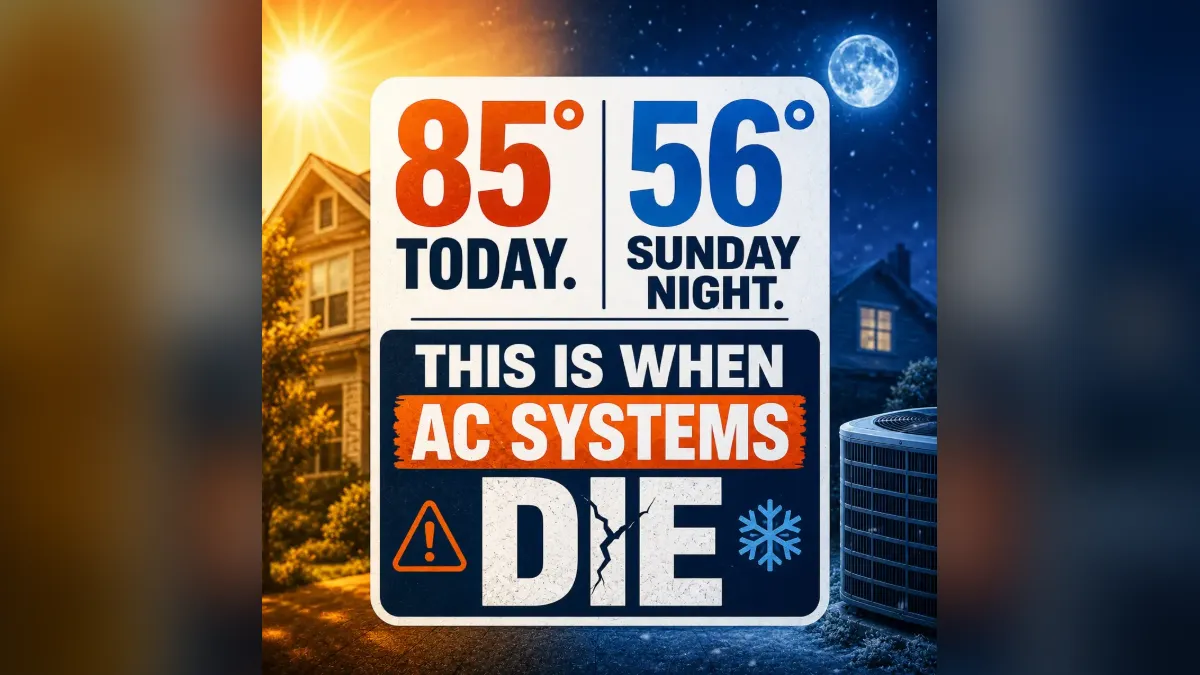
85° Today. 56° Sunday Night. This Is When AC Systems Die
That
is a 29-degree swing in about 48 hours, and if you work in this trade on Long
Island, you know exactly what that weekend looks like. Saturday the phone rings
about air conditioning. Sunday night it rings about heat. Same weekend,
opposite problems.
This
is not a coincidence and it is not bad luck. The first significant temperature
swing of the season is the most reliable predictor of HVAC failure in the
entire year, and it is worth understanding why before it happens to you.
A 29-Degree Swing in 48 Hours
Here is the actual forecast for our service area:
|
Day |
High |
Low |
|
Friday |
85° |
66° |
|
Saturday |
79° |
63° |
|
Sunday |
73° |
56° |
|
Monday |
77° |
57° |
Friday afternoon your air
conditioner is doing its hardest work in weeks. By Sunday night, most Long
Island homes will be reaching for the thermostat and calling for heat for the
first time since March.
Two
systems, neither of which has been checked, both getting tested inside two
days.
Why the Last Hot Day Is the One That Breaks Things
Everything weak gets tested at once
Your
air conditioner has run since May. Bearings have worn, capacitors have degraded,
contactors have pitted, and refrigerant charge has slowly drifted if there is a
small leak. None of that stops the system from working. It just narrows the
margin.
A
late-season 85-degree day demands full capacity from a system with four months
of wear on it. That is when the margin runs out.
Metal moves, and joints let go
This
is the part most homeowners have never heard. Copper expands when hot and
contracts when cool. A refrigerant line set that heats to 100+ degrees in the
sun on Friday and drops to the 50s by Sunday night moves measurably.
Do
that across a season and brazed joints that were marginal start to weep. Small
refrigerant leaks very often become noticeable on the first big temperature
swing, not during the steady heat of July.
The parts that fail are always the same
After
twenty years of these weekends, the list barely changes.
•
Run capacitors, the single most common late-season
failure. The compressor hums but does not start.
•
Contactors, pitted from a summer of cycling, they
stick or fail to close.
•
Condenser fan motors, bearings that survived July give
up on the last hot day.
•
Condensate drains, a summer of algae growth clogs the
line, and the float switch shuts the system down.
•
Low refrigerant, the leak was there in July. The swing
is when you notice it.
Every
one of these is a routine, same-day AC repair in September, when parts are on
the shelf.
Saturday: The Worst Possible Day for Your AC to Quit
Timing
is the thing that turns a $300 repair into a miserable weekend.
An
AC failure on a Tuesday morning is an inconvenience. You call, we come, it gets
fixed. A failure at 2pm Saturday is a different situation entirely. Supply
houses close. Fewer technicians are on the road. Weekend and after-hours rates
apply, because someone is coming out on their day off.
And
on the last genuinely hot weekend of the year, every HVAC company on the Island
is fielding the same calls at the same time.
If
your system has been making a noise you have been ignoring, or short-cycling,
or not quite keeping up, today is the day to deal with it. Not tomorrow
afternoon.
Sunday Night: The Other Half of the Problem
Now
the second failure.
At
56 degrees, a lot of Long Island homes will switch to heat for the first time
since spring. That furnace has sat idle for roughly five months. In that time,
dust settled on the burners and the flame sensor, motor bearings sat still in a
damp basement, and on high-efficiency systems the condensate line had all
summer to clog.
The
failure rate on the first heat call of the season is dramatically higher than
any other night of the year. Ignitors, flame sensors, inducer motors, and
pressure switches all get stress-tested at once when a dormant system is asked
to go to full combustion.
So
here is the scenario we actually see: a family loses their air conditioning
Saturday afternoon, gets through a warm night with fans, and then discovers
Sunday evening that the heat will not come on either. Two failures, one weekend,
and by then everyone is booked.
If
your heat does not start Sunday night, work through our 7 things to check
before you call. Several of those take under a minute and solve a real share of
first-night no-heat calls.
The 15-Minute Test That Prevents Sunday Night
This
is the most useful thing in this article, and you can do it right now while it
is still 85 degrees outside.
Turn
your heat on today, for fifteen minutes.
1.
Set the thermostat to HEAT and raise the setpoint above
the current indoor temperature.
2.
Wait. Let it run a full fifteen minutes.
3.
Listen for the burner to ignite and the blower to
engage.
4.
Walk the house and confirm warm air is coming from the
vents.
5.
Set it back to COOL or OFF.
Yes,
the house will get slightly warm. That is the point. You are trading fifteen
minutes of discomfort on a Friday for certainty on Sunday.
What
you might find:
•
A burning smell for the first ten or fifteen minutes, normal. That is summer dust burning off the heat exchanger.
•
Nothing happens, you have found a problem on a Friday
afternoon, when we can get to you, instead of Sunday night when you are cold.
•
It runs but the smell persists past twenty minutes, or
you hear banging or a delayed whoosh on ignition, stop and book service.
•
A carbon monoxide detector sounds, leave the house
immediately and call 911.
Finding
a dead furnace on a warm Friday is an appointment. Finding it at 10pm Sunday
with a 56-degree house is an emergency call at emergency rates.
That
fifteen-minute test is also the cheapest possible version of a furnace tune-upit tells you whether the system starts, though it tells you nothing about
whether it is running safely. That part requires a combustion analyzer.
Something not
right with either system? We run 24/7 emergency service across Suffolk and
Nassau, all weekend. Call (631) 414-7141 or book now.
What to Do This Weekend
Today, while it is still hot
•
Run the 15-minute heat test above
•
Listen to your AC on this last hot afternoon, grinding, screeching, rattling, or a compressor that hums before starting are
all telling you something
•
Check for water pooling around your indoor unit, which
means the condensate drain is clogging
•
Change your air filter, since both systems share it
•
If something is already wrong, call today rather than
Saturday
Sunday,
before the temperature drops
•
Switch the thermostat from COOL to OFF, then to HEAT
once you actually need it
•
Do not leave it on AUTO through the swing, or the
system will cool in the afternoon and heat overnight, cycling both systems
unnecessarily
•
Make sure supply and return vents are unblocked
•
Confirm your carbon monoxide detectors work before the
heating season starts
Next
week
•
Book your heating inspection while the schedule is
still open. In eight weeks it will not be.
•
Work through the AC winterizing checklist once you are
done with cooling for the year
•
If your AC struggled this summer, this is the moment to
decide about replacement, with two months to plan instead of a decision made in
a heat wave next June
We
Are Open All Weekend
The
85-degree day and the 56-degree night are both coming whether anyone is ready
or not. Fifteen minutes of testing today is the difference between an
appointment and an emergency.
K2
Cooling and Heating has served Long Island since 2002, with 24/7 emergency
service on air conditioning, gas, oil, and steam systems.
Call
(631) 414-7141 or contact our team. Serving Deer Park, Babylon, West Babylon,
North Babylon, Dix Hills, Huntington, Farmingdale, Massapequa, and the surrounding
Suffolk and Nassau communities.
Want
to skip this next year? A maintenance plan covers both the spring cooling visit
and the fall heating inspection, and puts you at the front of the line on
exactly the weekends everyone else is calling.
Need a technician rather than a guide? See our 24/7 emergency HVAC service, or read about HVAC repair in Deer Park, NY. K2 answers 24/7 at (631) 414-7141.