Written by the service team at K2 Cooling & Heating in Deer Park, NY: licensed and insured HVAC contractors serving Suffolk and Nassau County, rated 4.8 across 352+ Google reviews.
It is 48 degrees when you leave for work and 74 by three in the afternoon. So the thermostat goes to HEAT in the morning, COOL after lunch, and back to HEAT before bed.
Every Long Island October works like this, and most of us do it. The question is whether it matters.
First, the Honest Answer
Switching modes is not going to destroy your system. We are not going to tell you otherwise, because it is not true and you would find out.
Your furnace does not care that the air conditioner ran four hours ago. The changeover is a control decision, not a mechanical one. Plenty of homeowners flip modes for six weeks every autumn and nothing breaks.
But three things are genuinely true, and they are worth two minutes of your time:
- There is one real mechanical risk, and it is specific and avoidable
- You are spending money you do not need to spend
- The flipping is often a symptom of something else in the house
The One Thing That Actually Matters
Do not restart the air conditioner within a few minutes of shutting it off.
When a compressor stops, refrigerant pressure stays high on one side of the system for several minutes until it equalizes. Start it again before that happens and the motor has to work against that pressure — a hard start that draws heavy current and strains both the compressor and the capacitor.
Do it once and nothing happens. Do it repeatedly across a season and it is a real contributor to early compressor failure. It is the same wear mechanism behind short cycling.
The good news: most thermostats made in the last fifteen years have a built-in minimum off-time, usually around five minutes, specifically to prevent this. If yours does, it will simply ignore you for a few minutes and the delay is doing its job.
The practical rule: once the air conditioner shuts off, give it five minutes before it runs again, so if you flip from COOL to HEAT and straight back to COOL, wait. With a heat pump, both modes run the compressor, so the five minutes applies whichever way you switch. If you have an older mechanical thermostat with no delay, this matters more, and a modern thermostat is a cheap fix.
With a gas or oil furnace, the heating side needs no pause at all: the furnace is not working against refrigerant pressure. It is the compressor that needs the five minutes.
What It's Really Costing You
The mechanical risk is small and manageable. The waste is the bigger number.
You are paying on both sides of the same day. Heating the house to 70 in the morning and cooling it to 72 in the afternoon means you bought both. In a mild shoulder-season week, a great deal of that was avoidable.
You forget. This is the real one. You set COOL on a warm Tuesday afternoon, the temperature drops to 44 overnight, and the system sits in cooling mode doing nothing while the house gets cold — or you wake up, discover it, and the furnace then runs flat out to recover.
You overshoot. Manual flipping tends to come with impatient setpoints. Nobody switches to heat and sets 68; they set 74 because the house feels cold right now.
The shoulder seasons are when comfort should be nearly free. October on Long Island has some of the most pleasant outdoor air of the year. Running two systems against it is the opposite of taking advantage.
Use AUTO — But Set It Properly
AUTO mode exists precisely for this time of year. It lets the system decide, so you are not managing the thermostat three times a day.
Most people who tried AUTO and disliked it had it set wrong.
The deadband
In AUTO you set two temperatures: a heating setpoint and a cooling setpoint. The gap between them is the deadband, and inside that gap nothing runs.
Set them too close together and the system will fight itself — heating to the bottom of the range, drifting up, then cooling back down, burning energy on both sides to hold a band so narrow it should have been left alone.
Give yourself a real gap. Something like heat at 68 and cool at 75 means nothing runs between those temperatures, which in October is most of the time. Many thermostats enforce a minimum separation for exactly this reason.
Widen it until you stop noticing the system. That is the setting you want.
When not to use AUTO
Two situations where AUTO is worth skipping:
A heat pump with electric backup heat. Mode changes can engage auxiliary heat, which is the expensive way to warm a house. If you have a heat pump, check how the changeover and backup are configured before relying on AUTO, or ask us to look at the settings.
A thermostat that does not enforce a deadband. If yours lets you set heat at 71 and cool at 72, it will do exactly that and cost you for it. Either widen the gap manually or pick one mode.
The First Heat Run Deserves a Plan
Here is the part of autumn flipping that genuinely catches people out.
The first time your furnace runs after a summer idle, two things usually happen: a burning smell as dust burns off the heat exchanger, and the discovery that something does not work. A failed ignitor, a seized inducer motor, a dirty flame sensor.
Those faults do not announce themselves until the furnace is asked to run. If your first heat call of the season happens at 5am on the first genuinely cold morning, that is when you find out — along with everyone else on the Island calling the same day.
So run it deliberately, now, on a mild afternoon. Set it to heat, raise the setpoint ten degrees, and let it run fifteen minutes. If it fires, runs, and the smell clears within half an hour, you are in good shape. If it does not, our guide on a furnace that won't turn on covers the checks worth doing yourself.
Finding a problem on a 60-degree Tuesday is a scheduling matter. Finding the same problem on a 28-degree Sunday is an emergency call. Our guide on why September beats November covers that timing, and it applies to October too.
Why October Feels Worse Than It Should
There is a comfort problem specific to this time of year that no amount of thermostat flipping solves, and it explains a lot of the restlessness.
Humidity. Early autumn on Long Island still brings elevated dew points, but the afternoons are not hot enough to make your air conditioner run for long. Short cooling cycles remove very little moisture.
So you get a house at a perfectly reasonable 73 degrees that still feels heavy and clammy — and the instinct is to drop the thermostat, which makes cycles shorter and dehumidification worse. Our guide on how Long Island humidity affects your system covers the mechanism.
The fix is not colder air. Put a $15 hygrometer in the main living space. If you are above 60% relative humidity, that is what you are feeling, and a whole-house dehumidifier is the only thing that addresses it in shoulder season — because it works independently of whether the air conditioner is running.
What to Do Instead
Five things, in order of how much they help.
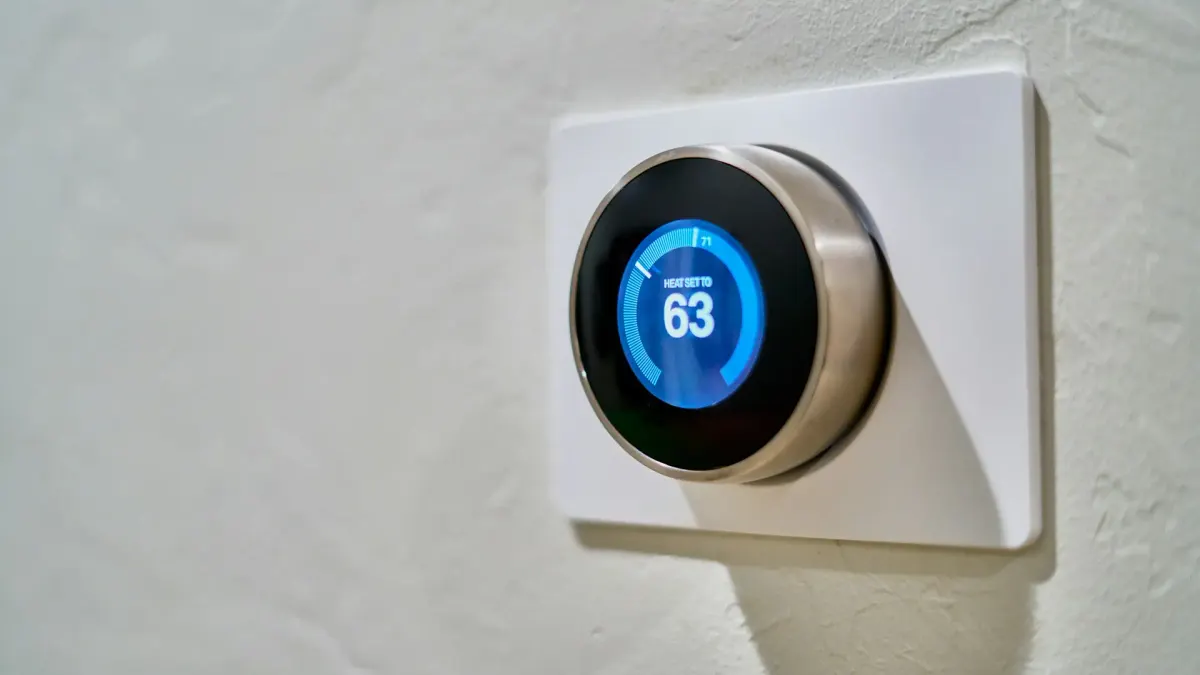
- Put the thermostat in AUTO with a wide deadband. Heat around 68, cool around 75, and stop touching it. This alone solves most of the problem.
- Open the windows in the afternoon. October air on Long Island is genuinely lovely, and it is free. Just remember to close them before the evening drop.
- Run ceiling fans. Moving air makes you feel cooler without any mechanical cooling. Counterclockwise in warm weather, and off when the room is empty.
- Dress for the morning rather than heating for it. A 64-degree house at 6am for an hour is cheaper than firing the furnace for a temperature you will not care about by nine.
- Measure your humidity before you blame the temperature.
And if you are still flipping after all that, the setpoints are probably too close together. Widen them.
When Flipping Means Something Is Wrong
Sometimes the constant adjusting is not a shoulder-season habit. It is the house telling you something.
- One floor needs heat while the other needs cooling. That is a distribution problem, not a weather problem — our guide on too hot upstairs, too cold downstairs covers why it happens and what fixes it.
- The house swings dramatically between morning and afternoon. Usually envelope — attic insulation, air sealing, and west-facing solar gain.
- It feels clammy at a comfortable temperature. Humidity, not temperature.
- One room is always wrong regardless of mode. Ductwork, or a room the system was never designed to reach.
- The system struggles to recover after an overnight setback. Could be capacity, charge, airflow, or age.
None of these are solved by a thermostat. They are worth measuring, and they are the sort of thing that is easy to assess on a shoulder-season visit when nobody is in a hurry.
Get the Heating Side Checked Before You Need It
The short version: switching modes will not break anything, give the compressor five minutes, put it in AUTO with a wide gap, and open the windows while October is still being generous.
The more useful version: if you are reaching for the thermostat several times a day, that is worth looking at properly — and right now is the easiest time of year to get someone out to do it.
K2 Cooling & Heating serves homes within about 15 miles of Deer Park. A shoulder-season visit checks the heating side before the first cold night, measures airflow and humidity performance, and gets your thermostat set up so you can stop thinking about it.
Call or text (631) 414-7141, or toll-free (800) 531-2160. You can also book online. We serve Deer Park, Babylon, West Babylon, North Babylon, Dix Hills, Huntington, Farmingdale, Massapequa, and the surrounding Suffolk and Nassau communities.
A maintenance plan covers both seasonal visits, and if the heating side turns out to be at the end of its life, our heating installation page covers what replacement involves — a far better conversation in October than in January.