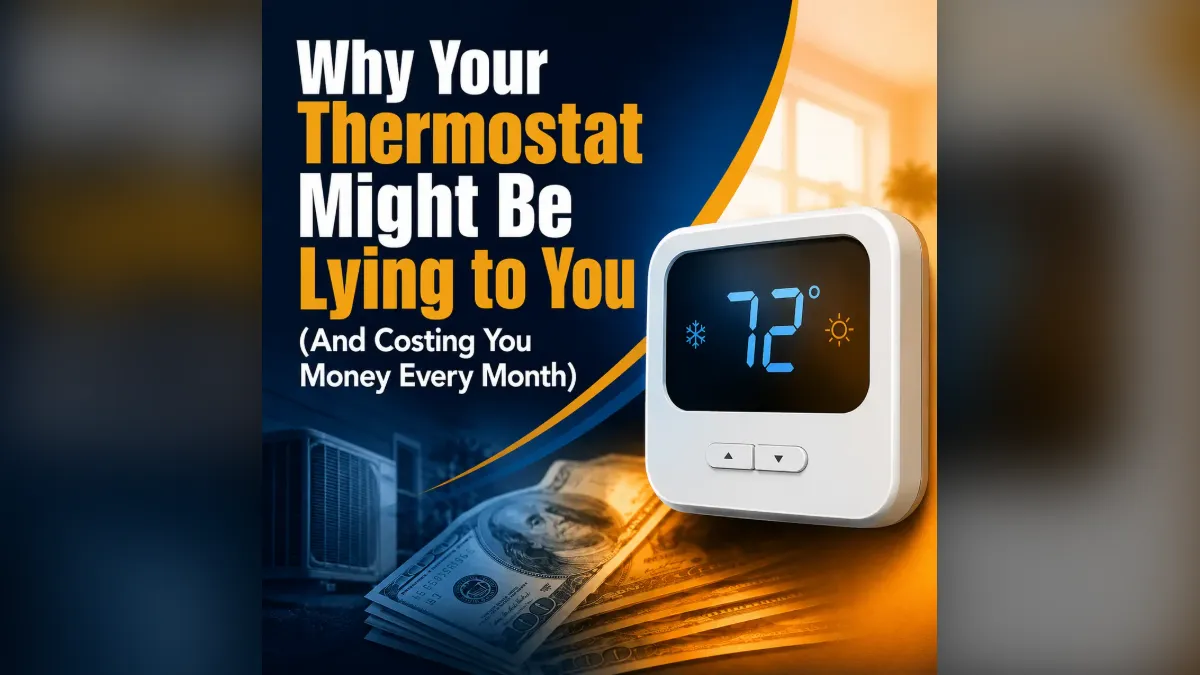
Imagine walking over to your thermostat and seeing 72°F. It says your home should feel perfectly comfortable.
So why are you sweating in the living room while someone upstairs is reaching for a blanket?
The surprising truth is this:
Your thermostat could be lying to you.
Not because it's broken on purpose, but because it isn't always measuring what your home is actually experiencing. A thermostat that gives inaccurate readings can make your HVAC system work harder, waste energy, and leave your family uncomfortable without you realizing the real problem.
Let's uncover why this happens and
what you can do about it.
Your Thermostat Doesn't Feel the Whole House
Many homeowners assume that the temperature displayed on the thermostat represents the temperature everywhere in the home.
Unfortunately, that's rarely true.
A thermostat only measures the air around its own location. If it's installed near a sunny window, kitchen, hallway, air vent, or exterior door, the reading can be several degrees different from the rest of your house.
As a result, your HVAC system may
shut off too early, or keep running longer than necessary.
Signs Your Thermostat May Be Giving False Readings
Your thermostat may not be telling the whole story if you notice:
- Some rooms are much hotter or colder than others.
- The AC or heater turns on and off frequently.
- The temperature never feels like what's displayed.
- Your energy bills keep climbing.
- The HVAC system runs for unusually long periods.
- The house feels uncomfortable even after changing the thermostat setting.
If several of these sound familiar,
the thermostat deserves a closer look.
Common Reasons Your Thermostat Is "Lying"
1. Poor Placement
Location matters more than most people realize.
A thermostat placed near:
- Direct sunlight
- Lamps or electronics
- Air supply vents
- Drafty doors or windows
- Kitchens
can measure temperatures that don't
reflect the rest of your home.
2. Dust and Dirt
Dust inside the thermostat can interfere with its sensors.
Over time, this can cause inaccurate readings and poor HVAC performance.
Regular cleaning can help improve
accuracy.
3. Aging Sensors
Like any electronic device, thermostat sensors wear out over time.
Older thermostats may drift several degrees away from the actual room temperature.
Even a difference of just 2–3
degrees can affect comfort and efficiency.
4. Dead or Weak Batteries
Many programmable thermostats rely on batteries.
Weak batteries may cause:
- Incorrect readings
- Blank displays
- Lost programming
- HVAC communication issues
Replacing batteries annually is
inexpensive preventative maintenance.
5. Poor Calibration
Some thermostats slowly lose calibration over the years.
The display may show one temperature while the actual room temperature is completely different.
A professional inspection can
determine whether recalibration or replacement is the better option.
How an Inaccurate Thermostat Costs You Money
When your thermostat gives incorrect information, your HVAC system reacts to bad data.
That can lead to:
- Longer cooling cycles
- Excessive heating
- Higher utility bills
- Increased wear on compressors and furnaces
- Reduced equipment lifespan
- Uneven comfort throughout the home
A simple thermostat issue can
quietly cost homeowners hundreds of dollars each year.
Should You Replace Your Thermostat?
If your thermostat is over 10 years old, upgrading may be worthwhile.
Modern smart thermostats offer:
- More accurate temperature sensors
- Wi-Fi control
- Energy-saving schedules
- Learning capabilities
- Maintenance reminders
- Remote access from your smartphone
They can improve comfort while
reducing unnecessary HVAC operation.
Simple Things You Can Check Yourself
Before calling a technician, try these quick checks:
- Replace the batteries.
- Remove dust from the thermostat.
- Compare the reading with a reliable room thermometer.
- Make sure no furniture blocks airflow.
- Check if sunlight is hitting the thermostat during the day.
If the temperature still seems
inaccurate, professional testing is recommended.
Don't Ignore the Small Problems
Many homeowners assume they need a major HVAC repair when the real issue is simply an inaccurate thermostat.
A quick inspection can often identify whether the thermostat, wiring, sensors, or HVAC system is responsible.
Fixing the correct problem early can
improve comfort, lower energy costs, and help extend the life of your heating
and cooling equipment.
Trust K2 Cooling AND Heating
At K2 Cooling AND Heating, we help homeowners diagnose HVAC issues quickly and accurately. Whether your thermostat needs recalibration, replacement, or your system requires a complete inspection, our experienced technicians are ready to help.
If your home never feels as comfortable as the thermostat says it should, don't ignore the warning signs. A professional evaluation today could save you money, improve comfort, and prevent larger HVAC problems down the road.
Schedule your HVAC inspection with K2 Cooling AND Heating and make sure your thermostat is finally telling the truth.
When the thermostat calls for heat and the vents blow cool air, the problem is often the furnace itself; see why your furnace is blowing cold air.
Spring and fall changeovers trip people up; see how to switch between heat and AC.
Closer to home, we handle heating repair in Lindenhurst.
Need a technician rather than a guide? See our heating repair service, or read about HVAC repair in Deer Park, NY. K2 answers 24/7 at (631) 414-7141.