The EIA's Winter Fuels Outlook (released October 2026) expects U.S. oil-heated homes to burn 402 gallons each this winter, and more than 80% of those homes are in the Northeast. A lot of them are on Long Island, with a tank in the basement, the garage or the yard. If you're switching to gas or a heat pump, or selling, that tank needs a plan. Here's what the state says, who to call locally and what a heating contractor does and doesn't handle.
Do you have to remove an old oil tank on Long Island?
Not always under state rules. As of October 2026, NYSDEC says most home heating oil tanks under 1,100 gallons aren't covered by New York's Petroleum Bulk Storage rules, but Nassau and Suffolk counties may regulate them. So your county is the place to ask before you remove or abandon a tank.
That's the short version. The state guidance still describes how a tank should be closed, which we cover below, and county rules can add their own steps.
What's the difference between an above-ground and a buried oil tank?
An above-ground tank sits in the basement, the garage or beside the house, where you can see it, check it for rust and drips, and take it out without digging. A buried tank is underground, so its condition is hidden, and closing it means excavation or filling it in place.
Plenty of Long Island Capes, ranches and split-levels have a basement tank next to the boiler. Older houses sometimes have a buried tank in the yard, and some have both: an old buried tank that was abandoned years ago and a newer one inside. Signs of a buried tank include a fill pipe or vent pipe sticking out of the ground or the foundation with no tank visible inside. If you find one, find out whether it was ever properly closed.
What does NYSDEC say about closing an oil tank?
As of October 2026, NYSDEC's homeowner guidance says heating oil tanks, above ground and underground, must be emptied, cleaned and purged of vapors when they're taken out of service. It calls removal the best choice. A tank closed in place gets filled with an inert material such as sand.
- Removal: the tank is emptied, cleaned, purged and taken away. NYSDEC prefers this.
- Closing in place: the tank is emptied, cleaned, purged and filled with an inert material, then left where it is.
- Spills: NYSDEC asks that spills be reported to 1-800-457-7362.
Who do you check with in Suffolk or Nassau County?
In Suffolk, call the Suffolk County Department of Health Services. In Nassau, call the Nassau County Fire Marshal. Do it before a tank is removed or abandoned, and ask what the county requires for your tank and who is allowed to do the work. Get the answer from the county, not from a neighbor.
We're not going to quote county rules here, because they're the county's to explain and they can change. Whoever does your tank work should know them too, but you'll be the one holding the paperwork, so it's worth hearing the requirements yourself.
What happens to the oil tank when you convert to gas or a heat pump?
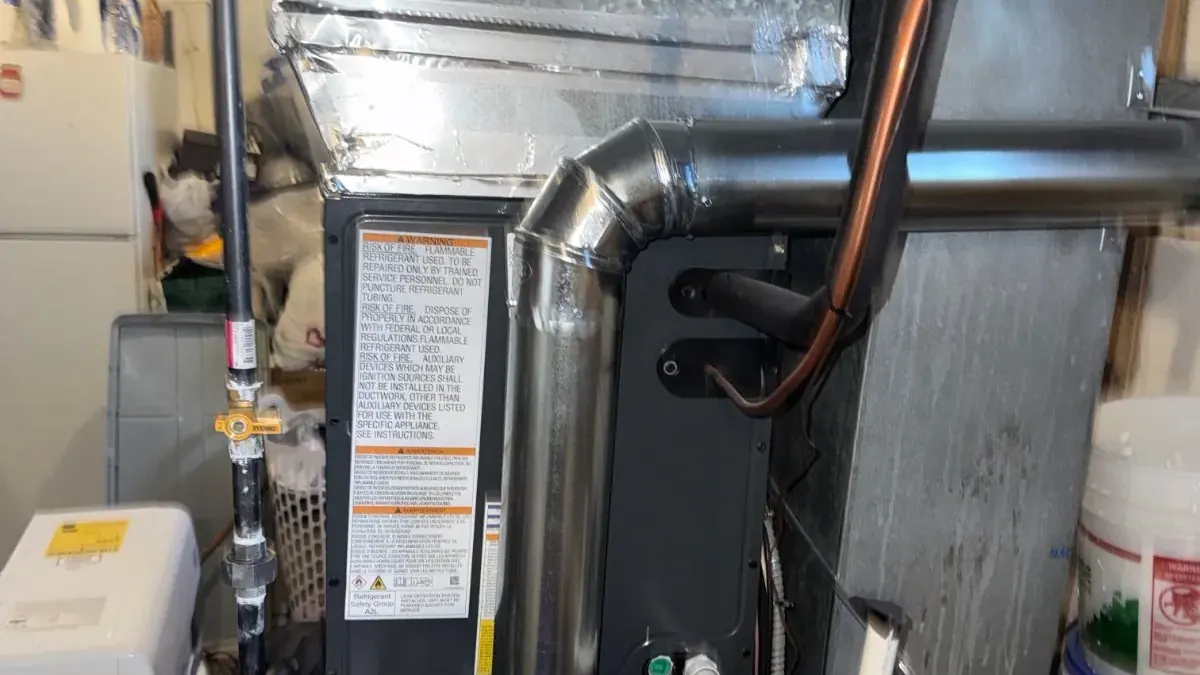
Once the oil burner or furnace is gone, the tank has no job, so plan its removal or closure as part of the conversion. On our October 2026 West Babylon oil-to-gas job, the crew removed the oil furnace and the oil tank together, then installed the new gas furnace and central air.
Timing matters on a gas conversion. As of September 2024, National Grid's Long Island service agreement says not to remove existing heating equipment or cancel oil until the gas line is installed. So the tank stays in service until gas is flowing, and comes out with the old equipment. Our guide on checking gas availability on your street covers that process.
With a heat pump, there's no gas line to wait on, but the same logic holds: when the heat pump takes over the whole house, the oil tank should be closed out. See our oil to heat pump conversion and oil to gas conversion pages, and compare running costs with our oil vs gas vs heat pump calculator.
Tip from Waseem Shahzad, Lead Technician: On the West Babylon conversion, the oil tank came out on the same job as the oil furnace, and the crew capped the opening. If you're converting, put the tank on the same work order as the heating swap, so the house isn't left with an empty, disconnected tank sitting in the basement.
Does an old oil tank affect selling or insuring a house?
It can. Buyers' home inspectors and insurance companies often ask about oil tanks, and buried tanks draw the most questions. Keep every piece of closure paperwork: who did the work, when, and what the county signed off on. A documented closure is far easier to explain than a tank nobody can account for.
If you're planning to sell in the next few years and you're already thinking about new heat, doing the conversion and the tank closure together gives you one clean set of records. If you've bought a house and found a fill pipe with no tank behind it, ask the seller or the county for records before assuming anything.
What does K2 do, and who handles buried tanks?
We take out an oil tank as part of a heating conversion, the way our crew did with the oil furnace in West Babylon, and our records also include an oil tank replacement in Melville. Buried tanks, soil testing and abandoning a tank in place are work for a licensed tank contractor, and we don't do that work.
If yours is buried, line up that contractor early. On our side, that means the new heating system: a gas furnace or boiler, a heat pump or dual fuel. Our furnace and boiler replacement cost guide and heat pump cost guide cover pricing.
If you're keeping the oil system a while longer, keep it maintained. Old hot-water systems wear out parts: in East Islip this October, a no-heat call needed a new expansion tank, relief valve and circulator. If your boiler gauge looks off, our guide to boiler pressure too high or low explains what the numbers mean.
Our recommendation: before you touch an oil tank, call your county office, Suffolk County Department of Health Services or the Nassau County Fire Marshal, and ask what applies. If you're converting to gas or a heat pump, plan the tank's removal as part of the job, and bring in a licensed tank contractor for anything buried. Keep every record.
Planning a move off oil? Call K2 Cooling & Heating at (631) 414-7141. We work within about 15 miles of Deer Park, and we'll walk through gas, heat pump and dual-fuel options for your house, including what happens to the tank in your basement.
Need a technician rather than a guide? See our HVAC tune-up service, or read about HVAC repair in Babylon, NY. K2 answers 24/7 at (631) 414-7141.