A healthy furnace runs in long, steady cycles: it lights, heats for a while, and shuts off when the thermostat is satisfied. When yours lights, runs a few minutes and shuts off, then does it again a few minutes later, that's called short cycling. It wastes fuel, wears out parts and can leave rooms uneven. The cause is usually one of a handful of problems, and a few of them you can check yourself.
What does it mean when a furnace short cycles?
Short cycling means the furnace shuts off before finishing a normal heating cycle and starts again soon after. Either the furnace is stopping itself because a safety control tripped, or the thermostat is telling it to stop too early. Noting when it shuts down helps narrow it down.
Watch one cycle. If the burners light and go out within seconds, the furnace likely isn't proving its flame. If they run several minutes and shut off while the blower keeps going, the furnace may be overheating. If the thermostat clicks off each time, look at the thermostat itself.
Can a dirty filter make a furnace short cycle?
Yes, and it's the first thing to check. A clogged filter starves the furnace of airflow, so heat builds up inside the cabinet. A high-limit switch senses the heat and shuts off the burners to protect the heat exchanger. The blower keeps running, the furnace cools, and the cycle repeats.
Pull the filter and hold it up to a light. If you can't see light through it, replace it; our post on how to spot a dirty air filter covers what to look for. Closed supply registers, blocked returns and a dirty cooling coil above the furnace can restrict airflow the same way.
What does a dirty flame sensor do?
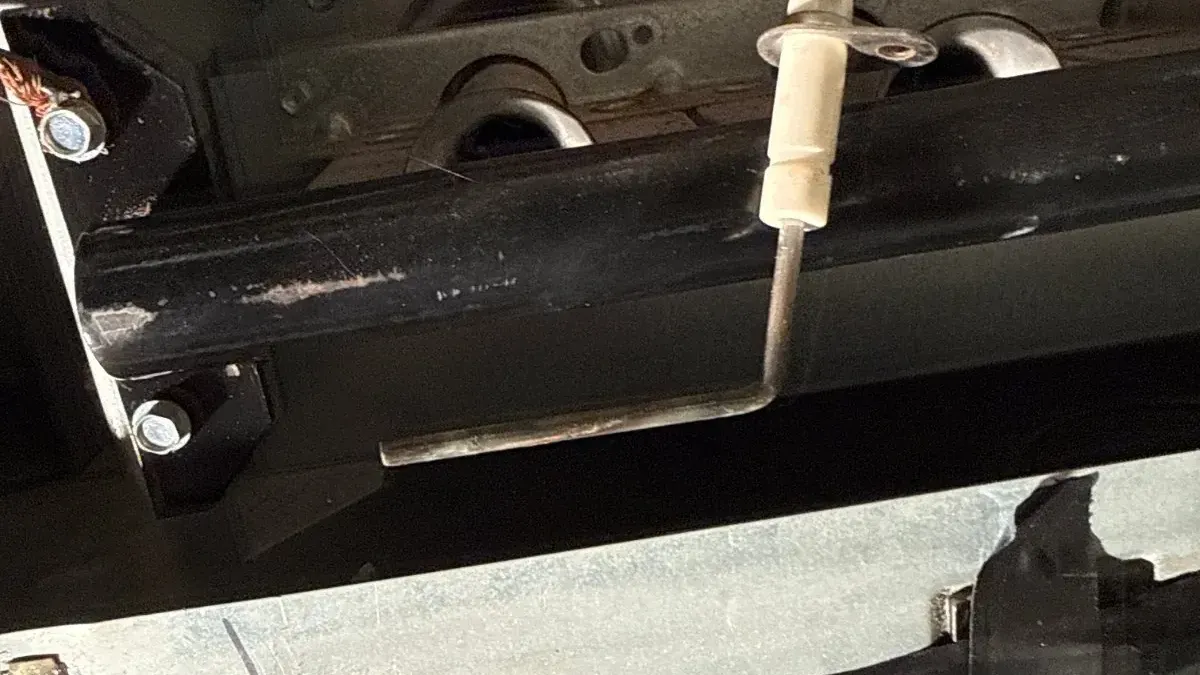
A flame sensor is a thin metal rod that sits in the burner flame and confirms the burners actually lit. When it gets coated with residue, it can't sense the flame, so the control board shuts off the gas within seconds as a safety step. The furnace then tries again, and the cycle repeats.
This is one of the most common reasons a gas furnace lights and goes right out. Cleaning the sensor is part of a heating tune-up. On a Babylon tune-up on twin 100,000 BTU gas furnaces, our technician cleaned both flame sensors and inducer tubes and checked motor amps. If the furnace won't light at all, see our guide to a furnace that won't light.
Could the thermostat be the problem?
Yes. A thermostat mounted near a supply register, in direct sun or above a lamp warms up faster than the rest of the house, so it shuts the furnace off early. Loose wiring, weak batteries or a failing thermostat can also send stop signals mid-cycle. Moving or replacing it often fixes the problem.
Smart thermostats can short cycle a furnace when their settings don't match the equipment, such as a cycle rate meant for a different system. Check the installer settings or the manufacturer's app, and replace batteries if your model uses them. If the thermostat looks fine and the furnace still stops early, the cause is inside the furnace.
Can a furnace be too big for the house?
An oversized furnace heats the air so quickly that the thermostat is satisfied within minutes, then the house cools and it starts again. It won't trip safety controls, but the short cycles waste fuel, wear the igniter and controls, and leave rooms far from the thermostat colder than the rest.
Older furnaces were often sized generously, and homes that have since gotten new windows or insulation need even less heat. Sizing is fixed only when the furnace is replaced, using a heat-loss calculation of the house rather than the old unit's label. Our furnace replacement page explains how we size new equipment.
When should you call a technician?
Call if a new filter doesn't fix it, if the burners light and go out within seconds, if you see an error code blinking on the control board, or if the furnace shuts down completely. Those point to a flame sensor, pressure switch, inducer, limit switch or control board problem that needs testing.
Failing parts can look like short cycling before they quit for good. On a Commack no-heat call, the furnace control board was no longer powering the inducer and blower; we replaced the board and the igniter and cleaned the coil. High-efficiency furnaces can also cycle off on cold nights when their vent or condensate line freezes, which we cover in high-efficiency furnaces shutting off in the cold. For furnace repair within 15 miles of Deer Park, call (631) 414-7141.
Need a technician rather than a guide? See our furnace repair service, or read about HVAC repair in Babylon, NY. K2 answers 24/7 at (631) 414-7141.